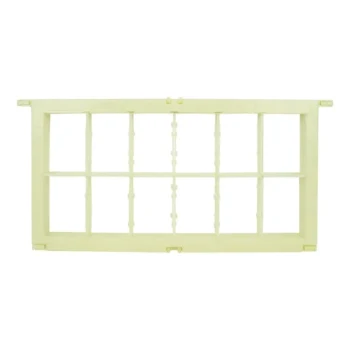
Standardized frame dimensions provide the essential geometric constant required to turn visual observations into hard data using the ColEval method. Because a specific frame type (such as the Dadant-type Hoffman) has a fixed, known surface area—approximately 22.68 dm²—observers can estimate the percentage of the frame covered by bees or brood and mathematically convert that percentage into accurate population metrics.
The Core Mechanism The ColEval method relies on the premise that if the total area is constant, the variable (coverage) can be measured precisely. By multiplying the observed coverage percentage by the frame's fixed surface area and applying known biological densities (bees per dm²), subjective visual scans are transformed into objective, quantitative colony datasets.
The Geometry of Assessment
Establishing the Fixed Baseline
The accuracy of the ColEval method hinges on the use of hardware with invariant physical parameters.
For example, a standard Dadant-type Hoffman frame provides a total surface area of roughly 22.68 dm² across both sides. This fixed number serves as the denominator for all subsequent calculations, eliminating the need to measure the physical space during every inspection.
From Visual Scan to Percentage
Instead of counting individual bees, the assessor visually estimates the percentage of the frame's surface area that is occupied.
Because the frame dimensions are standardized, an observation of "50% coverage" always represents the exact same surface area (e.g., 11.34 dm²). This standardization allows for rapid, non-invasive data collection without sacrificing the ability to calculate specific biomass later.
The Conversion Algorithm
Applying Theoretical Density Values
To convert the surface area calculation into a population count, the method applies theoretical values for biological density.
Researchers utilize established constants regarding the number of adult worker bees or brood cells that typically occupy a single square decimeter. This is the bridge between geometry (area) and biology (population).
Calculating Quantitative Metrics
By combining the three variables—Fixed Frame Area × Observed Percentage × Density Constant—the system produces a concrete number.
This allows qualitative visual data (what the observer sees) to be converted into quantitative metrics (adult bee populations and brood cell counts). This data is critical for analyzing complex biological relationships, such as the correlation between colony size and thermoregulatory capacity.
Why Standardization is Critical
Isolating Biological Variables
Using standardized dimensions ensures that observed variations in colony data are due to biological fitness, not environmental inconsistencies.
If frame sizes varied, a "full frame" in one hive would represent a different population size than in another. Standardization acts as a control, ensuring that differences in survival rates or honey production are attributed to the colony's genetics and health rather than the volume of their container.
Enabling Comparative Analysis
Standardized units allow for the establishment of health thresholds and efficiency comparisons across different apiaries.
Whether utilizing simple percentage estimates or more granular grid-based measurement tools (such as 25 cm² grid cells), the underlying principle remains the same: a uniform unit of measurement is required to objectively quantify colony biomass and reproductive vitality.
Understanding the Trade-offs
The Risk of Visual Subjectivity
While the frame dimensions are precise, the human estimation of "percentage covered" remains a variable.
Even with a fixed frame area, two different observers might assess the same frame as having slightly different coverage percentages. This introduces a margin of error that must be accounted for in statistical analysis.
Density Variations
The method assumes a standard density of bees per square decimeter, but biological behavior is not always static.
Factors such as ambient temperature can cause bees to cluster more tightly or spread out, potentially skewing the conversion from area to population count. It is crucial to treat these calculated metrics as high-confidence estimates rather than absolute headcounts.
Making the Right Choice for Your Goal
To effectively use standardized frames for colony assessment, align your approach with your specific objective:
- If your primary focus is rapid operational assessment: Rely on the total frame surface area constant (e.g., 22.68 dm²) and visual percentage estimates to quickly track colony strength and feeding needs.
- If your primary focus is precise scientific research: augment standard frames with grid-based measurement overlays (e.g., 25 cm² cells) to minimize visual estimation errors and generate exact brood counts for statistical analysis.
Ultimately, standardized frame dimensions act as the reliable constant that allows beekeepers to translate abstract visual patterns into concrete, actionable biological data.
Summary Table:
| Metric Category | Key Parameter | Value/Function |
|---|---|---|
| Geometric Constant | Dadant-type Hoffman Area | Approx. 22.68 dm² (both sides) |
| Observation Unit | Coverage Percentage | Visual estimate of occupied surface |
| Conversion Factor | Biological Density | Standardized bees/brood cells per dm² |
| Calculation Goal | Population Metrics | (Fixed Area × % Coverage) × Density |
| Primary Benefit | Data Comparability | Isolates biological health from equipment variables |
Scale Your Apiary Operations with Precision
At HONESTBEE, we understand that accurate data starts with high-quality, standardized equipment. Whether you are a commercial apiary manager or a global distributor, our comprehensive wholesale portfolio is designed to optimize your efficiency and assessment accuracy.
Our Value to You:
- Precision Hardware: Standardized hive-making and beekeeping tools ensuring consistent ColEval results.
- Industrial Efficiency: Advanced honey-filling and processing machinery for high-volume production.
- Total Support: From essential consumables to honey-themed cultural merchandise, we provide the full spectrum of industry needs.
Ready to elevate your beekeeping business with professional-grade equipment? Contact us today to explore our wholesale solutions!
References
- Ugoline Godeau, Cédric Alaux. Brood thermoregulation effectiveness is positively linked to the amount of brood but not to the number of bees in honeybee colonies. DOI: 10.24072/pcjournal.270
This article is also based on technical information from HonestBee Knowledge Base .
Related Products
- Professional Sectional Comb Honey Frame with 250g Cassette System for Beekeeping
- Professional Galvanized Steel Frame Rest for Beehives
- Heavy Duty Castellated Iron Frame Spacer for Honey Supers
- Professional 3-Bar Frame Grip with Integrated Hive Tool
People Also Ask
- How are honeybee combs utilized for non-destructive colony monitoring? Master Population Density Tracking
- What is the technical purpose of exchanging honeycomb frames? Master Apiary Equalization for Growth
- What frame to use for honeycomb? Choose the Right System for Pure, Edible Comb
- What is a honeycomb frame? The Key to Modern, Sustainable Beekeeping
- What are the recommended temperature and duration settings for freezing honey frames? Ensure Pest-Free Comb Storage