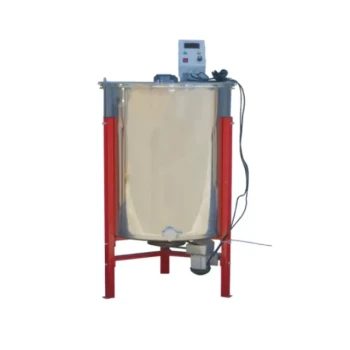
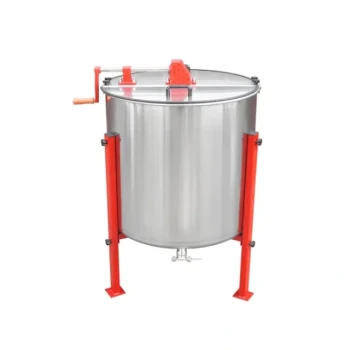
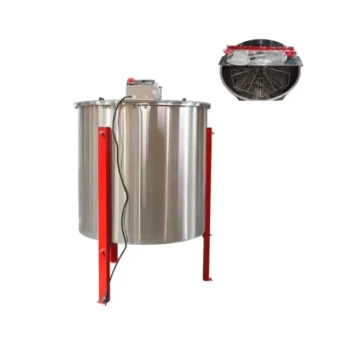
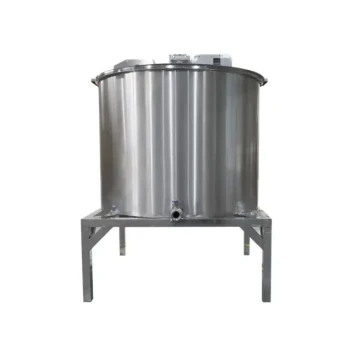
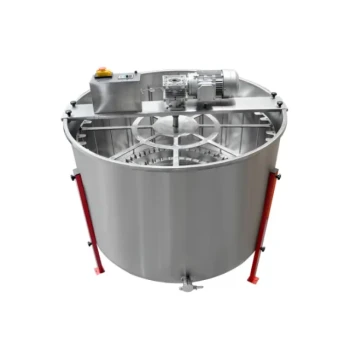
A centrifugal honey extractor acts as a mechanical separator, utilizing high-speed rotation to fling mature honey out of the honeycomb cells through centrifugal force. This process occurs inside a drum or basket where frames are spun, allowing the liquid honey to be ejected and collected while the wax structure remains securely in place.
Core Takeaway: The critical value of a centrifugal extractor is not just honey removal, but comb preservation. By extracting honey without destroying the beeswax, you allow the colony to reuse the empty combs immediately, saving the immense biological energy bees would otherwise spend rebuilding wax and significantly shortening the production cycle.
The Mechanics of Extraction
Generating Rotational Force
The extractor functions by placing honeycomb frames into a central basket or reel. When activated—either manually or via an electric motor—the basket spins at high speeds.
This rotation generates centrifugal force, which acts outwardly on the contents of the frames.
Non-Destructive Separation
As the frames spin, the force overcomes the surface tension holding the honey in the cells. The liquid is ejected against the inner wall of the drum.
Crucially, this force is calibrated to remove the fluid honey without damaging the physical structure of the beeswax combs. The empty combs remain intact within the frame, ready for removal.
Gravity-Fed Collection
Once the honey strikes the extractor's walls, gravity takes over. The honey runs down the sides of the drum and pools at the bottom.
From there, it is drained into buckets or settling tanks for packaging. This separation occurs without the need for heating or pressing.
Impact on Hive Ecology and Efficiency
Conservation of Biological Energy
Beeswax production is metabolically expensive for a colony. Bees consume significant amounts of honey and energy to secrete the wax required to build combs.
By using a centrifugal extractor, you return intact empty combs to the hive. This eliminates the need for bees to start from scratch, allowing them to redirect their energy toward foraging and honey production.
Shortening the Production Cycle
Because the bees are given "ready-made" storage space (the recycled combs), they can immediately begin filling cells with nectar.
This significantly accelerates the harvest cycle. The colony avoids the time-consuming construction phase, leading to improved overall collection efficiency for the beekeeper.
Quality and Clarity
Minimizing Impurities
Traditional methods, such as crushing and straining, often introduce significant amounts of wax particles, pollen, and debris into the final product.
Centrifugal extraction achieves a cleaner liquid-solid separation. Because the comb is not crushed, the resulting honey has higher clarity and fewer impurities, maintaining high standards of hygiene.
Operational Considerations
Dependence on Honey Maturity
The primary reference notes that this process is designed for mature honey. Unripe honey has a higher moisture content and different viscosity.
Extracting honey before it is fully mature (capped) can lead to fermentation issues later, while extracting it too late or when crystallized makes centrifugal separation difficult or impossible without heat.
Equipment Balance and Integrity
While the goal is to preserve the comb, the process relies on physics. If the extractor is spun too violently, or if the frames are not balanced within the basket, the wax foundation can "blow out" or break.
Proper speed regulation is required to ensure the force is sufficient to move the honey but gentle enough to spare the wax.
Making the Right Choice for Your Goal
When integrating a centrifugal extractor into your workflow, consider your primary objectives regarding yield and quality.
- If your primary focus is volume and speed: Prioritize this method to recycle combs rapidly, as it frees the bees from wax production and maximizes the number of harvests per season.
- If your primary focus is product clarity: Use centrifugal extraction to obtain a cleaner product with minimal debris, reducing the need for extensive filtering or settling compared to crush-and-strain methods.
By aligning your extraction method with the biology of the hive, you transform honey harvesting from a destructive process into a sustainable cycle.
Summary Table:
| Feature | Mechanism/Benefit | Impact on Efficiency |
|---|---|---|
| Rotational Force | Centrifugal action flings honey out of cells | Rapid liquid-solid separation |
| Comb Preservation | Non-destructive extraction | Bees reuse combs immediately; saves energy |
| Collection Method | Gravity-fed drainage into settling tanks | High clarity with minimal impurities |
| Energy Conservation | Eliminates wax-building phase | Shortens production cycle for higher yields |
| Speed Control | Balanced RPM to protect wax foundation | Prevents comb breakage and equipment wear |
Optimize Your Apiary with HONESTBEE’s Professional Solutions
At HONESTBEE, we specialize in empowering commercial apiaries and distributors with the industry's most reliable honey processing technology. Our comprehensive wholesale catalog includes:
- High-Efficiency Machinery: From advanced honey-filling machines to industrial-grade centrifugal extractors.
- Quality Hardware: Precision-engineered hive-making equipment and durable beekeeping tools.
- Essential Consumables: A full spectrum of supplies to keep your operations running smoothly.
- Cultural Merchandise: Unique honey-themed retail products to diversify your portfolio.
Whether you are scaling a commercial operation or supplying the next generation of beekeepers, HONESTBEE delivers the tools you need to maximize yield and ensure product purity.
Contact our team today to discuss bulk pricing and custom solutions!
References
- Ahmet Güler, Hakan Toy. Relationship between dead pupa removal and season and productivity of honey bee (Apis mellifera, Hymenoptera: Apidae) colonies. DOI: 10.3906/vet-1205-48
This article is also based on technical information from HonestBee Knowledge Base .
Related Products
- electric honey extractor honey centrifuge 3 frame honey extractor stainless steel honey frame extractor
- Manual Hand Crank 4 Frame Honey Extractor Centrifuge for Beekeeping
- Professional 4 Frame Self Reversing Electric Honey Extractor for Beekeeping
- 24 Frame Honey Extractor Commercial Radial Honey Frame Extraction Machine
- Electric 4 Frame Tangential Honey Extractor
People Also Ask
- What are the characteristics of electric honey extractors? Boost Your Apiary Efficiency with Automated Technology
- What are the disadvantages of using an electric honey extractor? Weighing Cost, Power, and Comb Safety
- What are the advantages of an electric honey extractor? Boost Efficiency and Scale Your Honey Production
- What are the technical advantages of electric honey extractors? Maximize Yield and Protect Your Bee Colony
- How does an electric honey extractor affect the quality of honey? Preserve Flavor & Purity with Precision Extraction