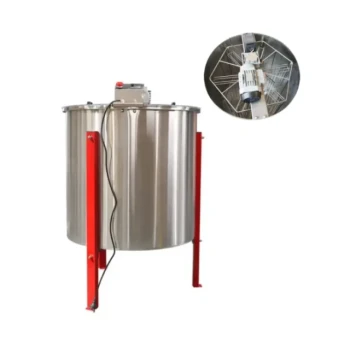
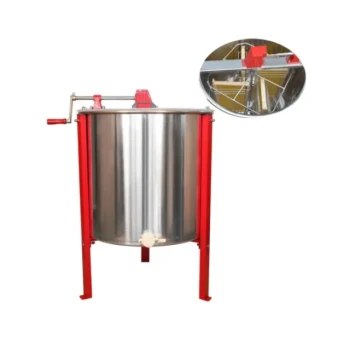
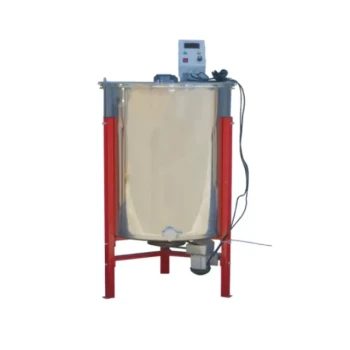
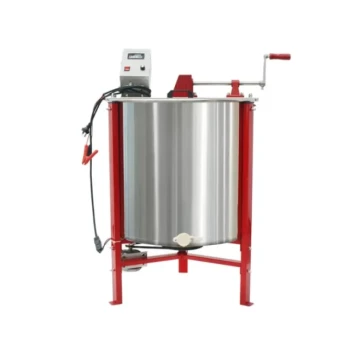
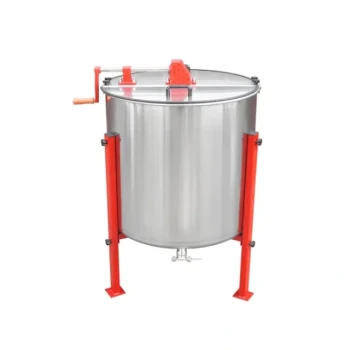
At its core, a honey extractor operates by utilizing centrifugal force to separate liquid honey from the wax comb without destroying the structure. Inside a large cylindrical drum, honeycomb frames are placed into a central rotating basket that spins at high speeds. This spinning motion "flicks" the honey out of the cells, forcing it against the inner walls of the drum, where it eventually drains to the bottom for collection.
The defining value of an extractor is not just speed, but conservation. By extracting honey via centrifugal force rather than crushing the comb, the wax structure remains intact, allowing beekeepers to return the frames to the hive for immediate reuse by the bees.
The Mechanical Process
The Principle of Centrifugal Force
The extractor functions as a centrifuge. As the central basket rotates, it generates outward force.
This force pulls the liquid honey out of the uncapped wax cells and flings it outward.
The Collection Phase
Once the honey is ejected from the comb, it hits the stationary inner walls of the drum.
Gravity then takes over, causing the honey to run down the sides and pool at the bottom of the tank.
Drainage and Filtering
At the base of the extractor, a valve or "honey gate" allows the pooled honey to flow out.
From here, the honey is typically passed through a sieve or mesh filter to remove stray bits of wax before being bottled.
Comparison of Extraction Methods
Radial Extraction
In a radial extractor, the frames are arranged like the spokes of a wheel, with the top bars facing the outer wall.
This orientation utilizes the natural upward slope of the honeycomb cells to extract honey from both sides of the frame simultaneously.
This is generally the most efficient method for commercial operations as it eliminates the need to flip frames mid-process.
Tangential Extraction
Some smaller or convertible units utilize tangential extraction, where the frame faces the drum wall directly.
While effective, this usually requires the operator to spin the frame, stop, flip the frame manually to expose the other side, and spin again.
Understanding the Trade-offs
Manual vs. Electric Operation
Manual extractors rely on a hand crank and a gearbox to generate the necessary speed.
While cost-effective for hobbyists, they require significant physical labor and make it difficult to maintain a consistent spinning speed.
Electric extractors automate the process with a motor and often include speed controls.
These units reduce physical fatigue and allow for a gradual increase in rotation speed, which prevents the heavy combs from blowing out or breaking under sudden force.
Making the Right Choice for Your Goal
To select the right extraction equipment, you must weigh your budget against the volume of your harvest.
- If your primary focus is low-cost entry for a few hives: A manual extractor is sufficient, provided you are willing to invest the physical effort to crank the basket.
- If your primary focus is efficiency and scalability: An electric radial extractor is the superior choice, as it extracts both sides of the comb at once and frees you to perform other tasks while the cycle runs.
The ideal extractor is simply the one that balances your harvest size with the amount of physical labor you are willing to perform.
Summary Table:
| Feature | Radial Extractor | Tangential Extractor | Manual Operation | Electric Operation |
|---|---|---|---|---|
| Mechanism | Spokes of a wheel | Parallel to drum wall | Hand crank/Gearbox | Motorized/Variable speed |
| Efficiency | High (Extracts both sides) | Moderate (Requires flipping) | Low (Labor intensive) | High (Automated) |
| Best For | Commercial & Scaling | Hobbyists/Small scale | Budget entry-level | Professional efficiency |
| Comb Safety | Excellent | Good (if speed controlled) | Variable | Superior control |
Elevate Your Honey Production with HONESTBEE
Are you looking to scale your apiary or upgrade your honey processing line? At HONESTBEE, we specialize in empowering commercial apiaries and distributors with high-performance beekeeping machinery.
From advanced electric radial extractors that maximize harvest efficiency to honey-filling machines and specialized hive-making hardware, our comprehensive wholesale portfolio is designed to streamline your operations and preserve the quality of your honey. We also provide a full spectrum of industry consumables and unique honey-themed cultural merchandise to help your brand stand out.
Maximize your harvest efficiency today. Contact our expert team to discuss how our professional-grade tools can grow your business.
Related Products
- HONESTBEE 72 Frame Industrial Electric Honey Extractor for Beekeeping
- Commercial Electric 12 Frame Honey Extractor Spinner Motorized Honey Extractor
- HONESTBEE 6 Frame Self Reversing Electric Honey Extractor for Beekeeping
- HONESTBEE 3-Frame Manual Acrylic Honey Extractor
- Stainless Steel Manual 8 Frame Radial Honey Extractor Machine for Beehives
People Also Ask
- What is the importance of balancing honeycomb frames within a honey extractor? Ensure Stability and Protect Machinery
- How is honey separated from the frames after they are uncapped? Efficient Extraction Methods for High Yields
- What are the main benefits of using a honey extractor? Maximize Yields and Protect Your Honeycomb
- What are the recommended methods for removing honey from the honeycomb? Top Extraction Techniques for Maximum Efficiency
- How do manual honey extractors compare to electric honey extractors? Choosing the Right Tool for Your Apiary Growth