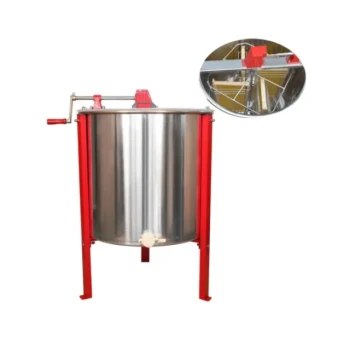
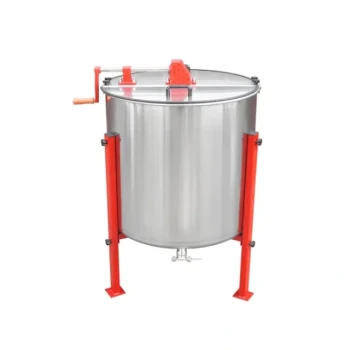
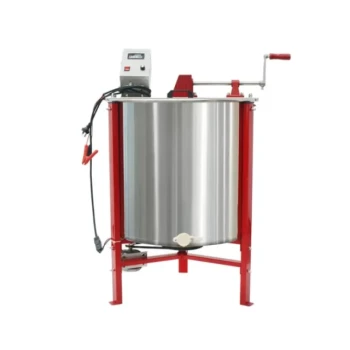
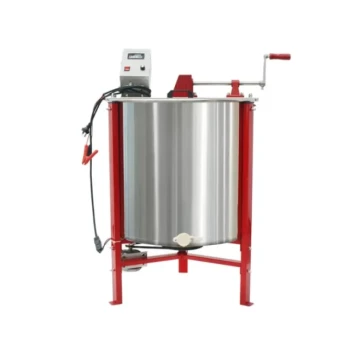
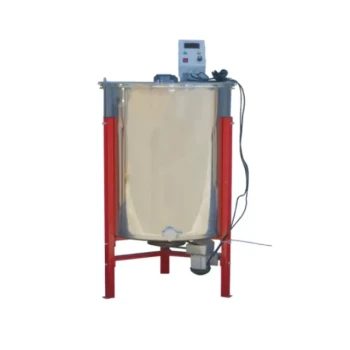
A manual honey extractor functions by utilizing a simple hand-crank mechanism to generate the speed required to separate liquid honey from the honeycomb. You provide the physical energy to rotate a basket holding the frames, creating sufficient force to fling the honey out while keeping the delicate wax structure intact.
Core Takeaway This device operates on the principle of centrifugal force, where manually spinning the frames flings honey out of uncapped cells and onto the drum's inner walls. It is the industry-standard solution for hobbyist beekeepers who prioritize cost-effectiveness and comb preservation over speed.
The Mechanical Process
The Crank and Gear System
The operation begins with a hand-crank, typically mounted on the top or side of the unit. This crank is connected to a central shaft via a set of gears.
When you turn the handle, the gears multiply your input force to spin the internal basket much faster than your hand is moving. This mechanical advantage is crucial for generating the necessary speed with manageable physical effort.
The Spinning Basket
Inside the drum, a basket holds the hive frames vertically. Before placement, the wax cappings on the honey cells must be removed.
As the central shaft rotates, the basket spins the frames in a circle. The design ensures the frames are held securely to prevent them from shifting or breaking during the high-speed rotation.
Centrifugal Force in Action
The defining principle of the extractor is centrifugal force. As the basket spins, the inertia of the honey forces it outward, away from the center of the basket.
This force pulls the liquid honey out of the uncapped cells and flings it against the inner walls of the extractor drum. This method is superior to crushing the comb because it leaves the wax frames intact, allowing bees to reuse them immediately.
Collection and Drainage
Once the honey hits the walls of the drum, gravity takes over. The honey runs down the sides and pools at the bottom of the tank.
A honey gate or tap located at the base allows you to drain the collected honey into a bucket or filter system. Because there is no heating element involved, the honey remains raw and chemically unaltered.
Understanding the Trade-offs
Physical Exertion Required
Unlike electric models, a manual extractor relies entirely on your physical stamina. Extracting honey from even a small number of hives can be a workout, as you must maintain a consistent speed to ensure thorough extraction.
Throughput Limitations
Manual extraction is a slower process. You generally have to stop, flip the frames (if using a tangential basket), and spin again to empty both sides. This makes it less efficient for beekeepers managing a large number of colonies.
Operational Stability
Because the force is generated by hand, the extractor can sometimes wobble if the frames are not perfectly balanced by weight. You may need to bolt the legs to the floor or have an assistant stabilize the drum while you crank.
Making the Right Choice for Your Goal
Whether a manual extractor is the right tool depends entirely on the scale of your apiary and your available resources.
- If your primary focus is budget and simplicity: A manual extractor is the ideal choice for hobbyists with fewer than 10 hives, offering a low cost of entry and minimal maintenance.
- If your primary focus is off-grid beekeeping: This is the only viable option for remote locations, as it requires absolutely no electricity to operate.
- If your primary focus is large-scale efficiency: You should likely avoid manual units, as the physical labor becomes prohibitive as you scale up beyond a hobbyist level.
By understanding the mechanics of centrifugal force, you can harvest high-quality honey while preserving your bees' hard work for the next season.
Summary Table:
| Feature | Manual Honey Extractor Mechanism |
|---|---|
| Core Principle | Centrifugal force generated by hand-cranking |
| Key Components | Hand-crank, gear system, rotating basket, drum, honey gate |
| Comb Preservation | High (leaves wax structure intact for bee reuse) |
| Power Source | Manual labor (no electricity required) |
| Ideal Scale | Hobbyists and small-scale apiaries (1-10 hives) |
| Output Quality | Raw, cold-processed honey |
Maximize Your Harvest with HONESTBEE Equipment
At HONESTBEE, we specialize in empowering commercial apiaries and beekeeping distributors with high-performance tools and machinery. Whether you are scaling up your production with advanced honey-filling machines or stocking a full spectrum of durable hardware for your customers, we provide the wholesale solutions you need.
From industrial-grade extraction machinery to essential beekeeping consumables and honey-themed cultural merchandise, HONESTBEE is your partner in growth.
Ready to streamline your apiary operations? Contact us today to explore our comprehensive wholesale catalog!
Related Products
- Stainless Steel 3 Frame Manual Honey Extractor Spinner for Bee Honey Extraction
- HONESTBEE 3-Frame Manual Acrylic Honey Extractor
- HONESTBEE 4 Frame Manual Self Reversing Honey Extractor for Beekeeping
- Stainless Steel Manual 8 Frame Radial Honey Extractor Machine for Beehives
- 2 Frame Stainless Steel Manual Honey Spinner Extractor for Beekeeping
People Also Ask
- Which type of honey extractor is generally more durable? Focus on Material & Build Quality for Longevity
- What are the disadvantages of a manual honey extractor? Overcome Efficiency Bottlenecks in Your Apiary
- What is a manual honey extractor? The Essential Guide to Cost-Effective Beekeeping for Beginners
- Why are manual extractors popular among beginner beekeepers? A Guide to Starting Simple & Saving Money
- What are the primary advantages of utilizing a manual honey extractor? Cost-Effective & Gentle Harvesting