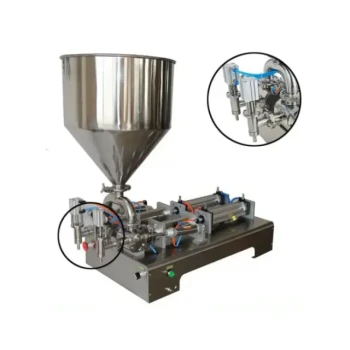
A piston honey filler operates on a volumetric displacement principle. It uses a piston moving back and forth within a cylinder to physically draw a specific amount of honey from a hopper and force it through a nozzle into a container. This mechanical action allows it to handle the high viscosity of honey with speed and precision, stopping exactly when the preset volume is reached.
Core Takeaway Honey's thick consistency often poses challenges for standard gravity-fed systems. Piston fillers solve this by utilizing positive mechanical force to push a defined volume of product into the jar, ensuring consistent fill weights regardless of the honey's viscosity.
The Mechanics of the Piston Cycle
The operation of a piston filler is defined by a repetitive "to-and-fro" motion. This cycle ensures that thick liquids are moved efficiently without relying on passive flow.
The Intake Stroke
The process begins with a hopper containing the bulk honey. As the piston retracts (moves backward), a valve opens between the hopper and the cylinder.
The suction created by this backward motion draws the honey from the hopper into the cylinder.
Volumetric Measurement
The machine does not fill based on the visual level in the jar; it fills based on volume. The cylinder is filled to a specific, preset capacity.
This ensures that every cycle captures the exact same amount of product, providing high accuracy for commercial standards.
The Dispensing Stroke
Once the cylinder is full, the valve shifts position. The piston then pushes forward, exerting force on the honey.
This pressure drives the viscous liquid out through the nozzles and into the container. The piston stops its motion immediately once the full volume has been dispensed.
Why This Mechanism Suits Honey
Honey presents unique challenges due to its thickness and resistance to flow. The piston design addresses these specific physical properties.
Handling High Viscosity
Unlike gravity fillers, which rely on the weight of the liquid to flow downward, piston fillers use mechanical force.
This allows them to push thick, viscous honey through the system efficiently, preventing the slow-flow issues common with other methods.
Precision and Control
The piston mechanism offers strict control over the fill amount. Because the volume is determined by the cylinder size and piston stroke, the fill is consistent.
This eliminates overfilling or underfilling, which is critical for inventory management and customer satisfaction.
Hygiene and Maintenance
Honey is sticky and can harbor residue if not cleaned properly.
Many piston filling machines are explicitly designed for easy disassembly. This allows operators to strip the machine down for thorough cleaning, ensuring food safety and machine longevity.
Understanding the Operational Context
While piston fillers are highly effective, it is important to understand how they fit into the broader equipment landscape.
Piston vs. Vacuum Filling
While a piston filler uses physical force to push product, a vacuum honey filler utilizes atmospheric pressure differences.
Vacuum fillers create a vacuum in the line to draw honey in. Piston fillers are generally preferred when you need a direct, positive displacement method for very thick products.
Distinction from Extraction
It is vital not to confuse the filler with an electric honey extractor.
An extractor uses centrifugal force (spinning) to remove honey from the comb. The piston filler comes into play after extraction, specifically for packaging the liquid honey into jars.
Making the Right Choice for Your Goal
Selecting the right equipment depends on the specific requirements of your production line.
- If your primary focus is consistency with thick honey: Choose a piston filler, as the mechanical force ensures accurate volumetric filling despite high viscosity.
- If your primary focus is hygiene and maintenance: Prioritize piston fillers specifically advertised with "easy disassembly" features to manage honey residue.
- If your primary focus is simple gravity-based flow: Be aware that while gravity fillers exist, they lack the mechanical force of a piston system and may be slower with thick honey.
The piston filler remains the standard for handling viscous honey because it replaces passive flow with active, measured mechanical force.
Summary Table:
| Feature | Piston Honey Filler | Gravity-Fed Filler |
|---|---|---|
| Mechanism | Positive Mechanical Displacement | Passive Weight/Gravity Flow |
| Best For | High Viscosity (Thick Honey) | Low Viscosity (Thin Liquids) |
| Accuracy | High (Defined Cylinder Volume) | Variable (Flow Rate Based) |
| Speed | Consistent for Thick Liquids | Slower with Viscous Products |
| Key Benefit | Handles Pressure & Resistance | Simple, Low Maintenance |
Elevate Your Honey Production with HONESTBEE
Maximize your apiary's efficiency and ensure precise packaging with our professional-grade honey filling solutions. At HONESTBEE, we specialize in supporting commercial apiaries and distributors by providing a comprehensive range of high-performance beekeeping machinery and tools.
Whether you need advanced honey-filling machines, hive-making hardware, or industrial consumables, our wholesale portfolio is designed to scale your business and maintain the highest standards of quality. Partner with us to streamline your operations and deliver consistent results to your customers.
Ready to upgrade your equipment?
Contact HONESTBEE Today to explore our full spectrum of beekeeping machinery and cultural merchandise.
Related Products
- Precision Durable Efficient HONESTBEE Rotary Honey Filling Machine
- Fully Automatic Honey Filling Packaging Machine for Processing Line
- Economy Small Honey Filling Machine Honey Bottle Filler Packaging Machine
- Small Honey Filling Machine Sachet Packing Equipment Single Nozzle
- Semi Automatic Small Honey Bottle Filling Machine Honey Filler
People Also Ask
- What are the common types of bottling machines used for honey? Choosing the Right Solution for Your Apiary
- How do high-precision honey filling machines ensure quality? Optimize Your Commercial Production with HONESTBEE
- What is a key feature of the new generation of the honey filling machine? The Advanced Electronic Control Unit
- What quality control role does professional honey filling equipment perform? Ensure Consistency and Product Stability
- How do honey filling and processing machines aid native bee product conservation? Boost Value with HONESTBEE Technology