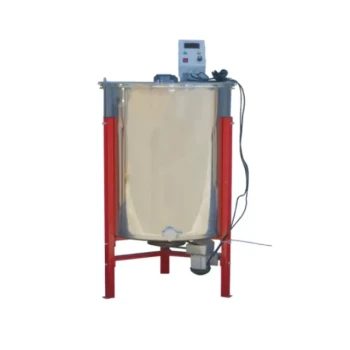
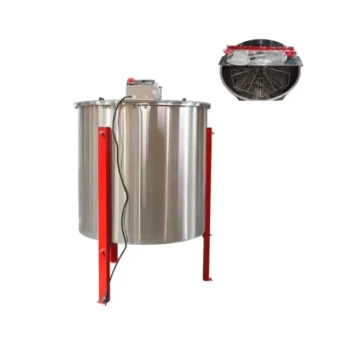
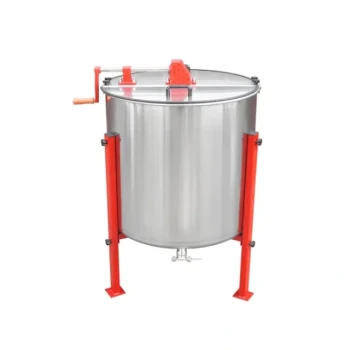
An industrial centrifuge extracts honey by spinning honeycombs at high speeds, utilizing centrifugal force to eject the liquid from the cells against the equipment's inner walls. This mechanical separation allows for the efficient collection of honey without requiring the physical crushing or heating of the wax structure.
The critical advantage of this technology is the preservation of the honeycomb's physical structure. By keeping the wax combs intact, producers allow the colony to reuse them, which significantly lowers the biological energy required for new wax production and shortens the overall harvest cycle.
The Mechanics of Extraction
Generating Centrifugal Force
The core mechanism relies on high-speed rotation. As the centrifuge spins, it generates significant outward force.
This force overcomes the surface tension holding the honey inside the hexagonal cells.
Non-Destructive Separation
Unlike traditional methods that might involve crushing the comb, the centrifuge flings the honey out while leaving the solid structure stationary relative to the frame.
The extracted honey hits the walls of the centrifuge and drains down for collection, separating the liquid product from the solid wax structure instantly.
Technical and Biological Advantages
Preservation of Comb Structure
The primary technical benefit is that the process is non-destructive. The physical integrity of the honeycomb is maintained throughout the extraction process.
This is a distinct improvement over crushing methods, which destroy the comb to release the honey.
Energy Conservation for the Colony
Because the honeycomb structure is preserved, it can be returned directly to the beehive.
This is biologically significant because bees consume vast amounts of energy and resources to secrete wax and build combs. Eliminating the need to rebuild allows the colony to focus energy on honey production and brood rearing.
Shortened Production Cycles
The ability to reuse honeycombs creates a direct efficiency gain for the producer.
By skipping the time-intensive comb-building phase, the colony can immediately begin filling the cells with nectar again, leading to a faster turnover and higher seasonal yields.
Understanding the Trade-offs
Equipment Dependency
While centrifugal extraction is superior for preservation, it relies heavily on the mechanical precision of the equipment.
The centrifuge must be balanced and operated at specific speeds; excessive speed could damage delicate combs, while insufficient speed may leave honey behind, reducing yield.
Making the Right Choice for Your Goal
To maximize the benefits of industrial centrifugation, align your usage with your production goals:
- If your primary focus is Production Speed: Prioritize this method to eliminate the "wax building" lag time, allowing immediate reuse of combs for the next nectar flow.
- If your primary focus is Colony Health: Use centrifugal extraction to reduce the metabolic stress on your bees, as they will not need to consume honey stores to produce new wax.
By choosing centrifugal extraction, you effectively convert biological energy savings into increased operational efficiency.
Summary Table:
| Feature | Centrifugal Extraction | Traditional Crushing |
|---|---|---|
| Comb Integrity | Preserved (Reusable) | Destroyed (Single-use) |
| Colony Energy | Low stress; saves wax production | High stress; requires new wax |
| Production Cycle | Fast turnover; immediate reuse | Slow; requires rebuilding |
| Product Quality | Pure liquid; cold-processed | Potential for wax contamination |
| Equipment Need | Industrial Centrifuge | Basic manual tools |
Scale Your Honey Production with HONESTBEE Precision
As a dedicated partner to commercial apiaries and global distributors, HONESTBEE provides the professional-grade machinery needed to turn biological efficiency into market-leading growth. Our high-performance centrifugal extractors are engineered to protect your hive assets while maximizing output.
From industrial-scale honey-filling lines to specialized hive-making machinery and essential beekeeping consumables, we offer a comprehensive wholesale portfolio designed for reliability and scale.
Ready to upgrade your apiary’s technical capabilities? Contact our expert team today to discover how our equipment and cultural merchandise can enhance your brand's value and operational efficiency.
References
- José Vivaldo Machado Fernandes Júnior, Napiê Galvê Araújo Silva. Cadeia Produtiva do Mel: um estudo no município de Pau dos Ferros/RN. DOI: 10.5902/2236117019781
This article is also based on technical information from HonestBee Knowledge Base .
Related Products
- electric honey extractor honey centrifuge 3 frame honey extractor stainless steel honey frame extractor
- Manual Hand Crank 4 Frame Honey Extractor Centrifuge for Beekeeping
- Professional 4 Frame Self Reversing Electric Honey Extractor for Beekeeping
- HONESTBEE 72 Frame Industrial Electric Honey Extractor for Beekeeping
- Honey Concentrating and Filtering Dehumidifier Machine 2T Capacity for Honey
People Also Ask
- What are the characteristics of electric honey extractors? Boost Your Apiary Efficiency with Automated Technology
- What are the disadvantages of using an electric honey extractor? Weighing Cost, Power, and Comb Safety
- What are the advantages of an electric honey extractor? Boost Efficiency and Scale Your Honey Production
- What are the technical advantages of electric honey extractors? Maximize Yield and Protect Your Bee Colony
- How does an electric honey extractor affect the quality of honey? Preserve Flavor & Purity with Precision Extraction