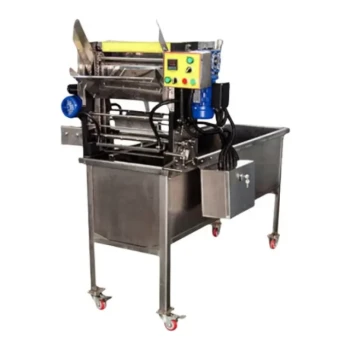
Production volume acts as the decisive filter for selecting the correct level of automation in honey packaging.
For start-ups or small-scale operations, semi-automatic models offer a balance of affordability and function, relying on some manual oversight. Conversely, large-scale facilities prioritize speed and reduced labor, making fully automatic systems the only viable option to maintain efficiency.
Core Takeaway: Your daily output requirement dictates the machine's architecture. Selecting a machine below your volume needs creates production bottlenecks, while over-specifying for a small operation drains capital without delivering return on investment (ROI).
Aligning Automation with Output Goals
Small-Scale and Start-up Operations
For businesses filling approximately 50 to 200 jars per day, heavy automation is rarely cost-effective.
A semi-automatic machine is the standard recommendation for this tier. These units require an operator to place the container or trigger the fill, but they handle the precision dosing of the honey.
This approach minimizes initial capital expenditure while significantly improving consistency compared to manual pouring.
High-Volume Industrial Production
When operations scale up to require hundreds of units per hour, manual intervention becomes a liability.
Fully automatic machines are designed for these environments. They handle container feeding, filling, sealing, and labeling with minimal human input.
The primary advantage here is continuous throughput. These systems are engineered to operate at high speeds, ensuring that production targets are met without the fatigue or inconsistency associated with manual handling.
The Role of Packaging Format
Volume is not just about the total liters of honey; it is about the number of units produced.
If you are producing single-serving honey sachets, your unit volume will be massive even if the total tonnage is moderate.
In this scenario, a multi-lane sachet packing machine is essential. These machines fill and seal multiple lanes simultaneously, drastically increasing unit output to match the demands of the single-serve market.
The Efficiency Equation
Speed and Throughput
Efficiency is measured by the time it takes to fill, seal, and label a container.
A basic filling machine generally processes one container at a time. An automatic system processes a continuous stream.
To maximize production speed, look for multi-lane capabilities. This feature allows the machine to package multiple products at once, directly reducing the time required to finish a batch.
Long-Term Cost vs. Initial Investment
While the upfront cost of a fully automatic machine is higher, the long-term economics often favor high-volume producers.
Automated systems offer superior filling accuracy, which reduces product giveaway (overfilling).
Over thousands of cycles, minimizing product loss and waste generates significant savings that can offset the higher purchase price of the equipment.
Understanding the Trade-offs
The Maintenance Challenge
Honey is inherently viscous and sticky. As production volume increases, the risk of residue buildup and cross-contamination increases.
High-volume machines see more wear and contact with the product. Therefore, you must prioritize machines with easy-to-remove parts for cleaning.
If a high-speed machine is difficult to clean, the resulting downtime for maintenance will negate the speed advantages you paid for.
Rigidity of Automation
Highly automated systems are often less flexible than semi-automatic ones.
A semi-automatic filler can often be adjusted quickly to handle different jar sizes or shapes (like tubes vs. jars).
Fully automatic lines are typically optimized for a specific container type. Switching formats on a high-speed line can require significant retooling and downtime.
Making the Right Choice for Your Goal
Selecting the right machine requires looking beyond today's numbers and anticipating your growth trajectory.
- If your primary focus is entering the market with low risk: specificy a semi-automatic machine, which handles 50-200 jars daily and keeps initial costs manageable.
- If your primary focus is maximizing speed and unit count: invest in a fully automatic or multi-lane system, as the reduction in labor and waste will drive long-term profitability.
- If your primary focus is diverse packaging formats: prioritize versatility and ease of cleaning over raw speed to ensure you can switch between jars, tubes, or bottles efficiently.
Match your machine not just to the honey, but to the scale of your ambition.
Summary Table:
| Production Scale | Daily Output | Recommended Machine Type | Key Advantage |
|---|---|---|---|
| Small-Scale/Start-up | 50 - 200 units | Semi-Automatic Filling | Low capital cost & high flexibility |
| Medium-Industrial | 1,000+ units | Fully Automatic Line | Continuous throughput & reduced labor |
| Single-Serve Market | High Unit Count | Multi-Lane Sachet Machine | Mass production for small formats |
| Custom/Diverse | Variable | Versatile/Modular Systems | Quick format changes & easy cleaning |
Scale Your Honey Production with HONESTBEE
Whether you are a growing commercial apiary or a global distributor, HONESTBEE provides the industrial-grade machinery you need to eliminate production bottlenecks. From precision honey-filling machines and automated packaging lines to hive-making equipment, we supply the full spectrum of beekeeping hardware and consumables.
Why partner with HONESTBEE?
- Comprehensive Wholesale Catalog: One-stop sourcing for tools, machinery, and honey-themed merchandise.
- Optimized Efficiency: Our equipment is designed to reduce product waste and maximize throughput.
- Expert Support: We help you select the right automation level to match your business growth.
Ready to upgrade your facility? Contact our experts today to find the perfect machinery for your volume requirements!
Related Products
- Automatic Single-Dose Snap & Squeeze Honey Sachets Packing Machine
- Fully Automatic Honey Filling Packaging Machine for Processing Line
- Precision Automated Packaging Turntable Honey Spoon Filling Sealing Packing Machine
- Economy Small Honey Filling Machine Honey Bottle Filler Packaging Machine
- Honey Stick Filler Vertical Paste Sachet Packing Machine for Honey Sachets
People Also Ask
- What are the advantages of honey sachet packing machines? Boost Efficiency & Unlock New Markets
- What are the main functions of a honey sachet packing machine? Boost Efficiency with Automated Precision
- How does an industrial-grade honey sachet packaging machine assist beekeepers in accessing public institution markets?
- Why is automated packaging machinery essential for scaling industrial honey production? Drive Commercial Scalability
- Why is it advantageous for apiaries to be located near honey processing centers? Boost Quality and Market Reach