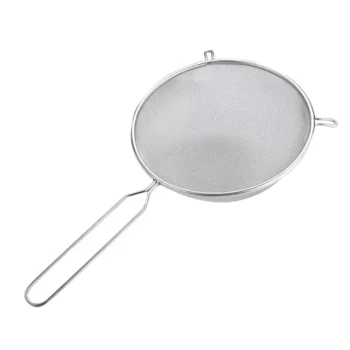
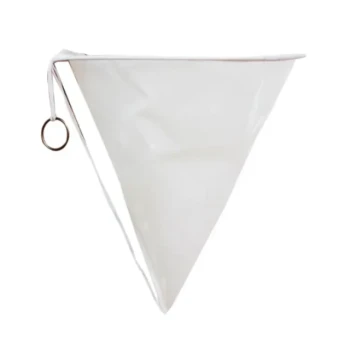
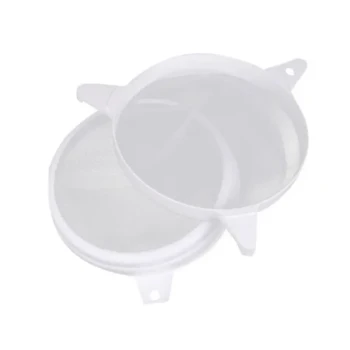
The physical comparison is straightforward: the largest pollen granules are significantly smaller than the mesh openings of a standard 200-micron honey filter. With a maximum width of approximately 100 microns, even the largest pollen grains are only half the size of the filter's holes. Consequently, a 200-micron filter will allow all pollen to pass through into the final product.
Because the largest pollen granules are only roughly half the size of the mesh openings in a 200-micron filter, this filtration level effectively cleans honey of debris without removing its natural pollen content.
The Mechanics of Honey Straining
To understand why this specific mesh size is the standard for many beekeepers, we must look at the physical dimensions of the particles involved.
Analyzing the Size Difference
A 200-micron filter is generally considered the smallest standard size for honey processing.
In contrast, the largest pollen granules found in nature measure approximately 100 microns in width.
This creates a substantial gap—the mesh opening is double the size of the largest particle you might want to retain.
The Flow of Particulates
Because of this size discrepancy, the pollen does not get caught in the mesh.
Instead, it flows freely alongside the liquid honey.
This ensures that the final product retains the botanical profile of the flowers from which the nectar was harvested.
Defining "Strained" Honey
Using a 200-micron mesh is technically defined as straining, not filtering, in the industrial sense.
The primary function of this mesh size is to remove macroscopic debris.
This includes bits of wax cappings, propolis, or bee parts that are undesirable for the consumer.
Understanding the Trade-offs
While retaining pollen is often viewed as a benefit for "raw" honey, there are objective trade-offs to using a 200-micron mesh compared to finer industrial filtration.
Visual Clarity vs. Natural Composition
Honey strained through a 200-micron mesh may appear slightly cloudy compared to commercial "ultra-filtered" honey.
This is because the microscopic pollen grains and fine air bubbles remain suspended in the liquid.
While this results in a less "polished" look, it serves as visual proof of the honey's raw status.
Crystallization Rates
Pollen grains act as nucleation sites within the honey.
These microscopic solids provide a surface for glucose crystals to form, which accelerates the natural crystallization process.
By allowing pollen to pass through a 200-micron filter, you are accepting that the honey will likely crystallize faster than honey that has been pressure-filtered to remove all particulates.
Making the Right Choice for Your Goal
Select your filtration method based on the final product you intend to create.
- If your primary focus is maximizing nutritional value: Stick with the 200-micron filter to remove wax and debris while keeping 100% of the natural pollen.
- If your primary focus is delaying crystallization: You would need specialized industrial filtration equipment with a much finer mesh to remove the microscopic pollen grains.
A 200-micron filter strikes the ideal balance between cleanliness and preserving the natural integrity of the hive's work.
Summary Table:
| Particle Type | Size (Microns) | Result with 200-Micron Filter |
|---|---|---|
| Largest Pollen Grains | ~100 Microns | Passes Through |
| 200-Micron Mesh Opening | 200 Microns | Reference Point |
| Macroscopic Debris | >200 Microns | Successfully Filtered |
| Air Bubbles/Fine Solids | Variable | Suspended (Causes Cloudiness) |
Elevate Your Honey Processing with HONESTBEE
Are you looking to scale your production while maintaining the natural integrity of your honey? At HONESTBEE, we specialize in providing commercial apiaries and distributors with the high-performance tools required for professional-grade success.
Our extensive portfolio includes:
- Advanced Machinery: From precision hive-making to high-speed honey-filling machines.
- Premium Equipment: Industrial-strength honey filters, extractors, and beekeeping tools.
- Essential Consumables: A full spectrum of supplies to keep your operations running smoothly.
Whether you need to preserve pollen content or optimize for shelf-life, our team can guide you to the perfect equipment solution. Contact us today to learn how our wholesale solutions can enhance your efficiency and product value.
Related Products
- Professional Stainless Steel Honey Filtering Machine with Water Bath Heating for Beekeeping
- Professional Stainless Steel Honey Filter with Support Handle
- Honey Concentrating and Filtering Dehumidifier Machine 2T Capacity for Honey
- Professional Cone-Shaped Honey Filter with Reinforced Steel Ring
- Electric Double Wall Honey Filtering Machine Purifier Equipment for Honey Processing Plant
People Also Ask
- Is it necessary to filter honey after extraction? A Guide to Straining vs. Raw Honey
- Why is filtering honey an important step in honey processing? Ensure Purity, Clarity & Marketability
- What is the best way to filter honey? A Guide to Quality, Clarity, and Raw Preservation
- Why do people filter honey? For Clarity, Stability, and Consumer Appeal
- What are the benefits of using honey filters? Achieve Purity, Efficiency, and Market Appeal