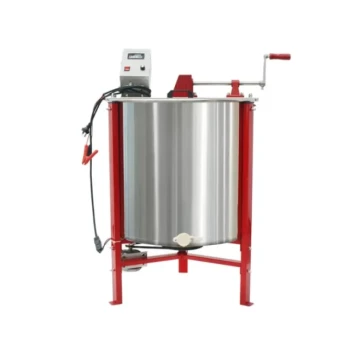
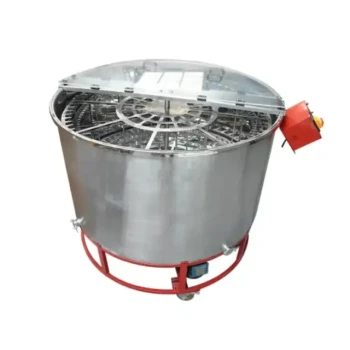
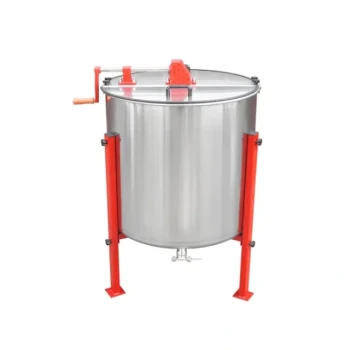
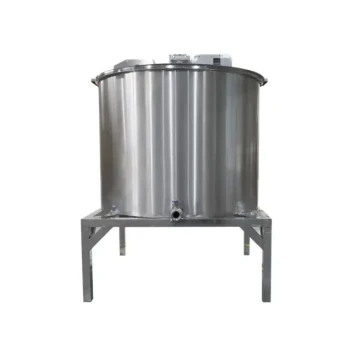
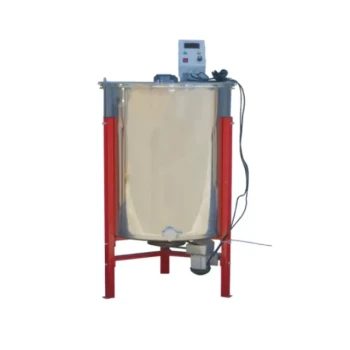
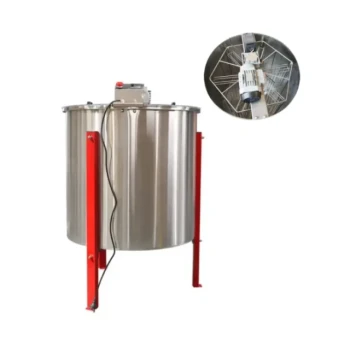
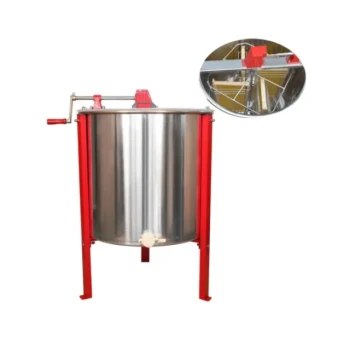
Upgrading to professional honey extraction machinery improves both honey quality and operational yield by removing honey more cleanly, preserving the wax comb, and reducing labor-intensive handling. Centrifugal extractors and suitable mechanical separation equipment reduce wax particles, debris, air exposure, and contamination risk compared with manual comb pressing. Because intact combs can be returned to the hive, colonies spend less time rebuilding wax and can recover faster for the next production cycle.
Professional extraction equipment turns harvesting from a destructive, labor-heavy process into a controlled recovery system: cleaner honey, reusable combs, more efficient labor, and greater output potential per hive.
Why Manual Comb Pressing Limits Performance
Pressing destroys valuable comb structure
Manual pressing squeezes honey from crushed comb, leaving the bees to rebuild the wax foundation before they can refill it. That reconstruction requires substantial colony energy and delays the return to full honey production.
Professional extractors remove honey while keeping the comb substantially intact. The extracted frames can then be returned to the hive, allowing bees to focus more quickly on nectar collection and honey storage.
Simple sieving leaves more impurities
Squeezing commonly introduces wax fragments, debris, and other particles into the honey. A basic sieve removes larger material but may not provide the consistency or clarity expected in commercial channels.
Professional systems combine controlled extraction with food-grade filtering or separation. This produces a cleaner, more uniform product that is better suited to bottling, wholesale distribution, and premium retail markets.
Manual handling increases exposure risk
Pressing and prolonged open handling create more opportunities for dust, contact contamination, and quality degradation. The longer honey remains exposed during processing, the more difficult it becomes to maintain consistent hygiene.
Mechanized equipment shortens the time between uncapping and collection. When paired with sanitary food-grade surfaces and disciplined cleaning procedures, it supports more reliable processing control.
How Professional Machinery Improves Honey Quality
Cleaner separation protects product clarity
Centrifugal extractors use controlled rotation to remove honey from capped combs without crushing the wax structure. Mechanical presses and separation units can also improve recovery when used with appropriate filtration.
The result is honey with fewer visible wax particles and impurities. Consistent clarity strengthens product presentation and helps meet the quality expectations of commercial buyers.
Controlled processing supports consistency
Professional equipment makes extraction speed, filtration, and collection more repeatable from batch to batch. This is important for wholesalers, resellers, and beekeepers supplying customers who expect stable product quality.
Equipment does not eliminate the need to monitor moisture, temperature, and sanitation. It gives operators better control over those variables when the full process is managed correctly.
Preserved beeswax creates a cleaner secondary stream
Intact combs retain greater practical value than wax heavily mixed with debris from pressing. Separated wax can be collected and directed toward secondary products such as creams, soaps, candles, or other beeswax-based goods.
This expands the operation's revenue potential beyond bottled honey. It also reduces the amount of usable material lost during crude extraction.
How Machinery Increases Operational Yield
More honey is recovered with less waste
Manual pressing can leave honey trapped in crushed comb or mixed with wax residue. High-efficiency extraction and separation recover honey more quickly and reduce avoidable product loss.
Higher recovery per harvested frame can increase net saleable output without requiring a proportional increase in colony count. The exact gain depends on equipment design, frame type, honey viscosity, operator technique, and filtration settings.
Reusable comb shortens colony recovery
Returning intact comb to the hive removes much of the wax-building work that follows destructive harvesting. Bees can use the existing structure for storage instead of spending time and energy secreting new wax.
This can shorten the production recovery cycle and support more productive use of each hive across the season. It does not guarantee a fixed increase in annual output because weather, forage availability, colony health, and management remain decisive factors.
Labor becomes easier to scale
Pressing comb manually requires repeated cutting, crushing, squeezing, and sieving. Those tasks consume time and create throughput limits as the number of hives increases.
A professional extractor allows fewer operators to process more frames in a controlled workflow. For distributors and B2B buyers, selecting equipment with suitable capacity, fast availability, and responsive technical support is therefore part of the yield calculation.
Faster processing reduces secondary contamination
Rapid extraction reduces the period during which honey is exposed to air and the surrounding work environment. Faster throughput also helps prevent harvested frames and open containers from accumulating unnecessary debris.
The benefit depends on the whole line, including uncapping, extraction, filtration, storage, and bottling. A fast extractor cannot compensate for poor sanitation or open, disorganized downstream handling.
Understanding the Trade-offs
The initial investment is higher
Professional machinery requires capital for the extractor, filters, pumps, tanks, cleaning supplies, and sometimes electrical or facility upgrades. The investment is easier to justify when the operation has sufficient seasonal volume or plans to expand.
For smaller producers, a correctly sized manual or semi-automatic extractor may offer a better return than purchasing industrial capacity that will remain underused.
Equipment requires maintenance and cleaning
Food-grade equipment must be cleaned and inspected consistently to prevent residue buildup and microbial contamination. Moving parts, seals, motors, and filters also require routine maintenance.
A purchasing decision should include spare-part availability, documentation, warranty terms, and service responsiveness. These factors affect operating continuity as much as the machine's advertised extraction rate.
Mechanical processing does not replace quality management
Centrifugal extraction preserves comb structure, but it does not automatically guarantee superior honey. Excessive heat, poor moisture control, dirty equipment, or unsuitable storage can still damage quality.
Operators should specify materials, sanitation procedures, temperature controls, and filtration requirements before choosing machinery. A full-spectrum supplier that can coordinate extraction and downstream processing equipment may simplify this evaluation.
Capacity must match the workflow
An extractor that is too small creates bottlenecks during harvest. One that is too large can increase cost, cleaning time, and unused capacity.
Compare frame compatibility, batch size, cycle time, power requirements, discharge design, and integration with uncapping and bottling equipment. Rapid delivery matters only when the supplied machine also fits the operation's actual workflow.
Making the Right Choice for Your Goal
The best upgrade is determined by the constraint limiting your operation today: product cleanliness, frame recovery, labor capacity, or processing scale.
- If your primary focus is premium honey quality: Choose food-grade extraction and filtration equipment that provides consistent separation, supports hygiene control, and helps produce clear, commercially presentable honey.
- If your primary focus is higher hive productivity: Prioritize a centrifugal extractor that preserves intact combs so frames can be returned to colonies promptly.
- If your primary focus is lower labor cost: Select equipment sized to your harvest volume, with efficient loading, extraction, filtration, and discharge stages.
- If your primary focus is broader revenue: Use machinery that separates usable beeswax cleanly for secondary products while minimizing waste.
- If your primary focus is dependable B2B supply: Evaluate supplier expertise, product range, order fulfillment speed, technical support, spare parts, and delivery reliability alongside machine specifications.
The right professional extraction system improves honey quality and yield by preserving the comb, controlling contamination, reducing waste, and making the entire harvest workflow more repeatable.
Summary Table:
| Aspect | Manual Comb Pressing | Professional Machinery |
|---|---|---|
| Comb Integrity | Destroys comb; bees rebuild | Preserves comb; reusable |
| Honey Purity | More wax debris, impurities | Cleaner separation, fewer particles |
| Recovery Rate | Honey trapped in crushed comb | Higher extraction efficiency |
| Labor Efficiency | Labor-intensive, slow, hard to scale | Faster, scalable with fewer workers |
| Contamination Risk | Longer exposure, higher risk | Reduced exposure, controlled processing |
| Secondary Products | Wax mixed with debris | Clean wax for secondary products |
| Investment | Low initial cost | Higher capital, but better ROI for volume |
Ready to upgrade your honey extraction line? HONESTBEE offers a full spectrum of beekeeping equipment, from centrifugal extractors to complete bottling systems. Our experts help you choose the right capacity and configuration for your apiary or distribution business. Benefit from rapid response, dedicated service, and ultra-fast delivery. OEM/ODM support and certifications available for B2B partners. Contact us today to boost your yield and honey quality!
Related Products
- Stainless Steel Manual 8 Frame Radial Honey Extractor Machine for Beehives
- HONESTBEE 6 Frame Three Use Electric Honey Extractor for Beekeeping
- 10L Stainless Steel Electric Honey Press Machine
- HONESTBEE 72 Frame Industrial Electric Honey Extractor for Beekeeping
- Commercial Electric 12 Frame Honey Extractor Spinner Motorized Honey Extractor
People Also Ask
- What types of beehive frames are compatible with honey extractor machines? Find the Perfect Match for Your Apiary
- Which type of honey extractor is generally more durable? Focus on Material & Build Quality for Longevity
- What are the key features and benefits of a stainless steel honey extractor? Upgrade to Professional Purity
- Why are manual extractors popular among beginner beekeepers? A Guide to Starting Simple & Saving Money
- What is a manual honey extractor? The Essential Guide to Cost-Effective Beekeeping for Beginners