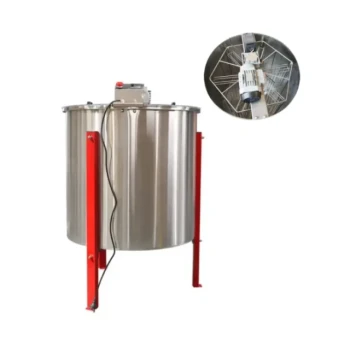
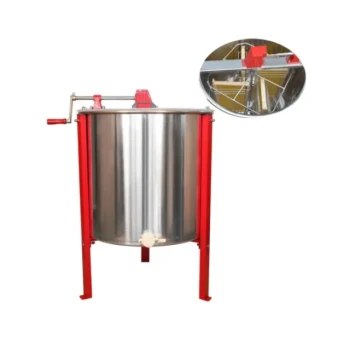
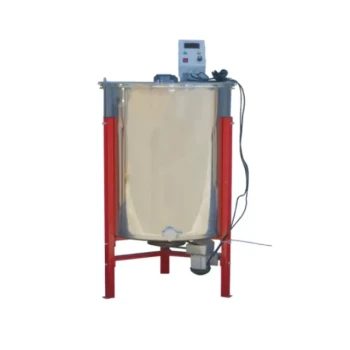
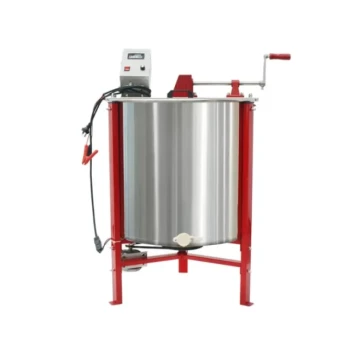
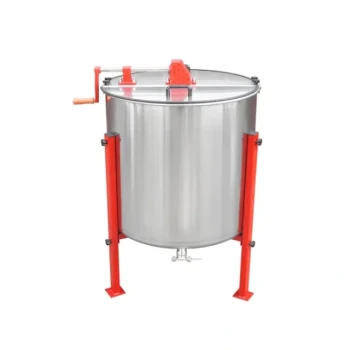
For commercial honey production, a centrifugal honey extractor is generally the most efficient and scalable option. It removes liquid honey from capped frames while preserving the beeswax comb, allowing frames to return to the hive for reuse. Crush-and-strain is simpler and requires less equipment but destroys the comb, while comb honey creates a premium product but demands stricter hive, nectar-flow, and quality control conditions.
The central commercial advantage of extraction is repeatability: reusable comb reduces rebuilding work for the colony, while mechanical processing improves throughput and supports consistent liquid-honey production. Crush-and-strain and comb honey remain useful for specific markets, but they are usually less suitable as the primary method for high-volume operations.
Why Honey Extractors Lead in Commercial Operations
Higher processing throughput
A honey extractor uses centrifugal force to remove honey from uncapped or uncapped? Actually honey from uncapped cells; user refs say wax-capped cells but extraction requires uncapping first. Say capped frames after uncapping. It processes multiple frames in a standardized workflow, making it substantially faster than hand-squeezing, pressing, or manually straining comb.
This matters commercially because harvesting speed affects labor requirements, equipment utilization, order fulfillment, and the ability to process honey soon after removal from the hive.
Reusable comb improves colony efficiency
After extraction, the empty frames can be returned to the hive. The bees can reuse the existing comb rather than investing substantial energy in producing new wax.
That supports more consistent production across harvest cycles and reduces the material loss associated with destroying comb during crush-and-strain harvesting.
More consistent liquid-honey quality
Mechanical extraction reduces unnecessary manual contact and can make the process easier to standardize. Combined with clean uncapping, filtering, settling, and storage procedures, this can support clearer and more consistent liquid honey.
An extractor does not guarantee hygiene by itself. Sanitary equipment, controlled handling, and appropriate storage remain essential to protecting honey quality.
How Crush-and-Strain Compares
Lower equipment investment
Crush-and-strain requires relatively little specialized machinery. The beekeeper crushes the comb and allows the honey to drain through a strainer or filter.
This can make it practical for small apiaries, trial production, emergency harvesting, or operations focused on minimizing initial capital expenditure.
The comb is destroyed
The principal commercial drawback is that the usable comb no longer remains intact. The wax may be recovered and rendered rather than simply discarded, but the original drawn comb cannot be returned directly to the hive.
The colony must therefore rebuild comb before using those frames for future storage and brood-rearing. That additional work can reduce operational efficiency compared with extraction.
Reduced process standardization
Crush-and-strain is more dependent on manual labor and drainage time. Results can vary with comb thickness, honey viscosity, temperature, straining conditions, and operator technique.
For commercial buyers and resellers, this may make it harder to maintain predictable volume, appearance, and delivery schedules across multiple harvests.
How Comb Honey Compares
It creates a distinct premium product
Comb honey is sold in its original beeswax structure. It offers a differentiated presentation and can appeal to customers seeking a minimally processed, premium, or specialty product.
Because the honey remains in the comb, it avoids the need for liquid extraction equipment for that portion of production.
It requires stronger production conditions
Comb honey generally requires abundant nectar flows, strong colonies, and careful hive management. The bees must build clean, properly filled, and fully capped comb suitable for sale.
This makes production more sensitive to weather, colony population, nectar availability, and timing than standard liquid-honey extraction.
It is less flexible for bulk supply
Comb honey is sold in a fixed physical format and cannot be processed as readily into bulk liquid honey. That can limit flexibility for wholesalers, private-label suppliers, and distributors serving customers with different packaging requirements.
For a commercial portfolio, comb honey may work best as a specialty product alongside—not instead of—extracted honey.
Understanding the Trade-offs
Capital cost versus operating efficiency
A commercial extractor requires upfront investment in equipment, workspace, maintenance, and compatible handling tools. The cost is justified when harvest volume and labor savings are sufficient to keep the equipment productive.
Smaller operators may find crush-and-strain more economical initially, while larger apiaries usually place greater value on throughput, repeatability, and comb reuse.
Yield is more than the honey removed today
Crush-and-strain can recover honey from the comb, but its impact should be evaluated across the full production cycle. Destroyed comb creates rebuilding work for the bees and may reduce the speed at which colonies can resume storing honey.
An extractor preserves the production asset represented by drawn comb, so its commercial benefit extends beyond a single harvest.
Comb honey has stricter quality requirements
Comb honey must be visually clean, well formed, and adequately capped to meet customer expectations. Damaged, poorly filled, or contaminated comb can be difficult to sell as a premium product.
It can command differentiation, but it also carries greater risk if environmental or colony conditions are inconsistent.
Equipment selection affects scalability
Extractor capacity, frame compatibility, construction quality, and ease of cleaning influence real-world performance. An undersized machine can become a bottleneck, while an unnecessarily large system can tie up capital without delivering proportional benefits.
Distributors and commercial buyers should evaluate the complete workflow, including uncapping, extraction, filtering, settling, filling, cleaning, and spare-parts support.
Choosing the Right Method for Your Business
The best approach depends on your production scale, target product, available labor, and customer requirements.
- If your primary focus is high-volume liquid honey: Use a suitably sized centrifugal extractor to maximize throughput, preserve drawn comb, and support repeatable commercial production.
- If your primary focus is minimizing upfront equipment costs: Consider crush-and-strain for small-scale or early-stage operations, while accounting for additional labor and comb rebuilding.
- If your primary focus is premium product differentiation: Add comb honey where nectar flows, colony strength, and hive management can reliably produce clean, fully capped comb.
- If your primary focus is reliable B2B fulfillment: Prioritize standardized extraction equipment, sanitation procedures, dependable after-sales support, and a supplier capable of rapid delivery and efficient order fulfillment.
For most commercial apiaries, extraction should form the operational foundation, with crush-and-strain and comb honey used selectively to serve specific production or market niches.
Summary Table:
| Method | Key Advantages | Key Drawbacks | Best For |
|---|---|---|---|
| Honey Extractor | High throughput, reusable comb, consistent quality | High upfront cost, needs equipment & space | High-volume liquid honey production, B2B supply |
| Crush-and-Strain | Low cost, simple, minimal equipment | Destroys comb, labor-intensive, less standardization | Small-scale or trial production, low capital |
| Comb Honey | Premium product, minimal processing | Strict hive conditions, limited flexibility | Specialty markets, niche products |
Ready to scale your honey production? At HONESTBEE, we provide a comprehensive range of beekeeping tools, machinery, and equipment including high-efficiency honey extractors, uncapping tools, and complete processing lines. Our one-stop sourcing and fast delivery ensure your operation runs smoothly. Whether you're a commercial apiary or a distributor, our dedicated support and premium trading services help you maximize efficiency and profitability. Contact us today for a tailored solution and experience rapid response, reliable supply, and expert guidance.
Related Products
- HONESTBEE 72 Frame Industrial Electric Honey Extractor for Beekeeping
- Commercial Electric 12 Frame Honey Extractor Spinner Motorized Honey Extractor
- HONESTBEE 6 Frame Self Reversing Electric Honey Extractor for Beekeeping
- HONESTBEE 3-Frame Manual Acrylic Honey Extractor
- Stainless Steel Manual 8 Frame Radial Honey Extractor Machine for Beehives
People Also Ask
- What is the importance of balancing honeycomb frames within a honey extractor? Ensure Stability and Protect Machinery
- How is honey separated from the frames after they are uncapped? Efficient Extraction Methods for High Yields
- What are the main benefits of using a honey extractor? Maximize Yields and Protect Your Honeycomb
- What are the recommended methods for removing honey from the honeycomb? Top Extraction Techniques for Maximum Efficiency
- How do manual honey extractors compare to electric honey extractors? Choosing the Right Tool for Your Apiary Growth