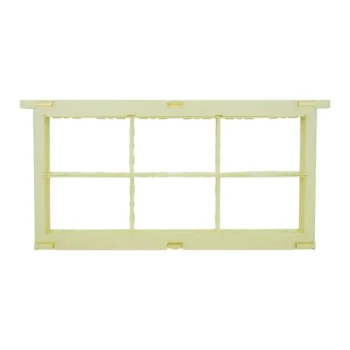
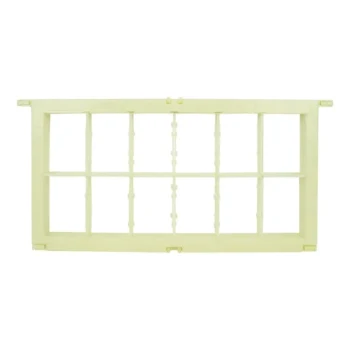
A frame-grid is a quantitative assessment tool used to standardize the measurement of honeybee colony dynamics in field trials. By physically placing a grid—typically divided into 5x5 cm squares—over a hive frame, researchers can count the number of squares covered by larvae, pupae, or adult bees to generate precise data on colony growth and health.
By converting visual observations into statistical units, the frame-grid method moves beyond rough estimation to provide accurate calculations of the queen's daily egg-laying rate and the total area of capped brood.
The Mechanics of Measurement
The Physical Setup
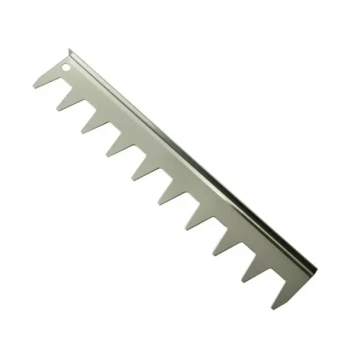
The tool consists of a measuring frame, often made of wood or wire, that divides the honeycomb surface into standardized sections.
While specific dimensions can vary (such as 2 cm or 10 cm variations), the primary standard is a 5x5 cm grid (25 cm² per square).
The Counting Process
Technicians overlay this grid onto the honeycomb frames within the hive.
Instead of counting individual bees or cells, which is prone to error, the technician counts the number of grid squares occupied by specific biological targets, such as capped brood, uncapped larvae, or stored pollen.
Converting Area to Biological Metrics
From Area to Population
The core value of the frame-grid is its ability to convert surface area into population counts.
In a standard 5x5 cm configuration, one grid square corresponds to approximately 100 honeycomb cells.
This allows for a rapid, accurate calculation of the total number of bee offspring without manual counting.
Calculating Queen Performance
The data derived from the grid is used to calculate the Daily Egg-Laying Rate (DELR).
By measuring the expansion of brood areas over time, researchers can objectively determine if the queen's fecundity is increasing or decreasing.
Evaluating Interventions
This quantitative data serves as the baseline for assessing external factors.
For example, field trials often use these metrics to determine if specific interventions, such as antioxidant agents or supplemental feeding, are successfully accelerating colony buildup during the spring.
Understanding the Constraints
Invasive Measurement
While accurate, this method requires opening the hive and manipulating frames physically.
Frequent application of the frame-grid can disturb the colony's temperature regulation and stress the bees, potentially influencing the very behavior being measured.
Labor Intensity
Compared to automated solutions like hive scales, frame-grid measurement is manual and time-consuming.
It requires trained technicians to visually assess and record data for every frame, making it resource-intensive for large-scale apiary studies.
Making the Right Choice for Your Goal
When designing a field trial, consider how the frame-grid aligns with your specific data requirements.
- If your primary focus is assessing queen fertility: Use the frame-grid to calculate the daily egg-laying rate based on the expansion of uncapped larvae areas.
- If your primary focus is testing nutritional supplements: Use the grid to measure the area of capped brood and stored pollen to quantify the colony's response to the new diet.
- If your primary focus is non-invasive monitoring: Acknowledge that a frame-grid requires hive intrusion; consider combining it with automated weight scales for a holistic view.
The frame-grid remains the industry standard for converting the complex biological activity of a hive into comparable, statistical data.
Summary Table:
| Metric Category | Measurement Detail | Biological Significance |
|---|---|---|
| Standard Grid Unit | 5x5 cm square (25 cm²) | Approximately 100 honeycomb cells |
| Primary Targets | Capped brood, larvae, pollen | Indicators of colony health and resource storage |
| Key Calculation | Daily Egg-Laying Rate (DELR) | Measures queen fecundity and reproductive health |
| Primary Use Case | Nutritional/Medical Field Trials | Quantifies impact of supplements or treatments |
| Method Type | Quantitative & Manual | Provides precise statistical units over rough estimates |
Scaling Your Apiary Operations with HONESTBEE
Precise data is the foundation of successful beekeeping, whether you are conducting field trials or managing a commercial enterprise. HONESTBEE supports commercial apiaries and global distributors by providing a comprehensive suite of high-quality tools designed for efficiency and accuracy.
From specialized hive-making and honey-filling machinery to essential consumables and professional-grade beekeeping equipment, we empower you to optimize colony development and streamline your production. Partner with a supplier that understands the technical demands of the industry.
Ready to elevate your wholesale supply or commercial production?
Contact HONESTBEE Today for a Comprehensive Consultation
References
- С.Л. Воробьева, A. S. Fedorova. ОПЫТ ПРИМЕНЕНИЯ ФЕРМЕНТНОГО ПРЕПАРАТА С УСИЛЕННЫМ АНТИОКИСЛИТЕЛЬНЫМ ЭФФЕКТОМ ПРИ НОЗЕМАТОЗЕ МЕДОНОСНЫХ ПЧЕЛ. DOI: 10.48012/1817-5457_2025_2_117-124
This article is also based on technical information from HonestBee Knowledge Base .
Related Products
- HONESTBEE Wired and Assembled Wooden Bee Frames Foundation for a Thriving Hive
- Professional 500g Sectional Comb Honey Frame System for Beekeeping
- Automatic Heat Preservation 6 Frame Pro Nuc Box for Honey Bee Queen Mating
- Assembled Wooden Bee Frames with Plastic Foundation for Durability and Convenience by HONESTBEE
- Assembled Wooden Bee Frames with Beeswax Foundation Ready to Use by HONESTBEE
People Also Ask
- What role does replacing foundation and frames play in controlling American Foulbrood (AFB)? A Key to Hive Sanitation
- What is the difference between frames and foundation in a bee hive? A Guide to Hive Structure and Comb Building
- What is the role of frames and foundation in a bee hive? Build a Stable and Productive Apiary with Modern Design
- What is the purpose of frames and foundations in a beehive? Achieve a Healthy, Manageable Hive
- How do wooden and plastic hive frames compare in terms of durability? Wood vs. Plastic Longevity & Repairability