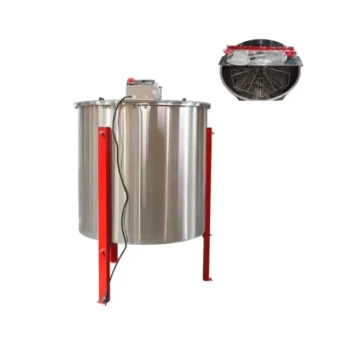
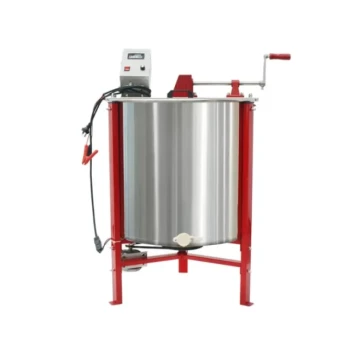
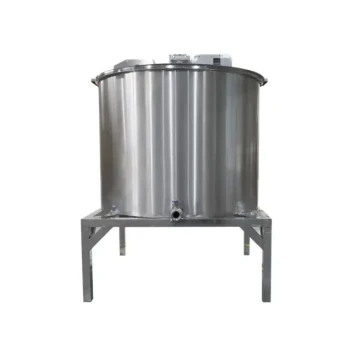
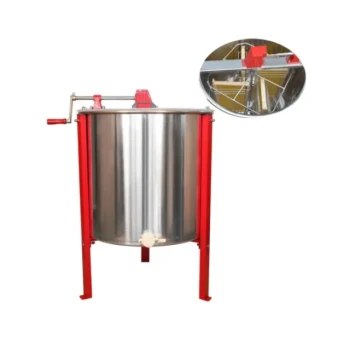
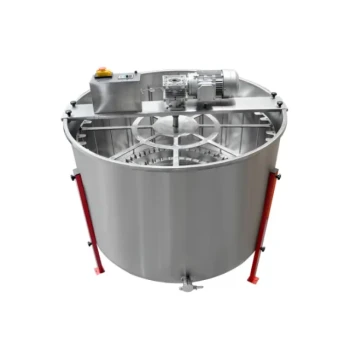
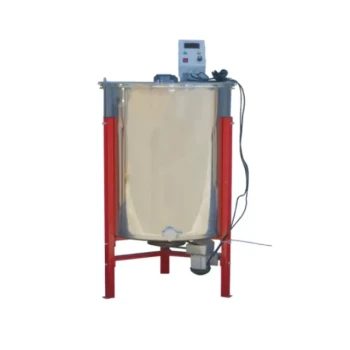
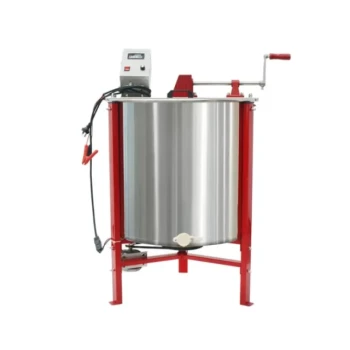
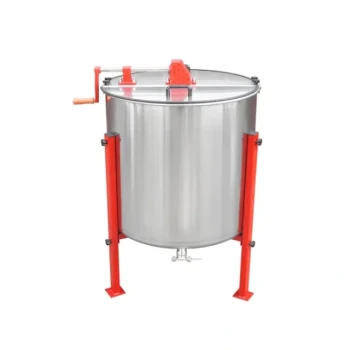
Motorized honey extractors are specialized mechanical devices that utilize an electric motor to spin honey frames, generating centrifugal force to remove honey without manual labor. By automating the rotation process, these machines significantly accelerate harvesting and eliminate the physical fatigue associated with hand-cranking.
Core Insight: The true value of a motorized extractor is not just the elimination of physical effort, but the optimization of workflow. It transforms extraction from a sequential task into a parallel one, allowing beekeepers to prep new frames while the machine processes the previous batch.
The Mechanics of Automation
Eliminating Manual Effort
The defining feature of these extractors is the electric motor.
It replaces the manual hand-crank mechanism found on smaller units.
This automation completely removes the physical exertion required to spin heavy frames, a critical benefit for beekeepers managing large harvests.
Preserving the Comb Structure
Like all extractors, motorized units rely on centrifugal force.
This physics-based approach pulls honey out of the cells without destroying the wax structure.
Because the comb remains intact, the colony can reuse the empty frames immediately, saving the bees the energy required to rebuild wax.
Workflow and Efficiency Gains
The Multitasking Advantage
The most significant operational advantage is the ability to multitask.
Because the extraction runs automatically, the beekeeper is freed from standing at the machine.
You can utilize this time to uncap the next set of frames while the current load is spinning, creating a continuous, efficient cycle.
Speed and Scalability
Motorized units are explicitly favored by commercial beekeepers and those with high hive counts.
They are designed to handle large quantities of honey rapidly.
This speed ensures that large-scale harvests do not become a bottleneck in your operation.
Precision Control and Preservation
Variable Speed Settings
Motorized extractors typically offer granular speed controls.
This allows the user to adjust the rotation intensity to match the specific requirements of the harvest.
Manual cranking often results in inconsistent speeds, whereas a motor provides steady, regulated revolutions.
Protecting Different Foundations
The ability to control speed is vital for comb preservation.
Durable plastic foundations can be spun at higher speeds for maximum extraction efficiency.
Conversely, delicate wax foundations can be spun at lower, gentler speeds to prevent the comb from blowing out or collapsing.
Understanding the Trade-offs
Necessity vs. Capacity
These units are tools of convenience and volume.
The primary reference notes they are favored by those with "many hives," implying they may be overkill for a casual hobbyist with only one or two colonies.
The investment is best justified when the volume of honey requires speed and automation.
Infrastructure Requirements
Motorized extractors depend on an electric power source.
This limits where you can perform your extraction compared to a hand-crank model, which can be used anywhere.
You must ensure your honey house or processing area has accessible and safe power outlets.
Making the Right Choice for Your Goal
To determine if a motorized extractor fits your apiary, consider your specific operational needs:
- If your primary focus is Efficiency: The ability to uncap frames while the machine runs effectively doubles your processing speed.
- If your primary focus is Comb Preservation: The variable speed control allows you to customize the force applied to fragile wax versus sturdy plastic foundations.
- If your primary focus is Volume: For commercial operations or high hive counts, the electric motor is essential to prevent physical burnout.
Ultimately, a motorized extractor shifts your role from a machine operator to a workflow manager, allowing you to process more honey with significantly less physical strain.
Summary Table:
| Feature | Advantage | Benefit to Beekeeper |
|---|---|---|
| Electric Motor | Eliminates manual cranking | Reduces physical fatigue & labor costs |
| Variable Speed | Precise centrifugal control | Protects fragile wax & maximizes extraction |
| Automation | Enables parallel processing | Allows multitasking like frame uncapping |
| High Capacity | Rapid processing speed | Essential for commercial scalability |
Scale Your Honey Production with HONESTBEE
Are you looking to transition from manual labor to industrial efficiency? HONESTBEE specializes in supporting commercial apiaries and distributors with high-performance beekeeping machinery.
Our extensive portfolio includes everything from motorized honey extractors and honey-filling machines to specialized hive-making equipment and essential consumables. We provide the tools you need to optimize your workflow, preserve your combs, and maximize your output.
Ready to upgrade your operation? Contact us today to discuss our wholesale offerings and discover how our professional-grade equipment can drive your business forward.
Related Products
- Commercial Electric 12 Frame Honey Extractor Spinner Motorized Honey Extractor
- 8-Frame Electric Self-Reversing Honey Extractor Spinner for Commercial Honey Extraction Equipment
- HONESTBEE 6 Frame Three Use Electric Honey Extractor for Beekeeping
- Vertical Motor Kits for 2 3 4 Frame Electric Honey Extractors
- HONESTBEE 72 Frame Industrial Electric Honey Extractor for Beekeeping
People Also Ask
- Who are commercial honey extractors designed for? Scaling Your Industrial Beekeeping Success
- What is a commercial honey extractor? The Essential High-Volume Solution for Large Apiaries
- How is honey extracted commercially? Maximize Your Apiary's Efficiency and Honey Yield
- What are commercial honey extractors used for? Boost Your Apiary's Efficiency & Profitability
- What are the advantages of motorized extractors? Boost Honey Production and Save Time