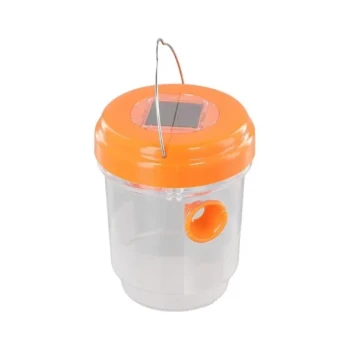
Placing hornet traps directly on top of beehives is a calculated defensive strategy designed to intercept predators at their primary point of attack. By positioning traps in this specific location, you leverage the natural aggressive behavior of Vespa orientalis to neutralize the threat before it can make contact with the colony.
Core Takeaway The effectiveness of top-mounted traps lies in shifting the defensive perimeter forward. This layout intercepts hornets along their natural flight paths during direct attacks, protecting the internal bee-covered combs from destruction and maximizing capture efficiency.
The Strategy Behind Top-Mounted Placement
To understand why this placement is effective, you must look beyond simple convenience and analyze the predatory mechanics of the hornet.
Exploiting Predatory Behavior
The placement is not random; it is strictly behavior-based. Vespa orientalis (the Oriental hornet) exhibits a strong tendency to attack honeybee colonies directly.
By acknowledging this instinct, you can turn the hive's location into a lure. The hornets are already drawn to the hive, so placing the trap on top puts the solution exactly where the problem manifests.
Intercepting Natural Flight Paths
Hornets follow specific vectors when approaching a target hive. Top-mounted traps are positioned to cut across these natural flight paths.
Instead of requiring the hornet to deviate from its course to find a trap located on the ground or nearby, the trap becomes an unavoidable obstacle in its attack trajectory. This significantly increases the probability of capture.
Enhancing Hive Defense
The ultimate goal of this placement is to minimize the damage inflicted upon the colony's infrastructure.
Forward Defense
Placing traps on the hive creates a forward defensive line. The objective is to stop the intruder at the perimeter rather than fighting it at the entrance or inside the hive.
This reduces the likelihood of hornets making direct contact with the guard bees or foragers, thereby preserving the colony’s workforce.
Protecting Internal Structure
The deepest need for the beekeeper is the preservation of the comb. Vespa orientalis attacks can lead to the destruction of bee-covered combs within the hive.
By intercepting the predator on the roof of the hive, you prevent the attackers from reaching the critical interior where the brood and food stores are vulnerable.
Understanding the Limitations
While this strategy is effective for specific threats, it is important to understand the reliance on specific biological traits.
Species-Specific Dependency
This deployment strategy relies heavily on the specific predatory patterns of Vespa orientalis.
Because this species tends to launch direct attacks on the colony, the trap placement is highly effective. However, against predators with different foraging behaviors—such as those that hunt individual bees in the field rather than attacking the hive structure—this placement may yield different results.
The Necessity of Attraction
The success of this placement assumes the hornets are already actively targeting the hive.
If the hornets are in a different phase of their lifecycle or are not yet focused on colony predation, the traps rely entirely on the hive itself acting as the primary attractant.
Making the Right Choice for Your Goal
When deciding on your trap deployment strategy, consider your primary defensive objectives.
- If your primary focus is preserving hive infrastructure: Place traps on top to create a barrier that prevents hornets from reaching and destroying the bee-covered combs.
- If your primary focus is maximizing capture rates: Utilize top placement to align traps directly with the hornets' aggressive flight paths during a colony attack.
By aligning your defensive layout with the predator's natural behavior, you turn the hive from a target into a trap.
Summary Table:
| Feature | Advantage of Top-Mounted Placement | Impact on Hive Safety |
|---|---|---|
| Defense Line | Creates a forward perimeter at the point of attack | Prevents predators from reaching guard bees |
| Flight Vector | Intercepts natural hornet flight paths | Increases capture probability during direct attacks |
| Comb Safety | Stops Vespa orientalis before entry | Protects internal brood and honey stores from destruction |
| Behavioral Use | Leverages the hive's natural attraction as a lure | Turns a vulnerability into a strategic trapping point |
Secure Your Apiary with Industrial-Grade Solutions
Protecting your commercial honey production requires more than just strategy—it requires the right tools. HONESTBEE provides commercial apiaries and distributors with a comprehensive range of professional beekeeping machinery, specialized hardware, and essential consumables. From automated hive-making and honey-filling machines to durable predator control equipment, we empower you to scale your operations and safeguard your colonies.
Ready to upgrade your wholesale beekeeping supply? Contact HONESTBEE today to discover how our end-to-end equipment solutions can enhance your efficiency and output.
References
- Mostafa A. Fouad, A. EL Roby. Behavioral Study of The Dangerous Insect Predator (Vespa orientalis) on The Honeybee Colonies in Minia Region, Egypt دراسة سلوک اخطر عدو حشري (الدبور الشرقي) على طوائف نحل العسل في منطقة المنيا ، مصر. DOI: 10.21608/jppp.2021.205739
This article is also based on technical information from HonestBee Knowledge Base .
Related Products
- Compact Multi-Funnel Hanging Wasp Trap
- Reusable Aluminium Beetle Trap for Small Hive Beetles Silver Bullet
- Removable Washable Hive Beetle Trap Attractants for Small Hive Beetles
- HONESTBEE Professional Telescopic Pole Bee Swarm Catcher
- HONESTBEE Collapsible Tiered Bee Swarm Catcher for Beekeeping
People Also Ask
- What are the practical advantages of using professional wasp traps and protective equipment in apiary management? Scale Up
- Why replace sugar syrup bait in wasp traps every three days? Ensure Maximum Attraction and Catch Rates
- What is the importance of deploying hornet traps around an apiary for maintaining colony stability? Protect Your Yields.
- What trapping methods and equipment setups protect commercial apiaries against seasonal hornet predation?
- What is the technical purpose of placing expanded clay balls in a hornet trap? Optimize Your Apiary Monitoring