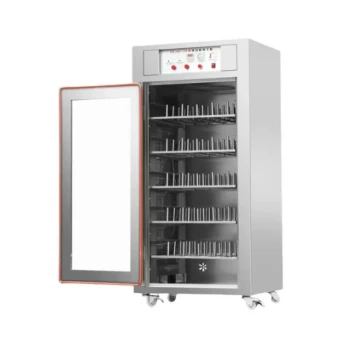
The primary advantage of using a vacuum oven for drying crude propolis extracts is the ability to remove solvents and moisture at significantly lower temperatures by lowering the atmospheric pressure. This method effectively extracts trace solvents from viscous resins while simultaneously creating an oxygen-free environment to prevent chemical degradation.
Core Insight: While standard ovens rely on high heat to drive off moisture—often "cooking" delicate compounds—vacuum ovens utilize pressure reduction to lower the boiling point of solvents. This ensures the complete drying of sticky propolis resins without compromising the stability of oxygen-sensitive bioactive markers.
The Physics of Low-Temperature Drying
To understand why a vacuum oven is superior for propolis, you must look beyond simple drying and consider the physical state of the extract.
Manipulating Boiling Points
In a standard oven, you must raise the temperature to the boiling point of the solvent (or water) to evaporate it.
In a vacuum oven, the system removes air to create a low-pressure environment. This physics shift drastically lowers the boiling point of liquids. You can achieve evaporation without subjecting the propolis to damaging thermal stress.
Handling Viscous Resins
Propolis is naturally resinous and viscous (sticky and thick). In a standard ambient-pressure environment, trapping solvents inside this thick matrix is a common problem.
The primary reference indicates that the vacuum environment allows for the complete removal of trace solvents even from these difficult, viscous materials. It pulls the solvent out more effectively than heat alone can achieve.
Preservation of Chemical Integrity
The "Deep Need" in processing propolis is not just removing liquid, but maintaining the bioactivity that gives the product its value.
Protecting Oxygen-Sensitive Compounds
Heat is not the only enemy; oxygen is also a threat. Standard ovens constantly circulate hot air, which promotes oxidation.
Vacuum ovens operate by eliminating oxygen interference. According to the primary reference, this is critical for preserving specific components like sesquiterpenes and diterpenoids. These compounds are chemically fragile and degrade rapidly when exposed to heated oxygen.
Preventing Physical and Chemical Changes
The visual appearance of an extract often signals its chemical quality. High heat and oxidation cause browning.
The vacuum environment prevents the extract from darkening in color. More importantly, it stops unwanted chemical transformations, ensuring the final chemical profile closely matches the original raw material.
Understanding the Trade-offs
While vacuum drying offers superior quality, it is important to recognize the operational differences compared to standard drying.
Complexity of Operation
Standard drying is a passive thermal process. Vacuum drying requires managing two variables: temperature and pressure. Achieving the specific "low-pressure conditions" mentioned in the reference is essential to lower the boiling point sufficiently.
Specialized Equipment Necessity
You cannot achieve these results with standard airflow. The process requires a sealed system capable of sustaining a vacuum to protect volatile components and preventing the "browning" associated with standard oxidation.
Making the Right Choice for Your Goal
When deciding on your drying methodology, consider what creates the most value for your final product.
- If your primary focus is Chemical Purity: Choose the vacuum oven to ensure the complete removal of trace solvents from the viscous resin matrix.
- If your primary focus is Bioactivity: Choose the vacuum oven to protect fragile sesquiterpenes and diterpenoids from oxidation and heat degradation.
- If your primary focus is Physical Appearance: Choose the vacuum oven to prevent the extract from darkening, maintaining a higher-quality visual standard.
By controlling pressure rather than just temperature, you transition from simply drying a product to actively preserving its therapeutic value.
Summary Table:
| Feature | Standard Oven | Vacuum Oven |
|---|---|---|
| Temperature | High (risk of degradation) | Low (preserves compounds) |
| Oxygen Levels | Normal (high oxidation risk) | Oxygen-free (prevents oxidation) |
| Solvent Removal | Surface-level evaporation | Deep extraction from thick resins |
| Final Quality | Potential browning/potency loss | Retains color and bioactivity |
| Target Compounds | Heat-tolerant materials | Sesquiterpenes & Diterpenoids |
Elevate Your Propolis Processing with HONESTBEE
Maximize the potency and market value of your extracts with professional-grade equipment. At HONESTBEE, we specialize in supporting commercial apiaries and distributors by providing a comprehensive wholesale range of beekeeping tools, specialized honey-filling machinery, and high-performance processing hardware.
Whether you are scaling up production or looking for the latest in honey-themed cultural merchandise, our experts are ready to help you optimize your workflow and preserve the therapeutic integrity of your products.
Contact HONESTBEE Today to Discuss Your Equipment Needs
References
- Noushin Aminimoghadamfarouj, Alireza Nematollahi. Structure Elucidation and Botanical Characterization of Diterpenes from a Specific Type of Bee Glue. DOI: 10.3390/molecules22071185
This article is also based on technical information from HonestBee Knowledge Base .
Related Products
- Solar Beeswax Melter Easy Solar Wax Melter for Beeswax
- Oxalic Acid Vaporizer 12V for Bee Varroa Mite Treatment
- Durable 12V Oxalic Acid Vaporizer for Varroa Mite Treatment Beehive Beekeeping Tool
- Heavy Duty 12V Oxalic Acid Evaporator Vaporizer for Bee Varroa Mite Treatment Beekeeping Fumigator Atomizer
- Economy Small Scale Honey Dryer Dehumidifier Thickening Machine
People Also Ask
- How does a solar melter work to process beeswax? The Eco-Friendly Way to Pure Wax
- What is a solar wax melter and how does it work? Harness the Sun for Pure Beeswax
- What are the benefits of using a solar wax melter? Harness the Sun for Pure, Cost-Effective Beeswax
- What is the purpose of a solar wax melter in beekeeping? Sustainable Wax Processing for Modern Apiaries
- How does a solar-powered frame wax melter work? Harness the Sun for Sustainable Beekeeping