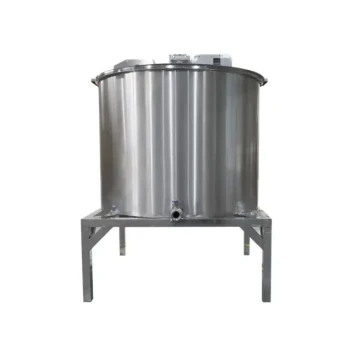
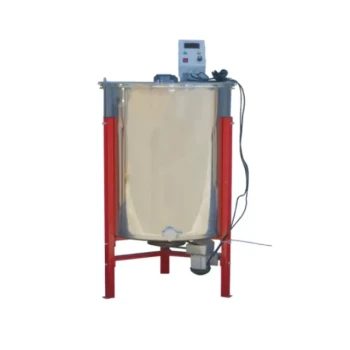
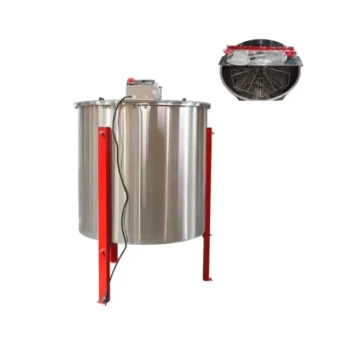
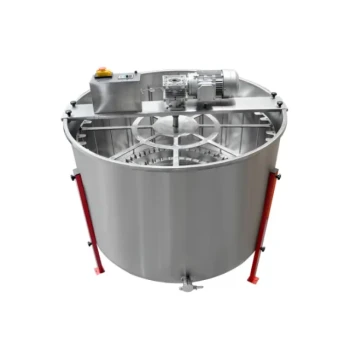
Industrial high-capacity honey centrifuges are the operational backbone for apiaries managing over 150 colonies, primarily because they decouple honey extraction from comb destruction. By utilizing precise centrifugal force, these machines separate honey from the wax frame without damaging the honeycomb structure, allowing for immediate reuse of the drawn comb and significantly increasing overall production efficiency.
The Core Insight For a professional apiary, the bottleneck is rarely just the speed of extraction; it is the biological energy of the hive. The true value of an industrial centrifuge lies in wax preservation: by eliminating the need for bees to rebuild combs, you convert colony energy directly into increased nectar foraging, maximizing yields during critical, short-duration flows.
Biological Efficiency and Yield Maximization
The primary benefit of industrial centrifugation is biological rather than mechanical. It changes how the colony utilizes its energy resources.
Preserving the Honeycomb Structure
Unlike crushing or pressing methods, industrial centrifuges use controlled rotational force to spin honey out of the cells. This leaves the delicate wax structure intact and ready for immediate re-insertion into the hive.
Reducing Metabolic Costs for Bees
Bees consume a significant amount of honey and energy to secrete wax and build combs. When you return intact combs to the hive, the colony bypasses this energy-intensive rebuilding phase.
Capitalizing on Peak Flowering
This energy saving is critical during short, intense flowering periods, such as Acacia or Linden blooms. Because bees are not distracted by construction, they can dedicate their entire workforce to nectar collection when natural resources are most abundant.
Operational Scalability and Hygiene
As an apiary scales beyond 150 colonies, manual processes become unsustainable. Industrial equipment introduces necessary standardization.
Increasing Throughput
High-performance complexes are designed to process frames from hundreds of colonies in a short window. This speed mitigates the risk of bottlenecks during peak harvest, preventing the backlog of supers in the honey house.
Reducing Labor Dependency
Automated systems drastically lower the manual labor hours required per kilogram of honey produced. By streamlining the extraction process, the enterprise improves overall profitability and reduces the physical strain on operators.
Enhancing Product Hygiene
Industrial-grade automation minimizes direct human contact with the product. This closed-loop approach reduces the risk of introducing environmental impurities and ensures compliance with strict commercial hygiene standards.
Product Quality and Versatility
Beyond volume, industrial centrifuges offer superior control over the physical properties of the extracted honey.
Handling High-Viscosity Varietals
Manual extraction is often insufficient for thick honeys like heather or honeydew. High-efficiency centrifugal force can separate these high-viscosity products rapidly without requiring excessive heat that might damage the honey.
Preserving Bioactive Components
Prolonged exposure to air and heat during slow manual extraction can degrade honey quality. Industrial speed ensures that the transition from comb to storage is rapid, preserving natural flavor profiles and bioactive compounds.
Understanding the Trade-offs
While the benefits are clear, adopting industrial-grade equipment introduces new complexities that must be managed.
Shift in Operational Focus
Moving to high-capacity machinery shifts your role from a beekeeper to a production line manager. You must implement strict maintenance schedules to prevent downtime, as a single machine failure can halt the entire harvest.
Capital vs. Labor Exchange
The reduction in labor costs comes at the price of significant upfront capital investment. Profitability relies on high utilization; the equipment must be run at capacity during harvests to justify the expense.
Making the Right Choice for Your Goal
The decision to upgrade should be driven by your specific production bottlenecks.
- If your primary focus is Maximum Yield: Prioritize centrifuges that guarantee zero comb damage to ensure immediate wax reuse during short nectar flows.
- If your primary focus is Labor Reduction: Look for fully automated extraction complexes that integrate uncapping and filtration to minimize manual handling.
- If your primary focus is Product Quality: Ensure the equipment allows for variable speed control to handle difficult varietals like heather without overheating the honey.
investing in high-capacity centrifugation is not just about moving honey faster; it is about optimizing the biological energy of your livestock to maximize profitability.
Summary Table:
| Benefit Category | Key Advantage | Impact on Apiary Operations |
|---|---|---|
| Biological Efficiency | Wax Preservation | Bees focus on nectar collection instead of rebuilding combs, increasing total yield. |
| Operational Scale | High Throughput | Rapidly processes frames from 150+ colonies, preventing harvest bottlenecks. |
| Labor & Cost | Automation | Reduces manual labor hours per kg and lowers long-term operational costs. |
| Product Quality | Controlled Extraction | Efficiently handles high-viscosity honey while preserving bioactive compounds. |
| Hygiene | Closed-Loop Systems | Minimizes human contact and environmental impurities for commercial compliance. |
Scale Your Apiary with HONESTBEE’s Professional Solutions
Transitioning to high-capacity extraction is the most effective way to turn biological energy into commercial profit. At HONESTBEE, we specialize in supporting commercial apiaries and distributors with a complete range of professional-grade beekeeping tools and machinery.
How we add value to your business:
- High-Capacity Machinery: From advanced honey-filling machines to automated extraction complexes designed for 150+ colonies.
- Comprehensive Supply: We provide everything from hive-making equipment to essential industry consumables and cultural merchandise.
- Wholesale Expertise: Our portfolio is tailored for large-scale operations requiring durability, hygiene, and efficiency.
Ready to eliminate your production bottlenecks and maximize your next harvest? Contact HONESTBEE today to discuss our wholesale equipment solutions!
References
- Lyubomir Lyubenov, Ivaylo Hristakov. Economic-geographical characteristic of beekeeping in the Ruse region. DOI: 10.22616/esrd.2022.56.021
This article is also based on technical information from HonestBee Knowledge Base .
Related Products
- Honey Concentrating and Filtering Dehumidifier Machine 2T Capacity for Honey
- 32 Frame Commercial Electric Honey Extractor for Beekeeping and Honey Production
- electric honey extractor honey centrifuge 3 frame honey extractor stainless steel honey frame extractor
- HONESTBEE 72 Frame Industrial Electric Honey Extractor for Beekeeping
- Professional 4 Frame Self Reversing Electric Honey Extractor for Beekeeping
People Also Ask
- What heating methods can be used with the honey concentrating equipment? Electric vs. Boiler Options
- How does honey filtration and processing machinery transform raw honey? Scale Your Production for Global Markets
- What maintenance should be performed when the honey concentrating equipment is not in use? Key Safety & Care Tips
- What electrical safety precaution is necessary when operating the honey concentrating equipment? Essential Grounding Tips
- What are the main functions of the honey concentrating equipment? Essential Machinery for Commercial Quality