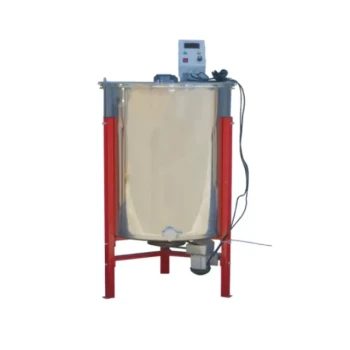
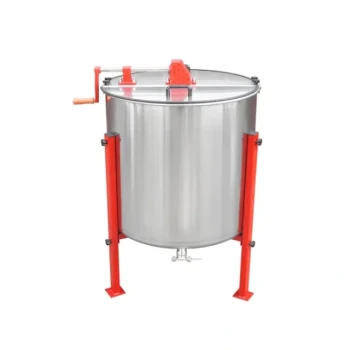
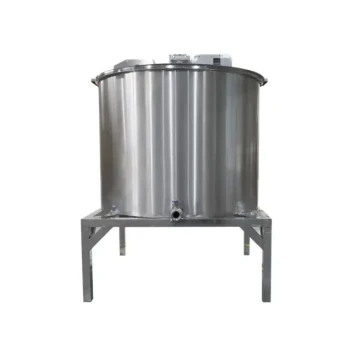
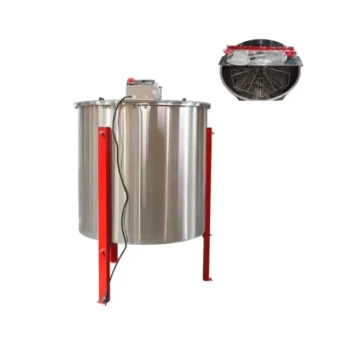
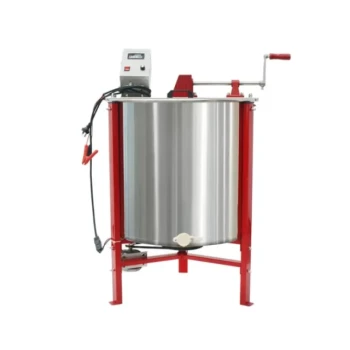
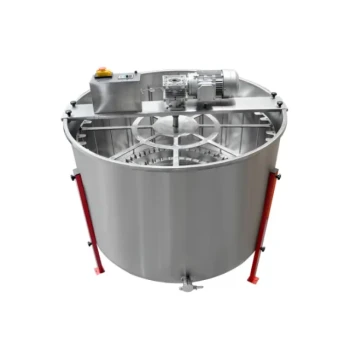
The use of a centrifugal honey extractor is mandatory with Langstroth hives because it is the only extraction method that safeguards the structural integrity of the wax comb. While traditional methods rely on crushing or squeezing the honeycomb to release the honey, the Langstroth system utilizes rigid, standardized frames that are designed to be reused rather than destroyed.
The Core Efficiency Principle The Langstroth system is engineered for high-volume production through the reuse of hive components. The centrifugal extractor is the critical tool that aligns with this philosophy, harvesting the harvestable crop (honey) while preserving the production infrastructure (wax), thereby saving the colony energy and significantly increasing annual yields.
The Mechanics of Extraction
Preserving the Wax Infrastructure
In a Langstroth hive, honey is stored within wax combs built onto movable, standardized frames. These frames provide a rigid structure that makes traditional harvesting methods, such as crushing or pressing, impractical and destructive.
Attempting to squeeze honey out of a Langstroth frame would destroy the comb. The centrifugal extractor solves this by accommodating the frame's shape and using physics, rather than pressure, to remove the honey.
Applying Centrifugal Force
The extractor functions by spinning the frames at high speeds. This generates centrifugal force, which pulls the mature honey out of the open cells and throws it against the wall of the tank.
This process empties the cells efficiently without physical contact that would warp or break the wax. The result is a clean, intact frame ready to be returned immediately to the hive.
The Economics of Bee Energy
Reducing "Recovery Time"
When a colony loses its wax comb to destructive harvesting methods, it enters a recovery cycle. The bees must divert their efforts from foraging to construction, rebuilding the storage cells from scratch.
By using an extractor, you bypass this recovery phase. The bees are presented with empty, intact combs, allowing them to focus entirely on nectar collection and honey production.
Wax Production Costs
Producing beeswax is chemically expensive for a colony. Bees consume vast amounts of honey and energy to secrete the wax scales needed to build comb.
The centrifugal extractor minimizes the need for new wax secretion. By recycling the combs, you effectively convert the energy the bees would have used on construction into surplus honey yield for the beekeeper.
Understanding the Trade-offs
Reliance on Specialized Equipment
Unlike low-tech beekeeping methods that require minimal tools (like a knife and a bucket), the Langstroth system creates a dependency on machinery. A centrifugal extractor is a specialized piece of hardware that represents a higher initial capital investment.
Maintenance and Complexity
Integrating an extractor introduces an additional step in the processing workflow. The equipment requires cleaning and maintenance to ensure hygiene. However, for most beekeepers, this operational complexity is a necessary trade-off to achieve the production efficiency that Langstroth hives are designed for.
Making the Right Choice for Your Goal
Whether you are a hobbyist or an industrial producer, the extractor is the key to unlocking the potential of the Langstroth design.
- If your primary focus is Maximum Yield: Prioritize a high-quality extractor to ensure combs are returned to the hive quickly, maximizing the nectar flow season.
- If your primary focus is Colony Health: Use the extractor to reduce the metabolic stress on your bees, as they will not need to over-consume resources to rebuild their home.
Ultimately, the centrifugal extractor is not just a tool for harvesting; it is an energy-conservation device that fuels the high-yield engine of the Langstroth system.
Summary Table:
| Feature | Centrifugal Extraction | Traditional Crushing/Pressing |
|---|---|---|
| Comb Integrity | Preserved (Ready for reuse) | Destroyed (Must be rebuilt) |
| Bee Energy Cost | Low (Focus on nectar collection) | High (Forced to secrete new wax) |
| Yield Potential | Maximum (Faster turnaround) | Lower (Delayed by recovery time) |
| Equipment Need | Specialized Extractor | Basic buckets/presses |
| Efficiency | High-volume industrial standard | Small-scale/Hobbyist focus |
Maximize Your Apiary's Productivity with HONESTBEE
Transitioning to high-efficiency honey production requires more than just skill; it requires the right industrial-grade machinery. HONESTBEE specializes in supporting commercial apiaries and distributors with a comprehensive range of beekeeping tools and hardware.
From high-performance centrifugal honey extractors that protect your valuable wax infrastructure to honey-filling machines and hive-making equipment, we provide the full spectrum of tools needed to scale your operations.
Partner with HONESTBEE to reduce colony stress and boost your annual yields. Our wholesale solutions and industry consumables are designed to give your business a competitive edge.
Contact us today to explore our wholesale catalog and expert solutions!
References
- Thomas M. Carroll, Jim Kinsella. Livelihood improvement and smallholder beekeeping in Kenya: the unrealised potential. DOI: 10.1080/09614524.2013.781123
This article is also based on technical information from HonestBee Knowledge Base .
Related Products
- electric honey extractor honey centrifuge 3 frame honey extractor stainless steel honey frame extractor
- Manual Hand Crank 4 Frame Honey Extractor Centrifuge for Beekeeping
- Professional 4 Frame Self Reversing Electric Honey Extractor for Beekeeping
- Electric 4 Frame Tangential Honey Extractor
- 24 Frame Honey Extractor Commercial Radial Honey Frame Extraction Machine
People Also Ask
- What are the characteristics of electric honey extractors? Boost Your Apiary Efficiency with Automated Technology
- What are the disadvantages of using an electric honey extractor? Weighing Cost, Power, and Comb Safety
- What are the advantages of an electric honey extractor? Boost Efficiency and Scale Your Honey Production
- What are the technical advantages of electric honey extractors? Maximize Yield and Protect Your Bee Colony
- How does an electric honey extractor affect the quality of honey? Preserve Flavor & Purity with Precision Extraction