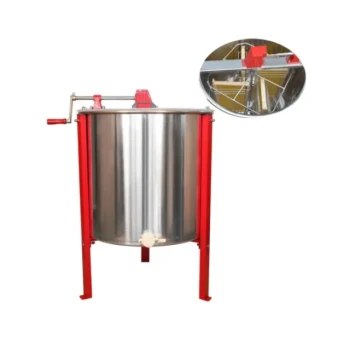
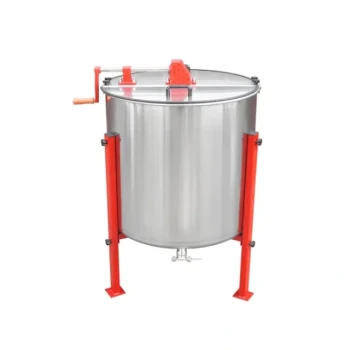
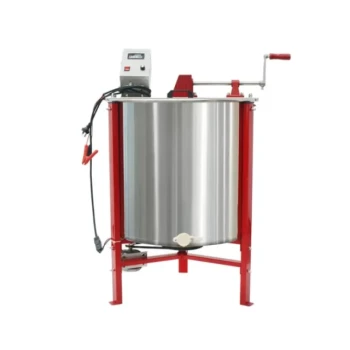
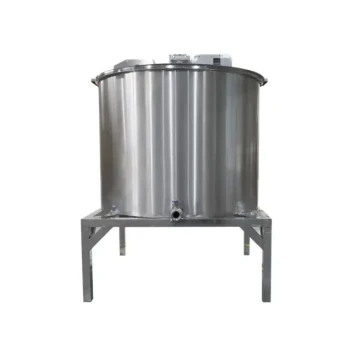
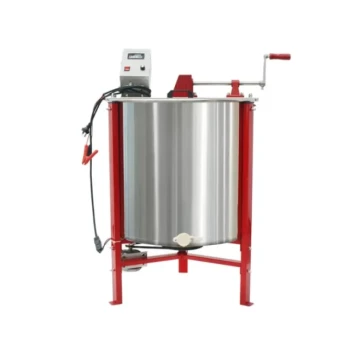
Manual honey extractors are hand-operated devices designed specifically for small-scale beekeeping operations and hobbyists. Instead of relying on a motor, these units utilize a hand crank—positioned either on the top or the side—to generate the centrifugal force necessary to spin honey out of the frames. They are typically sized to hold between two and eight frames, making them the standard choice for apiaries with limited hive counts.
Manual extractors are the most cost-effective solution for beekeepers managing fewer than ten hives, offering independence from electrical power sources at the expense of increased physical labor and slower processing times.
Design and Construction
Mechanical Operation
The defining characteristic of a manual extractor is the hand crank mechanism.
The operator manually rotates the crank to spin the internal basket. This provides a high degree of tactile feedback, allowing the beekeeper to feel the balance of the frames and adjust the speed intuitively.
Material Composition
Manual extractors are generally constructed from one of two materials: food-grade plastic or stainless steel.
Stainless steel models offer greater durability and longevity, while plastic models provide a lightweight, lower-cost entry point for beginners.
Frame Capacity and Placement
These units are compact, with a capacity designed for low-volume harvests.
Most models accommodate 2-frame, 4-frame, or 8-frame configurations. Internally, the frames can be arranged tangentially or radially, depending on the specific design of the basket.
Operational Advantages
Granular Speed Control
Because the unit is powered by hand, the operator has "very good" control over the acceleration and spinning speed.
This is particularly useful when extracting from delicate combs that might blow out (break) if spun too quickly by a high-torque motor.
Location Independence
Manual extractors do not require an electrical power source.
This allows for extraction in remote locations, field setups, or outbuildings where running extension cords would be impractical or unsafe.
Lower Financial Barrier
Manual units are significantly less expensive than their electric counterparts.
For a hobbyist or someone just starting with one or two hives, this lower price point reduces the initial capital investment required to begin harvesting.
Understanding the Trade-offs
Physical Exertion
The most significant drawback is the physical effort required.
Extracting honey manually is labor-intensive. It requires continuous arm movement to maintain the necessary centrifugal force, which can become exhausting during larger harvests.
Lower Efficiency
Manual extraction is inherently slower than electric extraction.
While an electric extractor allows a beekeeper to multitask—such as uncapping the next batch of frames while the current batch spins—a manual extractor requires the operator's full attention and physical engagement, creating a bottleneck in workflow.
Making the Right Choice for Your Apiary
If you are deciding between a manual and an electric model, consider your long-term goals and physical capabilities.
- If your primary focus is budget and small scale (<10 hives): The manual extractor is the logical choice, providing a low-cost, reliable tool that handles small harvests effectively.
- If your primary focus is efficiency or minimizing physical strain: The manual extractor may be insufficient; an electric model is better suited for streamlining operations and accommodating physical limitations.
Choose the tool that balances your budget with the reality of the physical labor you are willing to perform.
Summary Table:
| Feature | Description |
|---|---|
| Power Source | Manual hand-crank (top or side-mounted) |
| Frame Capacity | Typically 2 to 8 frames (Tangential or Radial) |
| Materials | Food-grade plastic or durable stainless steel |
| Key Advantage | High tactile speed control & location independence |
| Best Suited For | Hobbyists and small apiaries with <10 hives |
| Main Trade-off | Higher physical labor and slower processing speed |
Scale Your Beekeeping Success with HONESTBEE
Whether you are a growing commercial apiary or a global distributor, HONESTBEE provides the professional-grade tools you need to maximize your harvest. From manual extractors for boutique operations to advanced honey-filling machines and specialized hive-making hardware, we supply the full spectrum of beekeeping machinery and essential industry consumables.
Why partner with HONESTBEE?
- Comprehensive Wholesale Catalog: One-stop shop for all beekeeping equipment and tools.
- Built for Business: Durable, high-performance machinery designed for commercial use.
- Industry Expertise: Quality-tested supplies that cater to the unique needs of beekeeping professionals.
Ready to elevate your production? Contact us today to explore our wholesale offerings and discover how we can streamline your beekeeping operations!
Related Products
- Stainless Steel 3 Frame Manual Honey Extractor Spinner for Bee Honey Extraction
- HONESTBEE 4 Frame Manual Self Reversing Honey Extractor for Beekeeping
- HONESTBEE 3-Frame Manual Acrylic Honey Extractor
- Stainless Steel Manual 8 Frame Radial Honey Extractor Machine for Beehives
- 6 Frame Manual Stainless Steel Honey Extractor Beekeeping Equipment
People Also Ask
- Which type of honey extractor is generally more durable? Focus on Material & Build Quality for Longevity
- What are the disadvantages of a manual honey extractor? Overcome Efficiency Bottlenecks in Your Apiary
- What is a manual honey extractor? The Essential Guide to Cost-Effective Beekeeping for Beginners
- Why are manual extractors popular among beginner beekeepers? A Guide to Starting Simple & Saving Money
- What are the primary advantages of utilizing a manual honey extractor? Cost-Effective & Gentle Harvesting