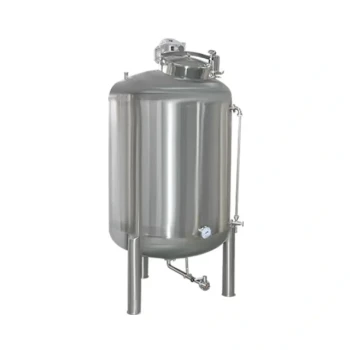
Settling and bulk storage tanks function as the primary gravity-based purification system in large-scale honey processing. These vessels hold harvested honey in a static state, allowing air bubbles and fine impurities to naturally separate from the liquid through density differences. This process is the prerequisite for achieving the transparency and uniformity needed for final filtration and commercial bottling.
By utilizing simple gravity and time, these tanks transform raw, aerated honey into a consistent, commercial-grade product. They act as a critical buffer between extraction and packaging, ensuring every batch meets strict hygiene and transparency standards without aggressive mechanical intervention.
The Mechanics of Natural Purification
Static Sedimentation
The primary function of these tanks is to facilitate static sedimentation. By allowing the honey to rest undisturbed—often for a period of approximately two weeks—impurities are separated based on density.
Separation of Debris and Air
During this resting phase, air bubbles and lighter residues, such as wax particles, naturally rise to the surface. Simultaneously, heavier fine impurities sink to the bottom, leaving the middle layer of honey clear and transparent.
Depth Filtration Preparation
This gravity-based separation acts as a preliminary processing stage. It ensures the honey reaches a uniform state before it enters industrial-grade filter tanks for final depth filtration.
Ensuring Hygiene and Stability
Creating a Closed Environment
In an industrial setting, these tanks often form part of a closed or semi-closed processing chain. This minimizes the honey's contact with the external environment, significantly reducing the risk of contamination from dust or foreign objects.
Preventing Fermentation
Properly designed tanks support rigorous hygiene protocols. When connected to a sufficient water supply, they can be thoroughly rinsed and disinfected between batches, which is vital for preventing microbial cross-contamination and honey fermentation.
Standardization for Mass Production
Batch Consistency
For cooperative marketing channels or wholesale distribution, product consistency is non-negotiable. Bulk storage tanks allow large volumes of honey to settle and homogenize, ensuring that the final bottled product is identical across the entire batch.
Transitioning to Industrial Scale
These tanks serve as the physical foundation for scaling up operations. They allow producers to move away from dispersed, traditional management toward modern, standardized industrial production capable of handling high throughput.
Operational Considerations and Trade-offs
The Cost of Time
The reliance on gravity is effective but slow. Because the static sedimentation process can take up to two weeks to achieve high purity, these tanks represent a bottleneck in the production flow that requires careful scheduling.
Space and Capital Requirements
To offset the slow processing time, large-scale centers require significant physical space to house multiple "industrial-grade" tanks. This demands a higher initial investment in hardware compared to smaller, on-demand filtration systems.
Making the Right Choice for Your Goal
When integrating settling and bulk storage tanks into your processing line, consider your specific production targets:
- If your primary focus is Product Clarity: Ensure your workflow accounts for the full two-week sedimentation period to allow all micro-bubbles and wax to rise fully before drawing off the honey.
- If your primary focus is Sanitation Standards: Prioritize tanks designed for closed-loop systems with integrated cleaning capabilities to eliminate the risk of fermentation between batches.
Ultimately, these tanks provide the necessary pause in the production line that guarantees your honey is both visually pristine and biologically stable.
Summary Table:
| Function | Description | Key Benefit |
|---|---|---|
| Static Sedimentation | Uses gravity to separate air bubbles and wax particles. | Ensures natural transparency and clarity. |
| Batch Homogenization | Stores large volumes of honey in a single vessel. | Guarantees product consistency for wholesale. |
| Hygiene Control | Provides a closed-loop environment for processing. | Minimizes contamination and prevents fermentation. |
| Pre-Filtration | Prepares honey for industrial-grade depth filters. | Protects downstream machinery from heavy debris. |
Scale Your Honey Production with HONESTBEE
Maximize your apiary's efficiency and product quality with HONESTBEE. As a premier partner for commercial apiaries and global distributors, we provide the full spectrum of industrial beekeeping solutions. From high-capacity settling tanks and automated honey-filling machines to essential consumables, our equipment is designed to transform your raw harvest into a premium, market-ready product.
Ready to upgrade your processing line? Contact us today to discuss your wholesale needs and discover how our comprehensive hardware and merchandise portfolio can drive your business growth.
References
- Nana Owusu-Ansah, Nikhil Agarwal. Apiculture and Conservation Opportunities: The Case of Sayinga-Kasena-Gavara-Kara. DOI: 10.5281/zenodo.3951599
This article is also based on technical information from HonestBee Knowledge Base .
Related Products
- Stainless Steel Honey Storage and Settling Tank with Double Strainer
- Heavy Duty Stainless Steel Honey Processing Machine Decrystallizing Tank
- Stainless Steel Honey Storage Tank with Lid for Honey
- Professional Honey Storage Tank with Agitation System
- Stainless Steel Uncapping Tank with Stand and Strainer
People Also Ask
- What economic role do honey storage tanks play? Boost Your Revenue Through Strategic Inventory Management
- What roles do industrial honey storage tanks and filtration meshes play in processing? Ensure Purity & Consistency
- What is the purpose of a honey storage tank? Streamline Your Honey Processing for Quality & Efficiency
- What role do settling tanks play in honey production? Achieve Pure, High-Clarity Honey Naturally
- Why are large settling tanks used in the honey clarification process? Achieve Natural Purity & Batch Consistency