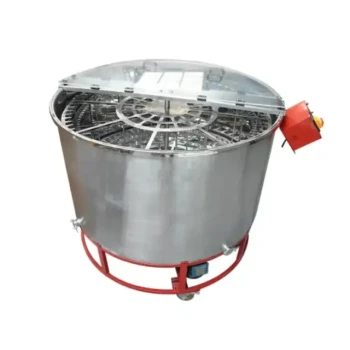
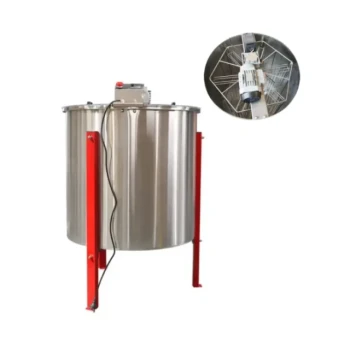
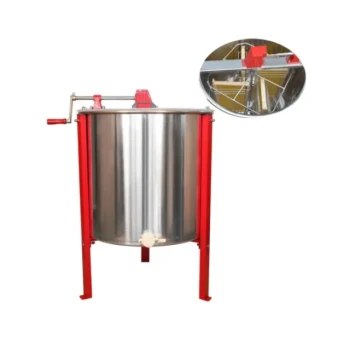
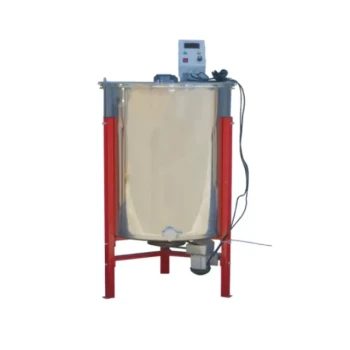
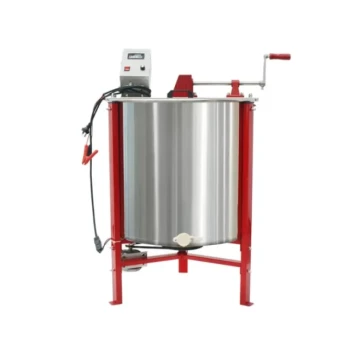
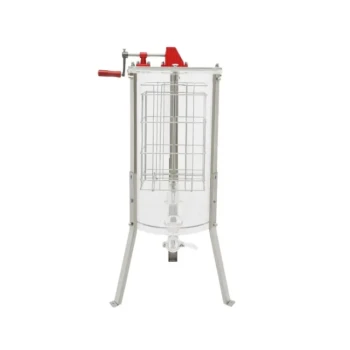
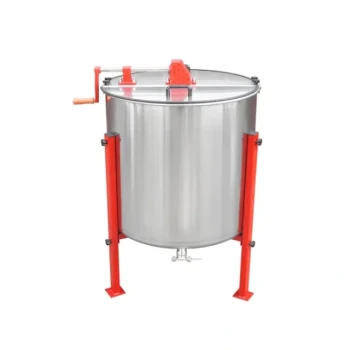
The key choice is workflow versus simplicity: radial extractors orient frames like wheel spokes and extract both comb faces without manual flipping, while tangential extractors place frames against the basket wall and normally require stopping and turning each frame. Radial units generally provide higher throughput, lower handling labor, and better comb support; tangential units usually offer lower purchase cost, smaller capacity, and slightly stronger extraction from each positioned comb face.
Choose radial equipment for volume, speed, and reduced labor; choose tangential equipment for lower initial investment, smaller apiaries, or operations where manual frame handling is acceptable. In both cases, prioritize food-contact-compliant construction, suitable frame compatibility, safe operating controls, and dependable after-sales support.
How the Two Extractor Designs Work
Radial frame positioning
In a radial extractor, frames are arranged like spokes around a central spindle, with the top bars generally facing outward toward the drum wall.
During rotation, centrifugal force draws honey from both sides of each comb without requiring the operator to remove and flip the frames. Some models may also use controlled reverse rotation, but manual turning is not normally part of the process.
Tangential frame positioning
In a tangential extractor, each frame is positioned with one comb face toward the outer wall of the basket.
The operator typically extracts one side, stops the machine, removes or turns the frames, and then extracts the reverse side. Motorized reversing cages can reduce this labor, but they add complexity and cost.
Why orientation affects productivity
The difference is not merely mechanical. It determines how many handling steps occur in every extraction cycle.
Radial equipment keeps the operator focused on loading, unloading, and transferring frames. Tangential equipment adds a repeated stop-and-flip procedure, which becomes increasingly costly as colony count and harvest volume grow.
Capacity, Throughput, and Labor
Radial extractors for higher-volume operations
Radial extractors commonly accommodate substantially more frames per cycle than comparable tangential units. Commercial models may range from approximately 8 frames to more than 80, depending on the basket design and frame format.
Higher capacity reduces the number of cycles required during harvest. The combination of larger batch size and no manual flipping makes radial equipment particularly suitable for commercial apiaries, contract extraction, and centralized processing facilities.
Tangential extractors for smaller operations
Tangential units are commonly found in compact, low-capacity machines, including hand-cranked models holding roughly 2 to 4 frames.
They can be practical for hobbyists, small apiaries, seasonal producers, or buyers whose priority is a lower entry price rather than maximum throughput.
Labor is a procurement cost
A lower equipment price does not necessarily mean a lower operating cost. With tangential extraction, labor is required to stop the machine and turn frames during each cycle.
For distributors and commercial buyers, the evaluation should therefore include total cost of ownership: purchase price, operator time, expected harvest volume, maintenance, spare parts, and likely capacity expansion.
Comb Protection and Extraction Performance
Radial systems generally reduce comb stress
Radial positioning distributes the extraction forces across the frame structure rather than pressing one broad comb face directly toward the basket wall.
This generally reduces mechanical strain and the risk of comb blowout, especially when the extractor is operated with an appropriate speed ramp and the comb is properly supported.
Tangential systems apply more direct force
Tangential extractors exert stronger direct force on the comb face positioned toward the outer wall.
This can increase the risk of comb damage, particularly with new, soft, poorly wired, or inadequately supported comb. Operators should begin at low speed and increase gradually rather than immediately running at maximum rotation.
Honey viscosity matters
Tangential extraction can be useful where stronger direct extraction from a single face is valuable, including some operations handling more viscous honey. However, performance depends on honey temperature, moisture content, frame condition, speed control, and the specific basket design.
No extractor type automatically guarantees better yield for every honey. Product trials or supplier guidance are worthwhile when processing unusually viscous honey or delicate comb.
Equipment Construction and Operating Features
Food-contact materials
Commercial honey equipment should be made from food-grade stainless steel or compliant food-grade plastic.
Stainless steel is usually preferred for durability, corrosion resistance, cleaning, and long service life. Older tin-plated equipment may not satisfy current commercial food-contact expectations, so buyers should verify applicable regulations and supplier documentation rather than relying only on the product description.
Bottom honey gate
A properly positioned honey gate at the bottom of the tank allows extracted honey to drain efficiently and limits accumulation during operation.
For high-throughput facilities, valve accessibility and compatibility with collection containers or downstream filtration equipment are important practical considerations.
Drive and speed control
Electric drives improve throughput and reduce operator fatigue, particularly for radial machines with larger baskets. Variable-speed control is valuable because frames should generally be started gently before higher speeds are applied.
Manual or hand-cranked tangential machines remain useful where electricity is unavailable, harvest volume is limited, or purchase simplicity is the priority.
Bearings and service access
Accessible bearings and a serviceable drive system support long-term reliability. Bearings should be maintained according to the manufacturer’s instructions using suitable food-grade bearing grease where applicable.
For B2B procurement, confirm the availability of replacement bearings, belts, motors, controllers, valves, and baskets before committing to a large order.
Frame compatibility
Capacity claims are meaningful only when the extractor matches the frames used by the apiary.
Before purchasing or reselling equipment, verify compatibility with the customer’s frame dimensions, number of frames, top-bar configuration, and any special frame supports. A high-capacity extractor that requires extensive adapters may not deliver its advertised productivity.
Understanding the Trade-offs
Radial advantages and limitations
Radial extractors provide higher capacity, fewer handling steps, and lower labor intensity. They are often the stronger choice for commercial or expanding apiaries.
Their limitations include a higher initial price, greater physical size, more demanding transport and installation, and potentially more complex drive or control systems.
Tangential advantages and limitations
Tangential extractors are often more affordable and compact. Their straightforward design can suit small producers and buyers who value basic operation and lower upfront investment.
The trade-off is lower throughput, more operator involvement, and greater potential comb stress. Manual frame turning also increases cycle time and can become a bottleneck during a concentrated harvest.
Avoid comparing only frame count
A frame-capacity number alone does not determine output. A tangential extractor may hold fewer frames but can extract strongly from each active face, while a radial extractor may process more frames with fewer labor steps.
Compare usable throughput, including loading time, spinning time, frame turning, unloading, draining, cleaning, and operator availability.
Do not overlook service and fulfillment
For distributors and wholesalers, technical specifications are only part of the buying decision. Reliable stock availability, rapid quotation response, spare-parts support, documentation, and efficient order fulfillment directly affect customer satisfaction.
A supplier with a full product range can also help match extractors with uncapping equipment, filters, settling tanks, pumps, replacement parts, and other apiary-processing equipment.
Making the Right Choice for Your Goal
The best selection depends on harvest volume, available labor, frame type, budget, and expected growth.
- If your primary focus is high-volume commercial extraction: Choose a high-capacity radial extractor with variable-speed control, robust stainless-steel construction, and readily available replacement parts.
- If your primary focus is minimizing initial investment: Choose a compact tangential extractor, provided the operator can accommodate manual frame turning and lower cycle throughput.
- If your primary focus is protecting valuable or fragile comb: Favor a well-supported radial design with gradual speed control, while confirming frame compatibility and operating procedures.
- If your primary focus is processing viscous honey: Evaluate tangential and radial models through supplier guidance or trials, considering honey viscosity, temperature control, speed range, and drainage performance.
- If your primary focus is resale and reliable customer service: Source from a supplier offering a broad equipment portfolio, responsive technical support, documented food-contact materials, spare parts, and fast order fulfillment.
Selecting the right extractor means matching the machine’s workflow and serviceability to the apiary’s real operating volume—not simply choosing the largest or least expensive model.
Summary Table:
| Feature | Radial Extractor | Tangential Extractor |
|---|---|---|
| Frame Orientation | Spokes around central spindle | Against basket wall |
| Frame Turning | Not required | Usually required |
| Capacity | Higher (8-80+ frames) | Lower (2-4 frames typical) |
| Throughput | Higher | Lower |
| Labor Intensity | Lower | Higher |
| Comb Stress | Generally lower | Higher risk |
| Initial Cost | Higher | Lower |
| Ideal For | Commercial, high-volume | Hobbyists, small-scale |
Ready to enhance your honey extraction efficiency? At HONESTBEE, we offer a comprehensive range of radial and tangential extractors to suit every scale. Our wholesale solutions include top-quality food-grade stainless steel equipment, fast delivery, and dedicated support. Contact us today for a personalized quote and discover how our one-stop sourcing can boost your productivity and profitability. Get in touch now.
Related Products
- HONESTBEE 72 Frame Industrial Electric Honey Extractor for Beekeeping
- Commercial Electric 12 Frame Honey Extractor Spinner Motorized Honey Extractor
- HONESTBEE 6 Frame Self Reversing Electric Honey Extractor for Beekeeping
- HONESTBEE 3-Frame Manual Acrylic Honey Extractor
- Stainless Steel Manual 8 Frame Radial Honey Extractor Machine for Beehives
People Also Ask
- What is the importance of balancing honeycomb frames within a honey extractor? Ensure Stability and Protect Machinery
- How is honey separated from the frames after they are uncapped? Efficient Extraction Methods for High Yields
- What are the main benefits of using a honey extractor? Maximize Yields and Protect Your Honeycomb
- What are the recommended methods for removing honey from the honeycomb? Top Extraction Techniques for Maximum Efficiency
- How do manual honey extractors compare to electric honey extractors? Choosing the Right Tool for Your Apiary Growth