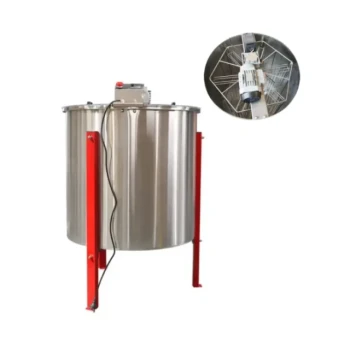
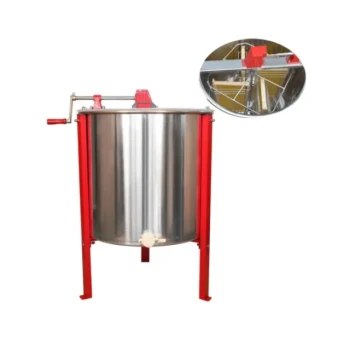
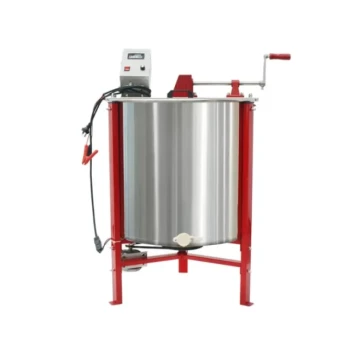
The fundamental difference lies in the power source used to generate centrifugal force. Motorized extractors utilize an electric engine to spin the honey frames automatically, while mechanical (or manual) extractors rely on a hand crank operated physically by the beekeeper. Despite this difference in propulsion, both devices function on the exact same mechanical principle, requiring balanced frames within a cylindrical barrel to effectively drain honey.
The choice between motorized and mechanical extractors is ultimately a trade-off between capital investment and physical labor. Motorized units cost more but streamline production, while mechanical units are cost-effective but require significant time and physical exertion.
The Mechanics of Operation
The Motorized Approach
Motorized extractors replace human effort with an electric engine. This allows the device to spin the internal basket at consistent speeds without manual intervention.
The Mechanical Approach
Mechanical extractors are purely manual tools. You must turn a hand crank to generate the necessary speed to spin the frames, giving you direct, tactile control over the extraction speed but requiring constant physical input.
The Shared Principle
Regardless of the power source, the extraction physics remain identical. Both types rely on centrifugal force to pull liquid honey out of the comb and onto the inner wall of the drum.
Efficiency and Workflow Implications
Speed and Consistency
Motorized extractors offer superior consistency. Because the engine maintains a steady RPM, they ensure fast results and maximize yield by extracting every drop of honey without the variances caused by human fatigue.
The Physical Toll
Manual extractors demand significant physical effort. For a hobbyist with only a few hives, this is manageable, but spinning frames by hand for hours becomes exhausting and time-consuming as hive counts increase.
Scale of Production
Motorized units are designed to boost productivity and reduce labor, making them essential for commercial operations. Manual units are optimized for cost-effectiveness rather than speed, making them ideal for small-scale beekeepers.
Understanding the Trade-offs
Cost vs. Time
The primary trade-off is financial cost versus time cost. Manual extractors save you money upfront but "charge" you in hours spent cranking. Motorized extractors require a higher initial budget but pay dividends in saved time and reduced labor during the harvest.
Complexity and Maintenance
Mechanical extractors are simple machines with fewer parts to break. Motorized extractors introduce electrical components and engines, which naturally require more maintenance and have a higher potential for technical failure over time.
Don't Confuse Power with Orientation
It is critical not to confuse the power source with the style of extraction. Whether you choose motorized or mechanical, the internal basket will generally be either Radial or Tangential.
- Tangential: Frames face the wall; one side is spun, then frames must be flipped.
- Radial: Frames face the center; both sides are extracted simultaneously.
- Note: Both styles are available in manual and motorized versions.
Making the Right Choice for Your Apiary
The "best" extractor is entirely dependent on the scale of your operation and your budget.
- If your primary focus is budget or small-scale hobbyist beekeeping: A mechanical (manual) extractor is the logical choice, offering a cost-effective way to harvest honey where time constraints are not a major factor.
- If your primary focus is volume, efficiency, or commercial production: A motorized extractor is a necessary investment to ensure consistent yield, preserve honey quality, and drastically reduce the labor required per hive.
Select the tool that matches not just your current hive count, but your willingness to perform physical labor during the harvest season.
Summary Table:
| Feature | Motorized Extractor | Mechanical (Manual) Extractor |
|---|---|---|
| Power Source | Electric Engine | Manual Hand Crank |
| Physical Labor | Minimal (Automatic) | High (Manual exertion required) |
| Speed & Consistency | High & Steady RPM | Variable (Depends on operator) |
| Ideal Scale | Commercial & Large Apiaries | Hobbyists & Small-scale |
| Initial Cost | Higher Investment | Cost-effective |
| Maintenance | Requires electrical upkeep | Simple mechanical maintenance |
Scale Your Honey Production with HONESTBEE
Whether you are a growing distributor or a high-volume commercial apiary, HONESTBEE provides the professional-grade machinery you need to maximize efficiency. From high-capacity motorized honey-filling machines to a comprehensive range of beekeeping tools and hive-making equipment, we supply everything required to streamline your workflow.
Why partner with HONESTBEE?
- Wholesale Excellence: Full spectrum of beekeeping hardware and essential industry consumables.
- Commercial Reliability: Durable machinery designed for heavy-duty honey production.
- End-to-End Solutions: From specialized hardware to unique honey-themed cultural merchandise.
Contact our experts today to discover how our wholesale offerings can enhance your apiary's productivity and value.
Related Products
- HONESTBEE 72 Frame Industrial Electric Honey Extractor for Beekeeping
- Commercial Electric 12 Frame Honey Extractor Spinner Motorized Honey Extractor
- HONESTBEE 3-Frame Manual Acrylic Honey Extractor
- electric honey extractor honey centrifuge 3 frame honey extractor stainless steel honey frame extractor
- HONESTBEE 6 Frame Self Reversing Electric Honey Extractor for Beekeeping
People Also Ask
- What is the importance of balancing honeycomb frames within a honey extractor? Ensure Stability and Protect Machinery
- How is honey separated from the frames after they are uncapped? Efficient Extraction Methods for High Yields
- What are the main benefits of using a honey extractor? Maximize Yields and Protect Your Honeycomb
- What are the recommended methods for removing honey from the honeycomb? Top Extraction Techniques for Maximum Efficiency
- How do manual honey extractors compare to electric honey extractors? Choosing the Right Tool for Your Apiary Growth