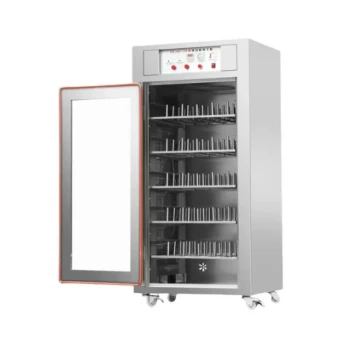
For commercial pollen drying, use heated forced air at approximately 45°C (113°F) and dry the pollen to a final moisture content of 2.5% to 6%. Freshly collected pollen should be frozen overnight before drying to eliminate wax moths and their eggs. Chemical fumigants must not be used because they can contaminate the pollen.
The essential process is freeze first, then dry gently and measure accurately: pre-treat fresh pollen by overnight freezing, use controlled forced air without exceeding the recommended heat limit, and stop drying when moisture reaches the range required for stable commercial storage.
Recommended Operating Parameters
Drying Temperature
For forced-air commercial pollen drying equipment, set the heated dry air to approximately 45°C (113°F).
This temperature provides enough heat to remove moisture efficiently while limiting the risk of damaging pollen’s sensitive nutritional components. The equipment should distribute dry air consistently throughout the pollen bed rather than creating localized hot spots.
Target Moisture Content
The recommended final moisture range is 2.5% to 6%.
Freshly harvested pollen commonly contains 7% to 21% moisture, so the drying process must remove enough water to prevent fermentation, spoilage, and deterioration during packaging and distribution.
Why Moisture Accuracy Matters
Pollen that remains too moist can support fermentation, mold, bacterial activity, and insect development. Pollen that reaches the correct moisture range is more stable and suitable for airtight packaging and commercial handling.
Moisture should be measured with suitable equipment rather than estimated from drying time alone. Batch size, pellet size, airflow, and initial moisture all affect the time required.
How to Pre-Treat Fresh Pollen
Freeze the Pollen Overnight
Freshly collected pollen should be placed in a freezer overnight before thermal drying. This treatment is intended to eliminate wax moths and wax moth eggs that may be present in the harvested material.
For pollen that cannot be dried immediately, freezing also provides a practical preservation option until processing can begin.
Do Not Use Chemical Fumigants
Chemical fumigants must never be used to control wax moths or their eggs in pollen intended for food, feed, or commercial distribution.
Fumigant residues can contaminate the product and compromise its food-grade status. Freezing is the appropriate non-chemical pre-treatment described for this process.
Move Promptly to Drying
Fresh pollen should be processed without unnecessary delay because its relatively high initial moisture content makes it vulnerable to fermentation and deterioration.
After freezing, transfer the pollen to the drying equipment and begin controlled moisture removal. Avoid exposing it to direct sunlight or ultraviolet radiation, which can reduce the quality of sensitive nutrients.
Managing Heat Sensitivity
Treat 45°C as the Upper Operating Limit
The primary commercial drying recommendation is approximately 45°C, but the process should not exceed this temperature in conventional thermal drying.
Excessive heat can degrade sensitive proteins, essential amino acids, and enzymes. Temperature control should therefore be based on the actual product and air temperature, not only the equipment’s nominal setting.
Use Lower Temperatures When Nutrient Preservation Dominates
For applications such as hive feed or products where maximum nutrient preservation is the priority, supplementary guidance recommends keeping the drying temperature at or below approximately 37.8°C (100°F).
This lower setting may require more drying time and tighter control of airflow and moisture measurement. It should not be confused with the primary commercial target of 2.5% to 6% moisture.
Consider Vacuum Drying Only With Suitable Equipment
Vacuum drying is an alternative process described at approximately 65°C and 45 mm Hg. These settings apply to vacuum conditions and should not be transferred to ordinary forced-air dryers.
Vacuum drying requires equipment specifically designed to control pressure, temperature, and product exposure. For standard commercial forced-air machinery, the practical limit remains approximately 45°C.
Verifying Dryness Before Packaging
Use Moisture Measurement
The final decision to stop drying should be based on measured moisture content. The target for the commercial process is 2.5% to 6%, while a broader food-quality objective is to reduce moisture below 10%.
The lower primary-reference range provides a stronger margin against fermentation and spoilage during storage and distribution.
Use a Physical Check as a Secondary Indicator
Dried pollen pellets should no longer stick together when squeezed. This check can help identify obviously wet material, but it is not a substitute for an accurate moisture measurement.
Package Immediately After Drying
Dried pollen can reabsorb moisture from the surrounding air. Once the target moisture level is reached, seal the product promptly in airtight packaging such as heavy-duty polythene bags, metal containers, or glass containers.
Storage should be cool and dry. Delays between drying and sealing can undermine the moisture target achieved inside the dryer.
Understanding the Trade-offs
Higher Heat Shortens Processing Time
Operating near 45°C can accelerate moisture removal and improve throughput for commercial orders. However, higher temperatures increase the need for accurate controls because excessive heat can reduce nutritional quality.
Lower Heat Protects Nutrients but Reduces Throughput
Operating at or below 37.8°C may better protect heat-sensitive components, particularly for hive-feed applications. The trade-off is longer drying time and potentially lower daily capacity.
Very Low Moisture Improves Stability but Requires Control
Reducing moisture to 2.5% to 6% provides strong protection against fermentation and spoilage. Over-drying may consume additional energy and processing time, so the operator should stop based on measured moisture rather than an arbitrary extended cycle.
Inconsistent Airflow Creates Uneven Batches
Pollen at the center, edges, or lower layers of a drying bed may dry at different rates if airflow is uneven. Commercial equipment should be loaded consistently, and operators should verify representative samples from across the batch.
Making the Right Choice for Your Goal
Select the operating approach according to the product’s intended use, nutrient priorities, and distribution requirements.
- If your primary focus is commercial stability and long-distance distribution: Use controlled forced air at approximately 45°C and dry to a measured moisture content of 2.5% to 6% before immediate airtight packaging.
- If your primary focus is nutrient preservation for hive feed: Use a drying temperature no higher than approximately 37.8°C and allow additional processing time to achieve the required measured moisture level.
- If your primary focus is rapid, high-volume fulfillment: Choose equipment with reliable temperature regulation, even airflow, and moisture measurement so throughput does not come at the expense of uneven or unsafe drying.
- If your primary focus is food-grade pest control: Freeze freshly collected pollen overnight and exclude chemical fumigants from the process entirely.
With overnight freezing, controlled heat, verified moisture, and immediate airtight packaging, commercial operators can produce pollen that is safer, more stable, and better suited to reliable distribution.
Summary Table:
| Parameter | Recommended Value |
|---|---|
| Drying Temperature | ~45°C (113°F) |
| Final Moisture Content | 2.5% - 6% |
| Pre-treatment | Freeze overnight |
| Pest Control | Freezing (no chemical fumigants) |
| Alternative Low Temp | ≤37.8°C (100°F) |
| Vacuum Drying | 65°C, 45 mm Hg (specialized) |
Ensure your commercial pollen drying process meets the highest standards of quality and safety. At HONESTBEE, we supply the full spectrum of beekeeping equipment, including advanced drying machinery that ensures precise temperature control and consistent results. Our one-stop sourcing solutions cater to commercial apiaries and distributors, offering rapid response, dedicated support, and ultra-fast delivery. Contact us today to discuss your equipment needs and boost your operational efficiency!
Related Products
- Heavy-Duty Ergonomic Stainless Steel Pollen Shovel
- Heavy-Duty Ergonomic Grip Galvanized Pollen Shovel
- High Quality Honey Dehumidifier Dryer Thickening Machine for Beekeeping
- 0.5T Capacity Honey Dehumidifier Dryer with Vacuum Heating and Thickening Filtering Machine
- Plastic Bee Pollen Trap Strips Comb Catcher Collector
People Also Ask
- How is pollen cleaned after it has been dried? Master Efficient Separation for Pure Bee Pollen
- What methods are used to clean harvested bee pollen? Scale Your Beekeeping Operations with the Right Technique
- How can harvested bee pollen be cleaned to remove impurities? Efficient Methods for Commercial and Hobbyist Beekeepers
- How do bee pollen collection tools affect the quality of bee pollen used in functional dairy ice cream production?
- What is the technical significance of using specialized cutting tools for propolis? Master Precision Pollen Harvesting