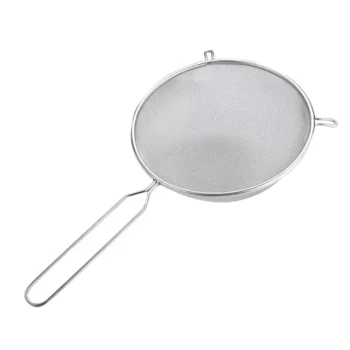
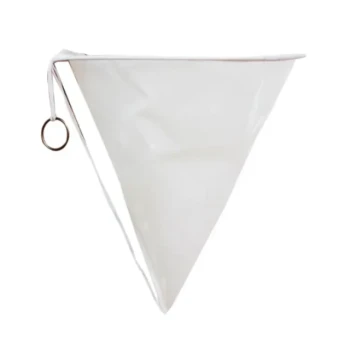
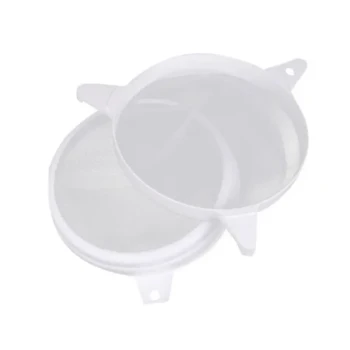
For hobbyist beekeepers, the standard honey filter mesh sizes are typically 200, 400, and 600 microns. These specific measurements refer to the diameter of the individual holes within the filter mesh, which dictates the level of clarity and the speed at which honey can pass through the screen.
Core Insight: The use of distinct mesh sizes—200, 400, and 600 microns—allows beekeepers to customize their filtration process. Selecting the right size is a balance between achieving visual clarity and maintaining a manageable flow rate.
Understanding Micron Ratings
Defining the Measurement
In the context of honey filtration, the "micron" rating refers directly to the diameter of the holes in the mesh.
The Inverse Relationship
It is critical to understand the relationship between the number and the hole size.
A lower number (e.g., 200 microns) indicates a finer mesh with smaller holes, resulting in higher filtration.
A higher number (e.g., 600 microns) indicates a coarser mesh with larger holes, allowing more material to pass through.
The Standard Sizes Explained
600 Microns (Coarse)
This is the largest standard mesh size used in non-commercial applications.
It is typically used for rapid filtration to remove large debris, such as wax cappings or bee parts, without significantly impeding the flow of the honey.
400 Microns (Medium)
The 400-micron filter serves as a middle ground for general use.
It captures smaller particulate matter that passes through a coarse screen but is less prone to clogging than the finest options.
200 Microns (Fine)
This is the finest standard mesh available for hobbyists.
It is designed to produce a very clear product by removing fine particles, but it requires the most patience due to the restricted flow.
Operational Trade-offs
Impact on Flow Rate
The primary trade-off when selecting a filter is speed.
A 600-micron filter allows honey to flow quickly, making it ideal for processing larger batches rapidly. Conversely, a 200-micron filter creates significant resistance, slowing the process considerably.
Clogging Risks
Finer filters are much more susceptible to clogging.
If you attempt to put raw, unfiltered honey directly through a 200-micron screen, the wax and debris will likely block the mesh almost immediately.
Making the Right Choice for Your Goal
Depending on your specific requirements for the final product, you should select your filter size accordingly:
- If your primary focus is processing speed: Utilize the 600-micron filter to quickly remove large debris without bottling up your workflow.
- If your primary focus is maximum clarity: Use the 200-micron filter, ideally as a final step after pre-filtering with a coarser mesh to prevent clogging.
- If your primary focus is a general balance: The 400-micron filter offers a compromise, providing decent clarity while maintaining a reasonable flow rate.
Filtration is less about sanitation and more about the texture and presentation of your final harvest.
Summary Table:
| Mesh Size (Microns) | Grade | Particle Removal | Flow Rate | Best Use Case |
|---|---|---|---|---|
| 600 Microns | Coarse | Large debris (wax, bee parts) | Very Fast | Initial rapid filtration |
| 400 Microns | Medium | Mid-sized particulates | Moderate | General-purpose filtering |
| 200 Microns | Fine | Fine particles & pollen | Slow | Final polishing for maximum clarity |
Elevate Your Honey Quality with HONESTBEE
At HONESTBEE, we understand that professional-grade filtration is key to a premium honey product. We cater specifically to commercial apiaries and distributors, providing a comprehensive wholesale range of high-performance beekeeping tools and industrial machinery.
Whether you need precision honey-filling machines to streamline your production or bulk supplies of specialized hardware and consumables, our portfolio is designed to maximize your efficiency and market appeal. From hive-making equipment to honey-themed cultural merchandise, we are your all-in-one industry partner.
Ready to scale your beekeeping operation? Contact us today to discover how our wholesale solutions can drive your business forward!
Related Products
- Professional Stainless Steel Honey Filtering Machine with Water Bath Heating for Beekeeping
- Electric Double Wall Honey Filtering Machine Purifier Equipment for Honey Processing Plant
- Professional Stainless Steel Honey Filter with Support Handle
- Professional Honey Filter with Tripod Support Stand
- Professional Cone-Shaped Honey Filter with Reinforced Steel Ring
People Also Ask
- What is the best way to filter honey? A Guide to Quality, Clarity, and Raw Preservation
- Why do people filter honey? For Clarity, Stability, and Consumer Appeal
- Is it necessary to filter honey after extraction? A Guide to Straining vs. Raw Honey
- Why is filtering honey an important step in honey processing? Ensure Purity, Clarity & Marketability
- What are the benefits of using honey filters? Achieve Purity, Efficiency, and Market Appeal