
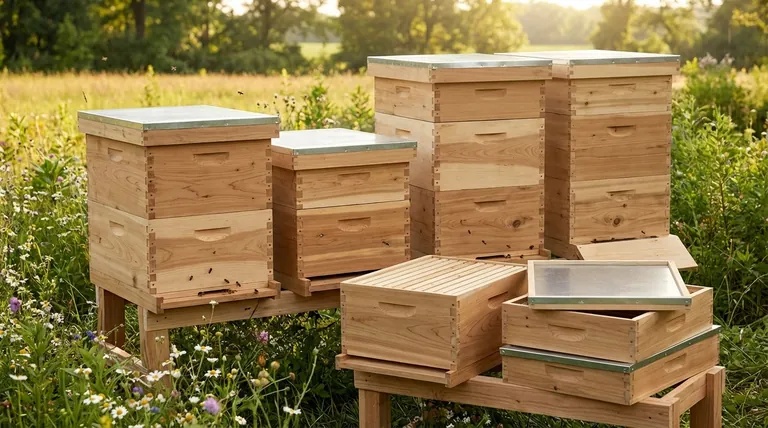
At its core, a Langstroth hive has two standard widths and three standard depths. The widths are 10-frame, the traditional standard, and 8-frame, a lighter and more modern alternative. For each width, there are three common box depths: deep, medium, and shallow. These components are used interchangeably to house the bee colony and store honey.
The choice of hive size is the fundamental trade-off every beekeeper makes between maximizing honey production capacity and minimizing the physical weight they need to lift.
The Two Standard Widths: 10-Frame vs. 8-Frame
The width of the hive determines its overall capacity and weight. This is the first and most important decision, as components of different widths are not compatible.
The 10-Frame Standard
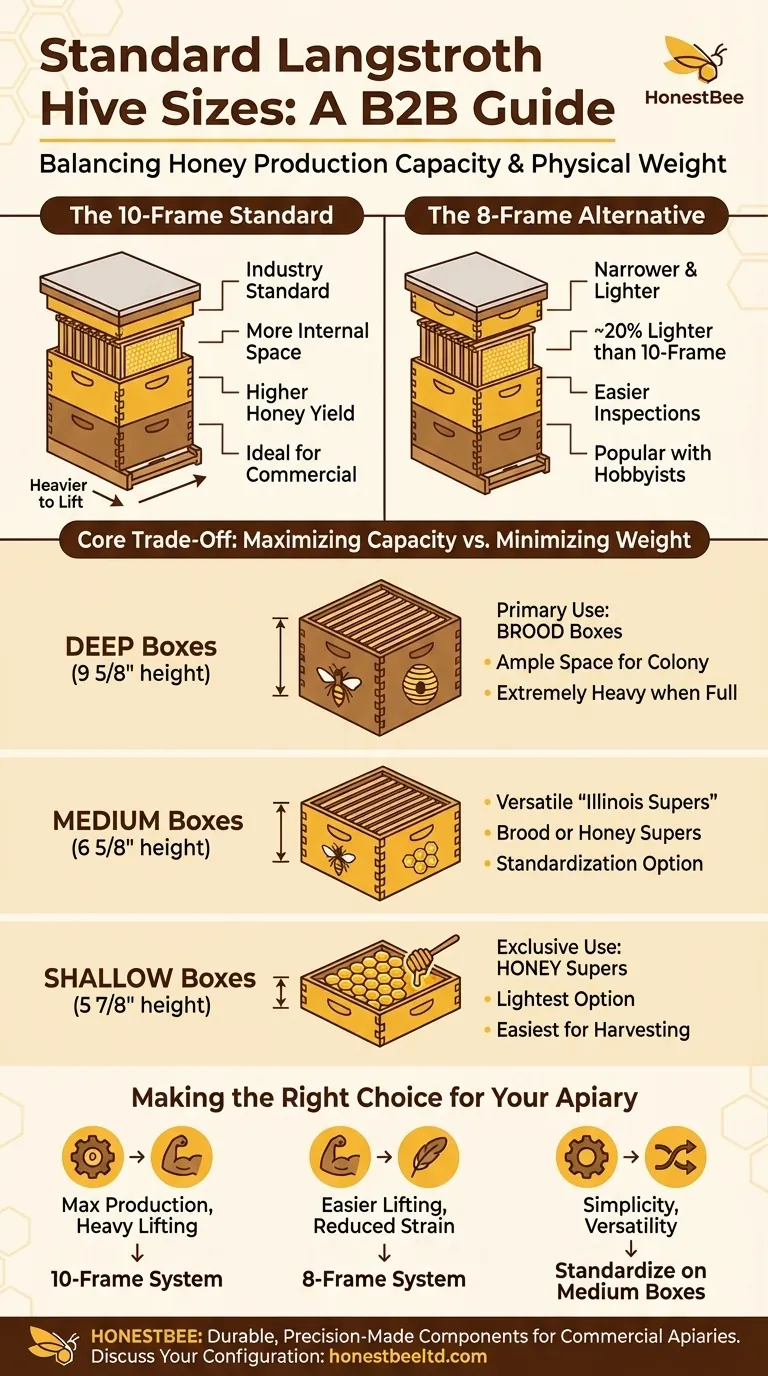
The 10-frame hive is the long-standing industry standard, originally designed by L.L. Langstroth. It offers more internal space for the colony to expand.
This larger size translates to a higher potential honey yield per box, making it a common choice for commercial or production-focused operations.
The 8-Frame Alternative
The 8-frame hive is a narrower, more compact version that has gained significant popularity, especially among hobbyist beekeepers.
Its primary advantage is reduced weight. A full 8-frame box is roughly 20% lighter than its 10-frame equivalent, making inspections and honey harvesting much more manageable.
The Three Standard Depths: Function and Purpose
While hive width must be consistent, you can mix and match box depths on a single hive. Each depth is optimized for a specific role within the colony.
Deep Boxes (9 5/8" height)
These are most commonly used as brood boxes—the area where the queen lays her eggs and the colony raises new bees.
Their large volume provides ample space for a strong queen to develop a robust brood nest. A full deep box can be extremely heavy.
Medium Boxes (6 5/8" height)
Often called "Illinois Supers," medium boxes are the most versatile. They can be used for either brood or as honey supers (boxes for storing surplus honey).
Many beekeepers choose to standardize their entire operation on medium boxes for simplicity, as every box and frame is interchangeable.
Shallow Boxes (5 7/8" height)
Shallow boxes are used almost exclusively as honey supers.
They are the lightest option, which is a major advantage when lifting boxes full of dense, heavy honey.
Understanding the Trade-offs
Choosing a hive configuration is about balancing competing priorities. There is no single "best" size, only the best size for your specific goals and physical capabilities.
Weight vs. Capacity
This is the central conflict. A 10-frame deep box full of honey can weigh over 80 pounds (36 kg), a significant challenge for many people to lift safely.
An 8-frame medium super, by contrast, might weigh around 40-50 pounds (18-23 kg). You sacrifice per-box capacity for a much more manageable weight.
Standardization and Compatibility
Consistency is key to efficient beekeeping. You cannot place an 8-frame box on a 10-frame hive; the dimensions are incompatible.
For this reason, it is crucial to choose either 8-frame or 10-frame and stick with it for all your hives. This ensures all your boxes, lids, and bottom boards will work together.
Making the Right Choice for Your Apiary
Your decision should be guided by your primary objective as a beekeeper.
- If your primary focus is maximizing honey production and you can comfortably lift heavy weights: The 10-frame system is the traditional and most productive choice.
- If your primary focus is easier lifting and reduced physical strain: The 8-frame system is an excellent, modern alternative that makes beekeeping more accessible.
- If your primary focus is simplicity and versatility: Consider standardizing your entire apiary on medium-depth boxes (in either 8 or 10-frame width) for both brood and honey.
Ultimately, the best hive is the one you can manage effectively and safely for years to come.
Summary Table:
| Standard Size | Width (Frames) | Common Depth(s) | Primary Use & Key Characteristic |
|---|---|---|---|
| 10-Frame | 10 Frames | Deep (9 5/8"), Medium (6 5/8"), Shallow (5 7/8") | Industry standard; maximizes honey yield per box; heavier weight. |
| 8-Frame | 8 Frames | Deep (9 5/8"), Medium (6 5/8"), Shallow (5 7/8") | Lighter alternative; easier to lift; ideal for hobbyists managing physical strain. |
Ready to build a more efficient and productive apiary?
Choosing the right hive boxes is a critical decision that impacts your workflow and honey yield for years to come. At HONESTBEE, we supply durable, precision-made Langstroth hive components to commercial apiaries and beekeeping equipment distributors through our wholesale-focused operations.
We can help you standardize your operation with the right mix of 8-frame or 10-frame boxes and depths to optimize your honey production and beekeeper safety.
Contact our wholesale team today to discuss your hive configuration needs and request a quote.
Visual Guide
Related Products
- High-Performance Langstroth Bee Hives for Global Professional Beekeeping
- Australian Langstroth Beehive Boxes for Beekeeping Wholesales
- Langstroth Honey Bee Box Hive Boxes for Different Depths
- 5 Frame Langstroth Poly Nuc Corrugated Plastic Nuc Boxes
- Solid Bottom Board Australian Pine Wood Langstroth Bottom Board for Wholesale
People Also Ask
- What are the structural and yield differences between traditional primitive beehives and modern standard wooden hives (such as Langstroth hives) for commercial honey producers? Discover why modern hives boost yield and efficiency.
- Why is the adoption of modern movable-frame hives, such as Langstroth hives, advantageous over traditional hive equipment for commercial apiaries? Key Benefits for Scalable Beekeeping
- How does transitioning to modern hives boost honey yield? Increase production and product quality for your commercial apiary
- How do Langstroth and Dadant standard beehives compare regarding brood chamber management and component compatibility? Find the Perfect Fit for Your Apiary
- What is the primary function of using standard Langstroth hives for bee performance evaluation? Eliminate Variables










