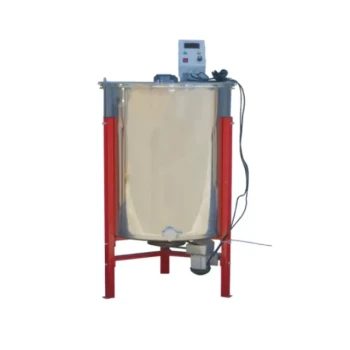
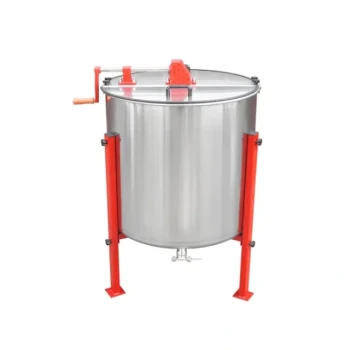
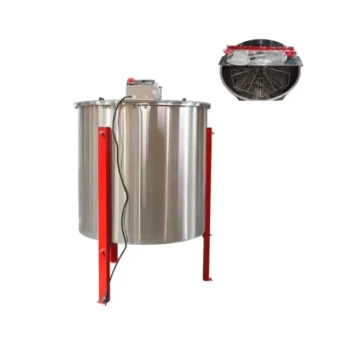
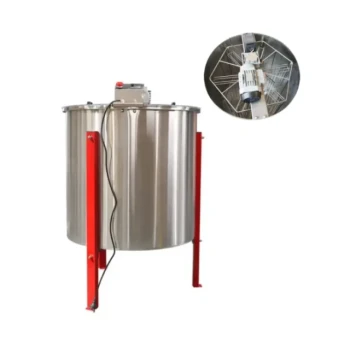
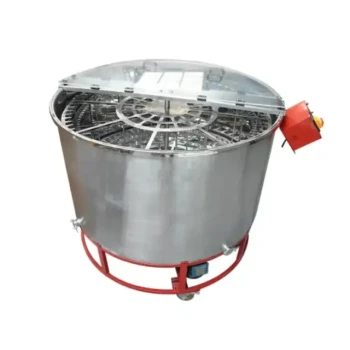
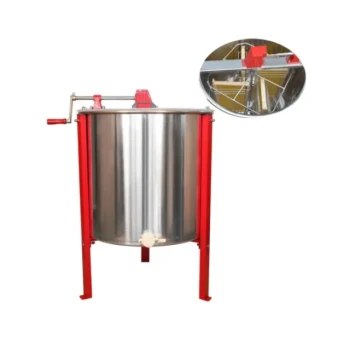
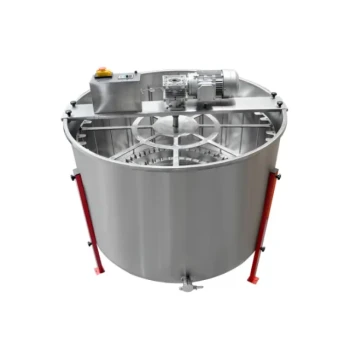
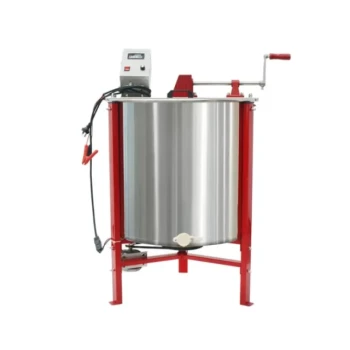
The primary technical advantage of a centrifugal honey extractor is the preservation of the honeycomb structure. Unlike traditional pressing methods that crush the wax combs to release honey, a centrifugal extractor utilizes high-speed rotation to expel the liquid while keeping the frames intact. This non-destructive process allows the empty honeycombs to be returned to the hive for immediate reuse.
Core Insight By maintaining the structural integrity of the honeycomb, centrifugal extraction eliminates the biological cost of rebuilding wax. This allows the colony to redirect energy from construction to production, significantly shortening harvest cycles and maximizing total yield.
The Bio-Economic Advantage
Reducing Biological Cost
Traditional pressing destroys the comb, forcing bees to rebuild the hive structure from scratch after every harvest. This is biologically expensive. By using centrifugal force, you preserve the wax, drastically reducing the raw materials and energy the colony must expend on secreting new wax.
Increasing Production Continuity
When intact combs are returned to the hive, bees can bypass the construction phase entirely. They can immediately begin filling the cells with nectar, improving the continuity of production and increasing the frequency of harvest cycles.
Quality and Purity Standards
Superior Clarity and Appearance
Traditional pressing inevitably mixes wax particles and other solid debris into the final product. Centrifugal extraction separates the liquid honey cleanly from the comb, resulting in a product with higher clarity and significantly fewer water-insoluble impurities.
Preservation of Nutritional Integrity
Industrial-grade centrifugal extractors are designed to process honey quickly and thoroughly. This method better preserves the honey's natural nutritional components compared to the physical stress and potential oxidation associated with manual crushing or pressing.
Enhanced Hygiene Control
The centrifugal process typically occurs within a sealed environment. This containment ensures the honey meets rigorous food safety and hygiene standards by minimizing exposure to external contaminants during extraction.
Understanding the Operational Trade-offs
Equipment vs. Simplicity
While centrifugal extraction offers superior efficiency, it represents a shift toward industrial processing compared to the simplicity of pressing. Pressing is a manual, low-tech method, whereas centrifugal extraction relies on high-speed rotation and mechanical precision to achieve its results.
Commercial Grading Implications
Honey obtained via manual crushing often contains high levels of particulate matter, which can lower its commercial grade. Centrifugal extraction consistently produces honey of a higher commercial grade due to its purity, making it the standard for professional distribution.
Making the Right Choice for Your Goal
To maximize your apiary's potential, consider your primary production objectives:
- If your primary focus is Maximum Yield: Choose a centrifugal extractor to recycle combs and redirect bee energy toward honey production rather than wax building.
- If your primary focus is Product Clarity: Rely on centrifugal extraction to minimize wax debris and impurities, ensuring a visually clear, high-grade product.
- If your primary focus is Harvest Speed: Utilize centrifugal force to shorten the harvest cycle and allow for multiple production turnovers in a single season.
Adopting centrifugal technology transforms beekeeping from a resource-intensive extraction process into a sustainable cycle of rapid reuse and high-efficiency production.
Summary Table:
| Feature | Centrifugal Extraction | Traditional Pressing |
|---|---|---|
| Comb Preservation | Intact; Reusable immediately | Destroyed; Must be rebuilt |
| Honey Purity | High clarity, low wax debris | High particulate content |
| Production Speed | Fast cycles; multiple harvests | Slow; construction delays |
| Hygiene Control | Sealed, professional-grade | Manual, exposed to air |
| Commercial Grade | High (Premium standard) | Lower (Due to impurities) |
Maximize Your Apiary's Efficiency with HONESTBEE
Transitioning to professional extraction is key to scaling your production. HONESTBEE specializes in supporting commercial apiaries and distributors with high-performance centrifugal honey extractors, honey-filling machinery, and comprehensive beekeeping tools. Our equipment is designed to preserve your honeycomb investment, allowing your bees to focus on production rather than reconstruction.
Ready to upgrade your harvest quality and yield? Contact us today to explore our wholesale machinery and essential consumables tailored for large-scale success.
References
- Delfy Lensari, Jun Harbi. Honeybee Cultivation Training Apis Mellifera with Forest Farmers Group (KTH) Wana Lestari, Rejo Sari Village, Megang Sakti District, Musi Rawas Regency. DOI: 10.32502/altifani.v5i1.268
This article is also based on technical information from HonestBee Knowledge Base .
Related Products
- electric honey extractor honey centrifuge 3 frame honey extractor stainless steel honey frame extractor
- Manual Hand Crank 4 Frame Honey Extractor Centrifuge for Beekeeping
- Professional 4 Frame Self Reversing Electric Honey Extractor for Beekeeping
- 24 Frame Honey Extractor Commercial Radial Honey Frame Extraction Machine
- Electric 4 Frame Tangential Honey Extractor
People Also Ask
- What are the characteristics of electric honey extractors? Boost Your Apiary Efficiency with Automated Technology
- What are the disadvantages of using an electric honey extractor? Weighing Cost, Power, and Comb Safety
- What are the advantages of an electric honey extractor? Boost Efficiency and Scale Your Honey Production
- What are the technical advantages of electric honey extractors? Maximize Yield and Protect Your Bee Colony
- How does an electric honey extractor affect the quality of honey? Preserve Flavor & Purity with Precision Extraction