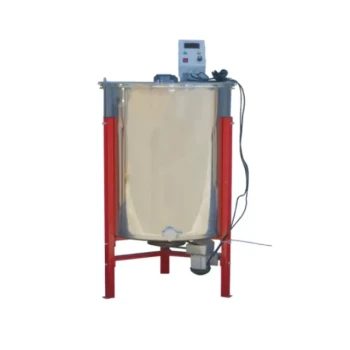
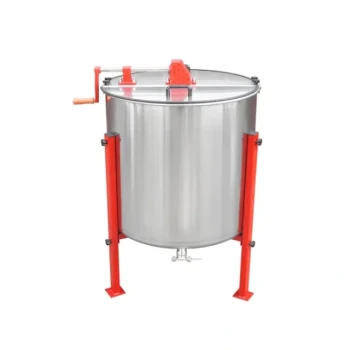
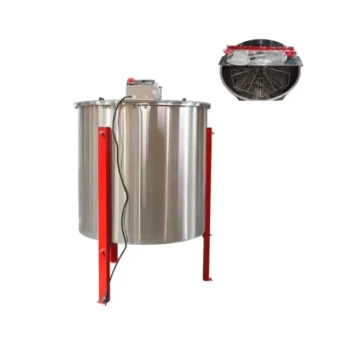
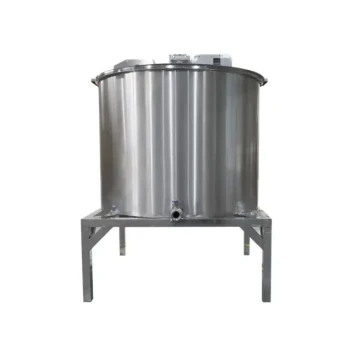
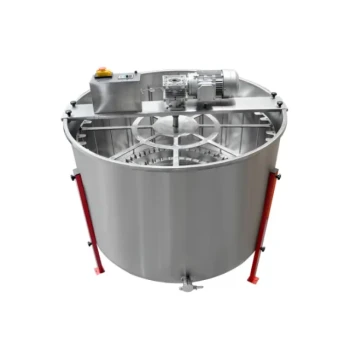
The role of a Centrifugal Honey Extractor is fundamentally about conservation and efficiency. This machine uses high-speed rotation to pull liquid honey from the honeycomb frames without destroying the structure of the wax itself.
By preserving the wax comb for reuse, the extractor eliminates the need for bees to rebuild their hives, allowing colonies to shift their energy entirely toward honey production rather than wax secretion.
The Operational Mechanism
Harnessing Centrifugal Force
The extractor operates by spinning honey frames at high speeds. This generates centrifugal force that pulls the honey out of the comb cells.
The liquid is forced against the walls of the extractor tank, where it drains to the bottom for collection.
Non-Destructive Harvesting
Unlike historical methods that required crushing the comb to squeeze out honey, this process leaves the wax frames intact.
This non-destructive approach is the defining technical characteristic of the machine.
The Economic Engine: Wax Preservation
Eliminating Construction Time
The primary industrial value of the machine lies in its ability to return empty, intact combs to the hive.
Bees require significant time and resources to secrete wax and build honeycomb structures.
Redirecting Colony Energy
When beekeepers provide drawn combs (used wax frames), bees do not need to expend energy rebuilding.
Instead, they immediately begin filling the existing cells with nectar. This significantly maximizes the overall efficiency of honey production during the flow season.
Quality and Chemical Preservation
Maintaining Phytochemical Integrity
Beyond volume efficiency, the extractor plays a vital role in quality control.
By using physical force rather than heat or chemical solvents, the process minimizes mechanical disturbance to the honey's natural components.
Preventing Contamination
Proper extraction prevents excessive aeration and mechanical contamination.
This ensures that sensitive compounds, such as polyphenols and alkaloids, remain intact for high-quality production or subsequent laboratory analysis.
Understanding the Trade-offs
Mechanical Stress vs. Speed
While the primary goal is efficiency, the speed of rotation must be carefully managed.
Excessive speed increases extraction rates but risks fracturing the wax comb, negating the primary benefit of reuse.
Sediment Management
It is important to distinguish the standard extractor from high-velocity laboratory centrifuges used for pollen analysis.
While the extractor removes honey, it does not forcibly concentrate solid sediments like pollen grains to the same degree as lab-specific equipment. Further filtration is often required for pure liquid honey.
Making the Right Choice for Your Goal
To optimize your extraction process, consider your specific production targets:
- If your primary focus is Volume and Efficiency: Prioritize equipment speed and capacity to return intact combs to the hive quickly, maximizing the bees' production cycles.
- If your primary focus is Chemical Purity: Operate at lower speeds to minimize aeration and ensure the preservation of delicate alkaloids and polyphenols.
The Centrifugal Honey Extractor is not just a harvesting tool; it is a resource management device that converts bee energy into maximum honey yield.
Summary Table:
| Feature | Benefit to Large-Scale Operations | Industrial Impact |
|---|---|---|
| Centrifugal Force | Efficiently extracts liquid honey without heat | Preserves phytochemical integrity |
| Non-Destructive | Keeps wax frames intact for immediate reuse | Eliminates hive reconstruction time |
| Energy Redirection | Bees focus on nectar collection instead of wax secretion | Significantly increases honey yield per season |
| Quality Control | Minimizes mechanical disturbance and aeration | Ensures high-purity honey for distribution |
Maximize Your Apiary's Potential with HONESTBEE
At HONESTBEE, we understand that for commercial apiaries and distributors, efficiency and equipment reliability are the cornerstones of profitability. Our comprehensive wholesale offering includes everything from high-capacity centrifugal honey extractors and honey-filling machines to specialized hive-making machinery and essential consumables.
By choosing HONESTBEE, you gain a partner dedicated to optimizing your honey production cycle. Our tools are designed to preserve your valuable wax combs and ensure the chemical purity of your harvest, allowing your colonies to focus on production while you scale your business.
Ready to upgrade your honey processing infrastructure? Contact us today to explore our full spectrum of beekeeping solutions!
References
- Sisay Fikru, Gebremedhin Gebresilassie. Assessment of Beekeeping Practices (Absconding, Bee Forage and Bee Diseases and Pests) in Jigjiga Zone, Somali Regional State of Ethiopia. DOI: 10.4172/2375-446x.1000135
This article is also based on technical information from HonestBee Knowledge Base .
Related Products
- electric honey extractor honey centrifuge 3 frame honey extractor stainless steel honey frame extractor
- Manual Hand Crank 4 Frame Honey Extractor Centrifuge for Beekeeping
- Professional 4 Frame Self Reversing Electric Honey Extractor for Beekeeping
- 24 Frame Honey Extractor Commercial Radial Honey Frame Extraction Machine
- Electric 4 Frame Tangential Honey Extractor
People Also Ask
- What are the characteristics of electric honey extractors? Boost Your Apiary Efficiency with Automated Technology
- What are the disadvantages of using an electric honey extractor? Weighing Cost, Power, and Comb Safety
- What are the advantages of an electric honey extractor? Boost Efficiency and Scale Your Honey Production
- What are the technical advantages of electric honey extractors? Maximize Yield and Protect Your Bee Colony
- How does an electric honey extractor affect the quality of honey? Preserve Flavor & Purity with Precision Extraction