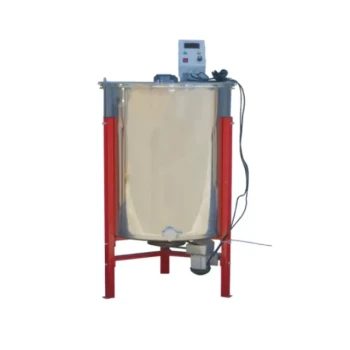
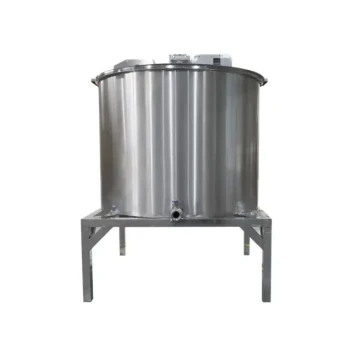
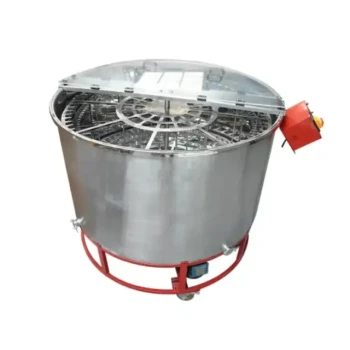
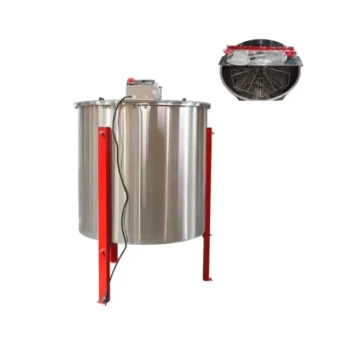
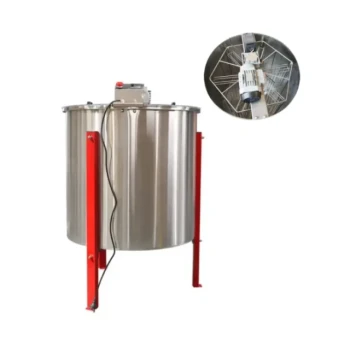
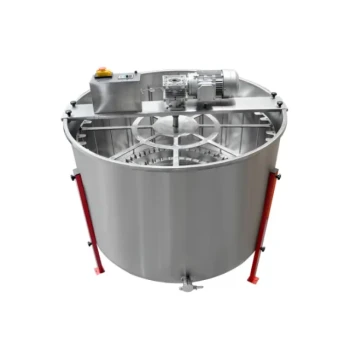
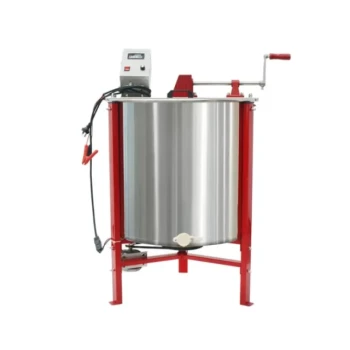
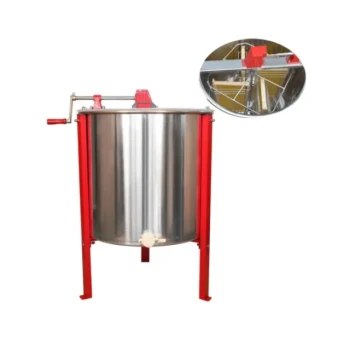
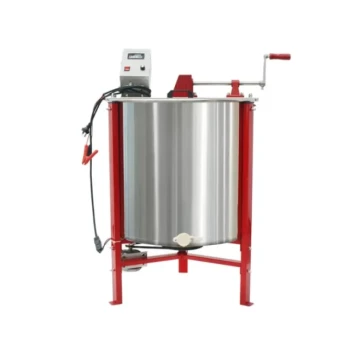
Technically defined, a honey centrifuge (commonly known as an extractor) utilizes rotational physics to mechanically separate liquid honey from the honeycomb without destroying the wax substrate. By spinning uncapped frames at precise speeds, the machine generates centrifugal force that overcomes the honey's viscosity, projecting it against the drum walls for collection while leaving the delicate comb structure intact.
The definitive advantage of centrifugal extraction is resource conservation. Unlike crush-and-strain methods, a centrifuge preserves the drawn comb, allowing bees to immediately reuse the wax structure. This significantly reduces the colony's energy expenditure on wax secretion and directly increases future honey production rates.
The Conservation of Hive Resources
The primary technical justification for using a centrifuge lies in its impact on the biological resources of the hive.
Minimizing Metabolic Cost
Beeswax secretion is a metabolically expensive process for a colony. Bees consume significant amounts of honey and pollen to produce the wax scales needed to build comb.
By using a centrifuge, you preserve the drawn comb. Because the wax structure remains intact after extraction, the bees are not forced to rebuild from scratch.
Accelerating Production Cycles
When bees are given empty, drawn comb (wet with honey residue) back into the hive, they can immediately begin cleaning and refilling the cells.
This bypasses the construction phase entirely. Consequently, the colony can focus its energy on foraging and nectar processing, leading to faster turnover and higher overall honey yields per season.
Operational Control and Quality Assurance
Beyond resource conservation, centrifugal extractors offer precise control over the physical extraction process, which directly correlates to product quality.
Viscosity-Matched Rotation
Professional extraction equipment often features stable rotation speeds that can be tailored to the viscosity of specific honey varieties.
Different nectars result in different thicknesses. A centrifuge allows you to dial in the exact force required to extract the fluid without exerting excessive pressure that might crack the wax foundation or damage the frame.
Hygienic and Closed Operations
Modern centrifugal systems typically operate as closed units. This design minimizes the risk of environmental contamination during the extraction phase.
By keeping the honey contained while it is being flung from the frames, you establish a material foundation for food safety certifications. This is critical for commercial operations aiming to produce high-value-added products.
Automation and Throughput
For larger operations, the technical advantages extend into hardware automation that reduces physical labor.
Self-Reversing Mechanisms
Advanced extractors utilize inertia or linkage mechanisms to automatically flip the honeycomb frames.
When the motor reverses direction, the frames reorient themselves. This allows both sides of the comb to be extracted in a single cycle without the operator physically handling the frames, significantly reducing process time.
Adaptive Drive Systems
Integration with adaptive drive control systems facilitates fully automated extraction cycles.
This technology manages the ramp-up speed and duration, ensuring thorough extraction while preventing the "blowouts" associated with manual speed control errors. This increases the overall processing capacity of the apiary during high-demand harvest periods.
Understanding the Trade-offs
While technically superior for yield, centrifugal extraction introduces variables that must be managed to avoid damaging the harvest.
The Risk of Structural Failure
The most common technical failure is comb blowout. If the rotation speed is too high—or if the extractor is ramped up too quickly—the centrifugal force will rip the wax foundation out of the frame along with the honey.
Operational Imbalance
Centrifuges require strict load balancing. Frames must be placed symmetrically based on weight. An unbalanced load can cause severe vibration, potentially damaging the machine's bearings or causing the extractor to "walk" across the floor.
Temperature and Viscosity Limits
Extraction is highly dependent on temperature. If the honey is too cold, its viscosity increases, requiring higher speeds to extract, which in turn increases the risk of frame damage. The process requires careful environmental temperature management.
Making the Right Choice for Your Goal
The specific type of centrifugal setup you choose should align with your operational scale.
- If your primary focus is Colony Health and Yield: Prioritize an extractor that guarantees comb preservation, as reusing drawn comb is the single biggest factor in reducing bee labor and increasing honey stores.
- If your primary focus is Commercial Throughput: Invest in a system with self-reversing frames and adaptive drive controls to eliminate the manual labor of flipping frames and to standardize extraction cycles.
- If your primary focus is Product Purity: Ensure your equipment allows for closed operation and precise speed adjustments to separate honey from impurities without introducing environmental contaminants.
Ultimately, the centrifuge is the only extraction method that treats the honeycomb as a reusable asset rather than a disposable by-product.
Summary Table:
| Technical Feature | Primary Benefit | Operational Impact |
|---|---|---|
| Resource Conservation | Preserves drawn wax comb | Bees reuse comb immediately, increasing honey yield |
| Rotational Control | Precision speed adjustment | Prevents frame damage while handling various honey viscosities |
| Closed System | Hygienic operation | Minimizes contamination and ensures food safety compliance |
| Automation | Self-reversing mechanisms | Reduces manual labor and accelerates processing cycles |
| Adaptive Drive | Managed ramp-up speed | Eliminates "comb blowouts" through consistent force application |
Scale Your Honey Production with HONESTBEE Professional Solutions
Are you ready to transform your apiary's efficiency? HONESTBEE specializes in supporting commercial apiaries and distributors with high-performance beekeeping technology. Whether you need precise honey-filling machines, high-throughput centrifugal extractors, or custom hive-making hardware, we provide the full spectrum of tools and industry consumables to grow your business.
Why Partner with HONESTBEE?
- Industrial Strength: Equipment designed for high-capacity commercial use.
- Complete Portfolio: From specialized machinery to honey-themed cultural merchandise.
- Expert Support: Tailored solutions for wholesale distributors and large-scale honey producers.
Contact HONESTBEE Today to discover how our comprehensive equipment range can maximize your yields and streamline your operations.
Related Products
- Manual Hand Crank 4 Frame Honey Extractor Centrifuge for Beekeeping
- electric honey extractor honey centrifuge 3 frame honey extractor stainless steel honey frame extractor
- Professional 4 Frame Self Reversing Electric Honey Extractor for Beekeeping
- Stainless Steel 3 Frame Manual Honey Extractor Spinner for Bee Honey Extraction
- 24 Frame Honey Extractor Commercial Radial Honey Frame Extraction Machine
People Also Ask
- What are some tips for achieving efficient honey extraction with a centrifuge extractor? Maximize Your Yield & Efficiency
- What is the proper procedure for maintaining a centrifuge honey extractor? Expert Tips for Longevity and Hygiene
- What are the advantages of using a centrifuge honey extractor? Maximize Yields and Protect Your Honeycombs
- Which type of honey extractor is generally more durable? Focus on Material & Build Quality for Longevity
- What is a manual honey extractor? The Essential Guide to Cost-Effective Beekeeping for Beginners