For beekeepers with red-green color blindness, the most reliable colors for marking queens are white and blue. These specific colors provide the highest contrast against the bees, comb, and pollen within the hive, ensuring you can spot your queen quickly and confidently, even when the standard international colors are indistinguishable.
The core challenge is that the international queen marking system uses colors (red, green, yellow) that are inherently unreliable for those with red-green color blindness. The solution is to abandon the flawed standard in favor of a simplified, high-contrast system built around white and blue that prioritizes your own ability to see the queen.

Why the Standard System Fails
The international color code is a five-year rotation designed to identify the year a queen was hatched. While useful as a universal standard, its reliance on a full spectrum of colors creates a significant problem for many beekeepers.
The International Color Code
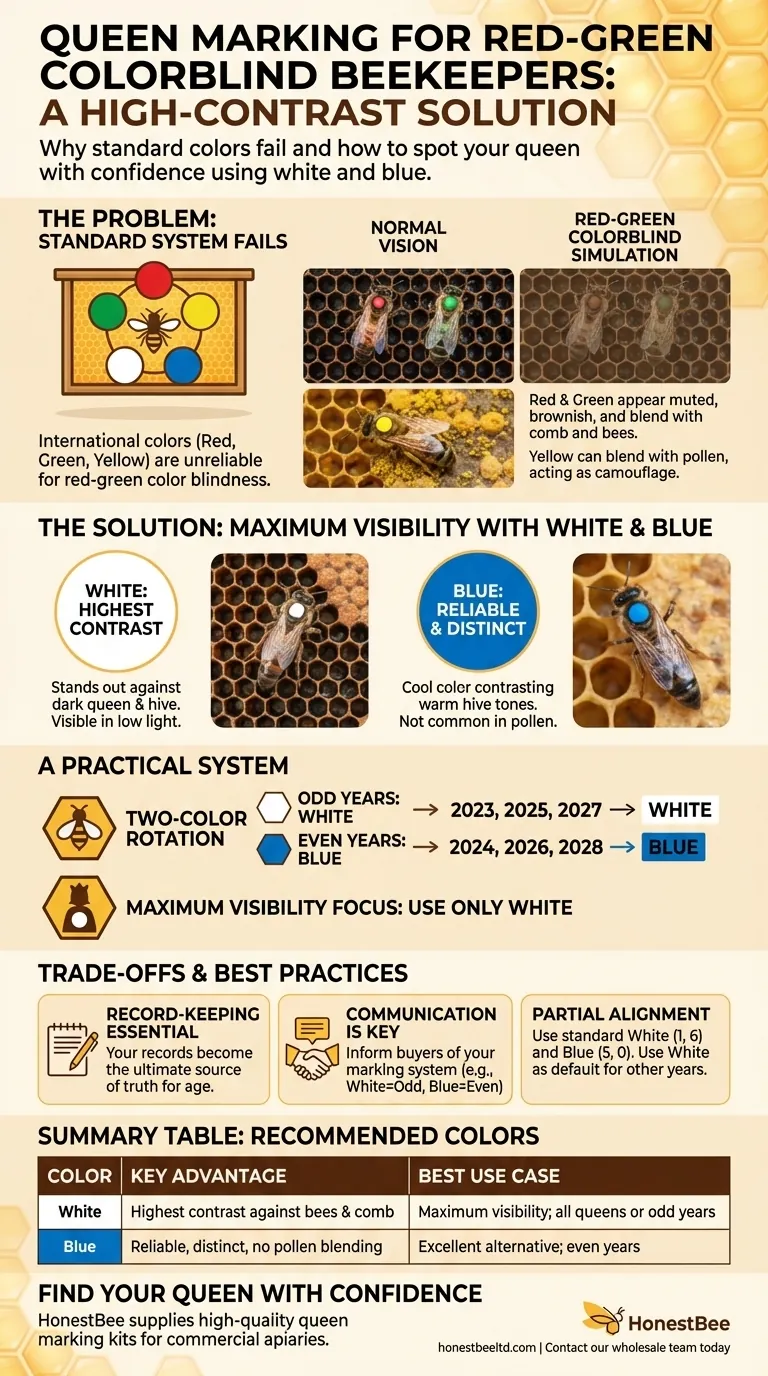
Beekeepers worldwide use a standardized five-color system to know a queen's age at a glance. The sequence, based on the last digit of the year, is:
- White: Years ending in 1 or 6
- Yellow: Years ending in 2 or 7
- Red: Years ending in 3 or 8
- Green: Years ending in 4 or 9
- Blue: Years ending in 5 or 0
The Problem with Red and Green
For a beekeeper with red-green color blindness, the most common form of color vision deficiency, red and green can appear muted, brownish, or nearly identical. This makes reliably spotting a red- or green-marked queen against the dark bodies of other bees and the brownish comb nearly impossible.
The Ambiguity of Yellow
Yellow also presents a challenge. It can be difficult to distinguish from green, and more importantly, it can blend in perfectly with the yellow and orange shades of pollen stored in the comb or carried on workers' legs. This camouflage effect defeats the entire purpose of marking the queen.
A Practical System for Color Blindness
Your goal is not to conform to a standard you cannot see, but to effectively manage your hives. This requires a system built on maximum visibility.
The Power of White
White is the single most effective color for marking a queen. It offers the highest possible contrast against the dark thorax of the queen and the brown-yellow colors of the hive. It is a stark, unnatural color in that environment and is easily seen in low light.
The Reliability of Blue
Blue is the second-best option. It is a cool color that stands out well against the warm tones of the hive. It is not a color commonly found in pollen, making it a reliable and distinct marker that won't blend into the background.
Creating a Simple Two-Color System
The most practical approach is to create a two-year rotation using only white and blue. For example:
- Mark queens hatched in odd-numbered years with white.
- Mark queens hatched in even-numbered years with blue.
This simple system allows you to track the age of your queens effectively without relying on colors you cannot distinguish.
Understanding the Trade-offs
Adopting a custom marking system is a practical necessity, but it's important to understand the implications.
Deviating from the Standard
The primary trade-off is that another beekeeper inspecting your hive will not immediately know the exact year your queen was hatched based on color alone. This is a minor issue compared to the major benefit of you being able to find your own queen.
The Importance of Record-Keeping
Because your color system is personalized, meticulous hive records are essential. Always note the year a queen was introduced and which color you used. Your written records become the ultimate source of truth, supplementing your visual marking system.
Communication is Key
If you sell nucleus colonies (nucs) or queens, you must clearly communicate your marking system to the buyer. A simple note explaining that "Queens from odd years are marked white, even years are blue" prevents confusion and demonstrates professionalism.
Making the Right Choice for Your Hives
Your marking strategy should be dictated by your personal needs for visibility and information.
- If your primary focus is maximum visibility above all else: Use only white for every queen. You will rely entirely on your written records for age, but you will never struggle to find your queen.
- If your primary focus is tracking queen age visually: Use the simple two-color system, alternating between white and blue for odd and even years.
- If you want to align partially with the international code: Use the standard color if the year calls for white (1 or 6) or blue (5 or 0). For all other years (yellow, red, green), use white as your default high-visibility color and make a clear note in your records.
A successful marking system is one that works reliably for you, ensuring you can always manage your hives with confidence.
Summary Table:
| Recommended Color | Key Advantage | Best Use Case |
|---|---|---|
| White | Highest contrast against bees and comb | Maximum visibility; use for all queens or odd-numbered years |
| Blue | Reliable, distinct, doesn't blend with pollen | Excellent alternative; use for even-numbered years |
Find Your Queen with Confidence
Struggling to spot your marked queen? HONESTBEE supplies high-quality, durable queen marking kits and other essential beekeeping supplies to commercial apiaries and distributors. Our products are designed for precision and ease of use, helping you manage your hives more effectively.
Let us help you enhance your beekeeping operations. Contact our wholesale team today to discuss your equipment needs and discover how our reliable supplies can support your success.
Visual Guide
Related Products
- One Hand Yellow Queen Marking Catcher Tube Cage Beekeeper Tool Accessory for Queen Bee
- Queen Bee Marking Tube Cage Bottle Catcher Holder with Clear Plastic Plunger Marker
- Queen Bee Marking Pen POSCA Queen Marking Pens for Beekeeping Bee Markers
- Queen Bee Marking Pen UNI Medium Point for Queen and Bee Marking
- Plastic Long Marker Device for Catching and Marking Bees Queen Bee Marking Tube and Cage
People Also Ask
- What tools are available to assist in safely marking a queen bee? Essential Gear for Professional Beekeepers
- What equipment is needed to mark a queen bee? A Simple 3-Tool Guide for Every Beekeeper
- Why are high-quality queen bee marking tools essential for pedigree tracking? Master Honey Bee Genetic Integrity
- What are the specific advantages of using international standard marking tools in queen bee production and management?
- What tools are recommended for marking a Queen bee? Ensure a Safe and Successful Mark