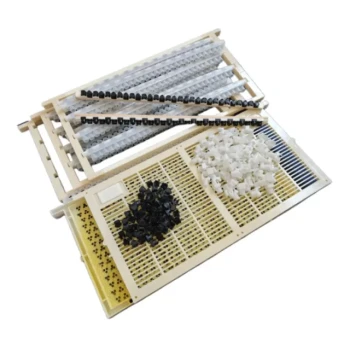
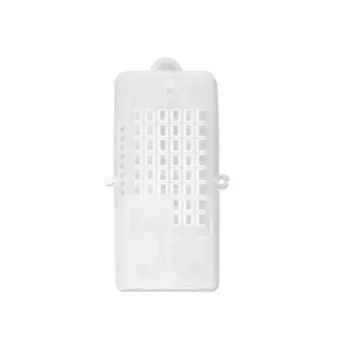
A queen rearing kit is typically an integrated system designed to facilitate the propagation of queens without the need for manual grafting. The core components usually include a plastic comb box that serves as the laying cage, cell plugs for egg deposition, a front queen excluder plate to confine the queen, a rear cover plate for access, and specialized starter caps and cup holders to transfer the cells to hive frames.
Core Takeaway These kits are designed around a "non-grafting" principle: by creating a removable substrate (the plugs) for the queen to lay on, you can transfer eggs to cell builder colonies without ever physically touching or damaging the delicate larvae.
The Containment Assembly
The foundation of the kit is a specialized housing unit designed to mimic natural comb while offering mechanical advantages for the beekeeper.
The Plastic Comb Box
This is the central housing unit of the system. It simulates a section of honeycomb to encourage the queen to lay, but allows for the insertion of removable components.
The Front Queen Excluder Plate
This component is critical for controlled laying. It fits over the front of the comb box, allowing worker bees to pass through to tend to the queen, but preventing the larger queen from leaving the box until she has laid eggs in the desired plugs.
The Rear Cover Plate
This plate secures the back of the cassette. It provides access to the "backstage" area of the comb, allowing the beekeeper to insert or remove the cell plugs without disturbing the queen on the front side.
The Transfer Mechanism
The deep value of these kits is the ability to move an egg without using a grafting needle. This relies on three specific interacting parts.
Cell Plugs
These are small, removable cups that fit into the back of the comb box. The queen lays her eggs directly into these cell plugs, which effectively become the movable floor of the honeycomb cell.
Queen Cell Starter Caps
Once the eggs hatch or are ready for transfer, these caps are fitted over the cell plugs. They mimic the geometry of a natural queen cell cup, signaling the worker bees to begin feeding the larva royal jelly and drawing out a queen cell.
Cup Holders
These are larger, cone-shaped components. They serve as the interface between the small plug assembly and the wooden frame bar, allowing you to mount the developing cells securely into a rearing colony.
Understanding the Trade-offs
While these kits simplify the process for many, the specific components introduce constraints that differ from traditional methods.
Confinement Stress
The system relies on the front queen excluder plate to force the queen to lay in a specific area. This restricts the queen's movement and can temporarily disrupt the natural flow of the hive or cause stress to the queen if she is confined for too long.
Component Complexity
Unlike simple grafting, which requires only a needle and cups, a kit relies on the precise interaction of multiple small parts like plugs, caps, and covers. If any single component is lost or damaged, the assembly may not function correctly, making inventory management critical.
Making the Right Choice for Your Goal
When evaluating whether to utilize a component-based rearing kit, consider your specific objectives regarding workflow and volume.
- If your primary focus is larva safety: Rely on the cell plugs to move eggs, as this eliminates the risk of physical damage caused by manual grafting needles.
- If your primary focus is process control: Utilize the front queen excluder plate to ensure you know exactly when the eggs were laid, allowing for a precise hatching schedule.
- If your primary focus is scalability: Ensure you have a surplus of cup holders and starter caps, as these are the components that will be occupied in the hive during the development cycle.
By leveraging these specialized components, you transform queen rearing from a manual art into a repeatable mechanical process.
Summary Table:
| Component | Primary Function | Key Benefit |
|---|---|---|
| Comb Box | Central housing for egg laying | Mimics natural honeycomb structure |
| Queen Excluder Plate | Confines queen to the box | Ensures controlled and timed egg laying |
| Cell Plugs | Removable cell floors | Allows egg transfer without larva contact |
| Starter Caps | Fits over plugs | Signals workers to begin queen cell building |
| Cup Holders | Frame interface | Securely mounts cells to hive bars |
Elevate Your Beekeeping Operation with HONESTBEE
Ready to scale your apiary's production? HONESTBEE specializes in supporting commercial apiaries and distributors with high-quality, wholesale beekeeping solutions. From precision queen rearing kits and hive-making machinery to honey-filling equipment and essential consumables, we provide everything you need to succeed at scale.
Why partner with HONESTBEE?
- Comprehensive Catalog: One-stop shop for tools, machinery, and cultural merchandise.
- Built for Professionals: Durable equipment designed for high-volume commercial use.
- Wholesale Advantage: Competitive pricing tailored for distributors and large-scale operations.
Contact us today to discuss your bulk equipment needs!
Related Products
- Premium Nicot Style Queen Rearing Kit with Hair Roller Bee Cages
- Jenter Queen Rearing Kit Complete Set for Bee Breeding
- Nicot Queen Rearing Kit for Beekeeping and Grafting in Nicot System
- No Grafting Queen Rearing Kit: System for Royal Jelly Production and Queen Rearing
- Retractable Chinese Queen Rearing Grafting Tools Equipment
People Also Ask
- What is the primary function of a queen rearing kit? Eliminate Manual Grafting for Superior Bee Breeding
- What are some alternative methods to grafting for queen cell production? Discover Graft-Free Queen Rearing Systems
- How do specialized queen rearing kits and queen management tools improve the success rate of bee colony expansion?
- How do modern queen bee rearing and breeding kits improve apiary management? Transition to Proactive Precision Breeding
- How is 'active' queen rearing defined in beekeeping? Master Intentional Colony Management & Genetic Control