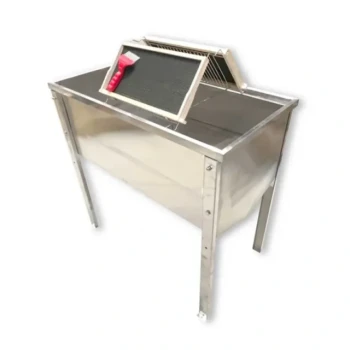
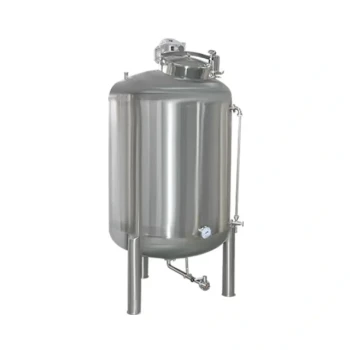
Industrial decanting tanks utilize gravity sedimentation to serve as the primary clarification step for raw honey. By allowing extracted honey to sit undisturbed, these vessels enable the physical separation of impurities—heavy debris settles to the bottom while lighter materials rise to the top—creating a cleaner product foundation for subsequent filtration and storage.
Decanting tanks function as passive separators that rely on time and density rather than mechanical force. They remove the bulk of suspended solids to protect downstream equipment and ensure the initial purity required for commercial processing.
The Mechanics of Gravity Sedimentation
Separation by Density
The primary mechanism at work in a decanting tank is density stratification. Raw honey contains various impurities with different weights compared to the liquid honey itself.
During the resting period, heavy foreign matter settles at the base of the tank. Conversely, lighter materials, such as wax fragments and air bubbles, rise to the surface to form a scum layer that can be skimmed off.
Reducing Filtration Load
Decanting is a preparatory measure, not a final solution. By removing large suspended particles through gravity, the process significantly reduces the "particulate load" on downstream systems.
This step is critical for efficiency. It prevents fine filtration screens from becoming prematurely clogged with gross debris, ensuring the finer processing stages operate smoothly.
Strategic Role in the Workflow
Intermediate Storage
Beyond separation, these tanks often serve as intermediate storage buffers. They hold the product between the extraction line and the bottling or fine filtering stages.
This allows for a continuous workflow where honey can be accumulated and treated in batches. It stabilizes the production line, ensuring a steady supply of settled honey is available for final refinement.
Enhancing Commercial Value
The clarification achieved in these tanks directly impacts the final visual quality of the product. By removing visible debris like larval fragments or comb wax early on, the system sets the stage for a high-clarity final product.
Understanding the Constraints
The Requirement of Time
Decanting is a passive process that requires patience. For gravity sedimentation to work effectively in a viscous fluid like honey, the product requires adequate standing time.
Rushing this stage reduces efficacy. If the honey is moved too quickly, the separation will be incomplete, passing larger impurities downstream.
Limitations of Separation
While effective for large particles, decanting cannot remove everything. It is designed for gross separation of visible impurities.
Microscopic particles and pollen often remain suspended. Therefore, decanting must always be viewed as a preliminary step that supports, but does not replace, final fine filtration.
How to Apply This to Your Process
To maximize the utility of your decanting stage, align your usage with your specific processing goals:
- If your primary focus is equipment longevity: Prioritize longer settling times to remove maximum debris, protecting your expensive fine filters from clogging and wear.
- If your primary focus is product clarity: Ensure the tank design allows for easy skimming of the top layer, where wax and light impurities accumulate.
Effective decanting transforms a raw, debris-filled harvest into a manageable, process-ready liquid.
Summary Table:
| Feature | Mechanism | Primary Function | Impact on Workflow |
|---|---|---|---|
| Gravity Sedimentation | Density stratification | Separates heavy debris from light wax/bubbles | Simplifies initial purification |
| Passive Separation | Time-based settling | Removes bulk suspended solids | Reduces load on fine filters |
| Intermediate Storage | Batch holding | Buffer between extraction and bottling | Stabilizes production flow |
| Impurity Removal | Skimming and settling | Eliminates larval fragments and comb wax | Enhances final product clarity |
Scale Your Honey Production with HONESTBEE
Are you looking to optimize your commercial apiary's efficiency? HONESTBEE specializes in supporting commercial apiaries and distributors with high-performance honey-making machinery and beekeeping tools.
Our industrial-grade decanting tanks and honey-filling machines are designed to streamline your processing workflow, ensuring superior product clarity and protecting your downstream equipment from premature wear. From specialized hardware to essential industry consumables, we provide the full spectrum of equipment needed to grow your honey business.
Ready to upgrade your processing line? Contact us today to discuss your wholesale needs and let HONESTBEE deliver the precision machinery your brand deserves.
References
- Jan Darvine C. Ojeda, Adrián Toncovich. An ERP implementation on a beekeeping and honey value chain. DOI: 10.14488/bjopm.1550.2023
This article is also based on technical information from HonestBee Knowledge Base .
Related Products
- Heavy Duty Stainless Steel Honey Processing Machine Decrystallizing Tank
- Stainless Steel Uncapping Tank with Stand and Strainer
- Plastic Honey Uncapping Tub Tank for Beekeeping
- Professional Honey Storage Tank with Agitation System
- Stainless Steel Honey Storage and Settling Tank with Double Strainer
People Also Ask
- What are the features of the processing tanks offered? Engineered for Purity and Efficiency
- What types of stainless steel processing tanks are used for honey? Essential Equipment for Quality Honey Production
- What design options are available for honey processing tanks? Optimize Efficiency with Custom Geometries
- What types of stainless steel are used for honey processing? Ensure Food Safety with 304 & 316 Grade Equipment
- Why is industrial-grade stainless steel processing equipment required for honey harvesting? Ensure Purity & Compliance