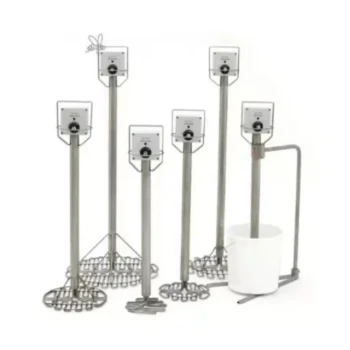
The primary purpose of using an industrial electric steel mixer in this context is to achieve complete homogenization of the honey stored in large-capacity tanks. This mechanical action is necessary to counteract the natural tendency of pollen grains to settle or distribute unevenly, ensuring that any sample drawn for analysis is statistically representative of the entire batch.
Core Takeaway In large-scale honey storage, viscosity and gravity cause pollen to settle and distribute unevenly. Industrial mixing eliminates this stratification, guaranteeing that analytical samples accurately reflect the true botanical origin and composition of the total volume.
The Challenge of Large-Scale Storage
Overcoming Natural Separation
Honey is a viscous substance, yet it is not static. Within large vessels, pollen grains tend to settle over time or clump in specific areas rather than remaining suspended uniformly.
Without intervention, the concentration of pollen at the bottom of a tank can differ significantly from the top. This natural separation compromises the integrity of the honey if it is sampled without preparation.
The Scale of the Issue
The necessity for mixing is amplified by the volume of the container. In industrial settings using 50,000-liter units, natural diffusion is insufficient to create a uniform mixture.
An industrial electric steel mixer provides the mechanical force required to move these massive volumes, forcing the pollen to redistribute evenly throughout the tank.
Ensuring Analytical Accuracy
Creating a Representative Sample
The ultimate goal of using the mixer is to validate the quality control process. For a laboratory analysis to be valid, the small sample tested must be a perfect microcosm of the huge batch.
By achieving a high level of homogenization, the operator ensures that the extracted sample contains the same ratio of pollen types as the rest of the tank.
Validating Botanical Origin
Pollen analysis is the standard method for determining the botanical origin of honey (e.g., proving it is Clover or Manuka).
If a tank is not mixed, a sample might show an artificially low or high pollen count. The mixer prevents these data errors, ensuring the final classification of the honey is factually correct.
Common Pitfalls to Avoid
The Risk of Static Sampling
The most significant error in large-scale honey management is assuming the product is uniform simply because it is a liquid. Attempting to sample a 50,000-liter tank without prior mechanical agitation is a critical procedural failure.
This approach leads to stratified data, where the analytical results apply only to the specific layer sampled, rendering the analysis useless for the batch as a whole.
Reliance on Passive Mixing
Operators should not rely on pumping or transfer alone to mix the product. Dedicated industrial electric steel mixers are required to generate sufficient turbulence to re-suspend settled pollen in such viscous fluids.
Making the Right Choice for Your Goal
To ensure your quality control data is actionable and accurate, apply the following principles:
- If your primary focus is accurate botanical certification: You must utilize an industrial mixer to homogenize the tank immediately prior to drawing your sample.
- If your primary focus is process efficiency: Recognize that skipping the mixing stage to save time invalidates your downstream analysis, likely requiring costly re-testing.
Consistent mechanical homogenization is the only bridge between a large-scale storage tank and a reliable laboratory result.
Summary Table:
| Feature | Purpose in Honey Processing | Impact on Quality Control |
|---|---|---|
| Homogenization | Eliminates stratification of pollen and solids | Ensures samples are statistically representative |
| Mechanical Agitation | Overcomes high viscosity in large tanks | Prevents natural settling and uneven distribution |
| Pollen Distribution | Re-suspends particles uniformly | Guarantees accurate botanical origin certification |
| Large-Scale Mixing | Forces movement in 50,000L+ units | Replaces ineffective passive mixing or diffusion |
Elevate Your Honey Processing with HONESTBEE
For commercial apiaries and global distributors, maintaining product integrity at scale is non-negotiable. HONESTBEE provides the professional-grade industrial equipment you need to ensure every batch meets the highest quality standards. From robust honey-mixing machinery to high-capacity storage solutions and honey-filling systems, our comprehensive wholesale portfolio is designed to optimize your workflow.
Our value to your business:
- Precision Engineering: Specialized machinery tailored for viscous honey handling.
- Complete Supply Chain: A full spectrum of beekeeping tools, machinery, and essential consumables.
- Commercial Expertise: Supporting large-scale operations with reliable hardware and honey-themed merchandise.
Ready to enhance your production efficiency and analytical accuracy? Contact our expert team today to find the perfect industrial solution for your facility.
References
- Anna‐Liisa Varis. Influence of changes in crop cultivation areas on pollen contents of honey (Research Note). DOI: 10.23986/afsci.5666
This article is also based on technical information from HonestBee Knowledge Base .
Related Products
- Heavy Duty Stainless Steel Honey Processing Machine Decrystallizing Tank
- 10L Stainless Steel Electric Honey Press Machine
- 32 Frame Commercial Electric Honey Extractor for Beekeeping and Honey Production
- Double Wall Honey Heating Stirring Homogenizer Mixing Machine with Various Capacity
- Stainless Steel Honey Storage and Settling Tank with Double Strainer
People Also Ask
- What are the features of the processing tanks offered? Engineered for Purity and Efficiency
- What types of stainless steel processing tanks are used for honey? Essential Equipment for Quality Honey Production
- What design options are available for honey processing tanks? Optimize Efficiency with Custom Geometries
- What types of stainless steel are used for honey processing? Ensure Food Safety with 304 & 316 Grade Equipment
- Why is industrial-grade stainless steel processing equipment required for honey harvesting? Ensure Purity & Compliance