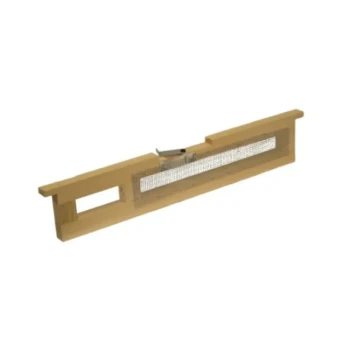
The core function of standardized wooden bee hives is to provide a controllable, movable nesting environment that serves as the hardware foundation for modern apiculture. By replicating the natural nesting conditions of honeybee species like Apis cerana and Apis mellifera, these hives allow beekeepers to actively manage colony dynamics through the use of movable frames, facilitate artificial feeding, and intervene against pests and diseases without destroying the colony structure.
The shift from wild nesting to standardized hives represents a transition from foraging to farming. These hives prevent colonies from absconding due to resource scarcity and provide the consistent physical architecture necessary for stationary, industrial-scale beekeeping.
Operational Control and Colony Management
The Role of Movable Frames
The defining feature of the standardized hive is the ability to monitor the colony without destruction. Unlike natural nests, which are fixed and often inaccessible, standardized hives utilize movable frames.
This allows the beekeeper to inspect the brood, check for the queen, and assess overall health. It transforms beekeeping from a passive observation activity into an active management science.
Facilitating Artificial Feeding
In the wild, a colony facing nectar scarcity might starve or migrate. Standardized hives allow for artificial feeding interventions.
By providing sugar syrup or pollen substitutes directly within the hive structure, beekeepers can sustain colonies during dearth periods. This capability is critical for preventing colony collapse and maintaining population levels year-round.
Pest and Disease Intervention
The controlled environment of a wooden hive is designed for accessibility. This accessibility is vital for implementing pest and disease control protocols.
Beekeepers can introduce treatments for mites or other pathogens directly into the brood nest. This proactive health management is virtually impossible in natural, inaccessible nesting sites.
Stability and Production Efficiency
Preventing Absconding
A major challenge in traditional or wild beekeeping is "absconding," where the colony abandons the nest due to lack of resources or stress.
Standardized hives serve as a stationary anchor. By allowing for resource supplementation and pest management, the hive environment remains favorable, significantly reducing the instinct of the colony to flee.
Modular Expansion for Honey Yield
Standardized systems often feature a multi-layered structure, including "supers" (additional boxes).
This modular design allows beekeepers to expand the storage space based on nectar flow. It maximizes the honey yield per hive during the production season by adapting the physical space to the colony's immediate needs.
Enabling Industrial Scale
The uniformity of these hives is not just for the bees; it is for the beekeeper's logistics. Standardized dimensions facilitate mechanized operations and consistent data collection.
When every hive has the same specifications, equipment is interchangeable, and production capacity becomes quantifiable. This turns dispersed apiary sites into manageable, data-driven agricultural units.
Understanding the Trade-offs
The Burden of Maintenance
While standardized hives offer control, they eliminate the "survival of the fittest" aspect of wild nests.
This equipment requires regular physical maintenance. Unlike a hollow tree, a wooden hive is subject to weathering and requires human labor to clean, repair, and replace rotting components to ensure the controlled environment remains intact.
Dependency on Management
The system is designed for intervention, meaning it creates a dependency on the beekeeper.
Because the hives are often stationary and hold large populations, they cannot easily migrate to better forage on their own. Successful use requires constant monitoring; without active management of feeding and pests, a standardized hive can quickly become a trap rather than a sanctuary.
Making the Right Choice for Your Goal
Standardized hives are tools, and their effectiveness depends on how they are applied to your specific objectives.
- If your primary focus is Commercial Production: Prioritize the modularity of the system to maximize honey supers during peak nectar flow, ensuring high per-unit yield.
- If your primary focus is Colony Health & Research: Leverage the movable frames to perform frequent, non-destructive inspections to gather data on pest levels and brood viability.
The standardized wooden hive is not just a box; it is a precise instrument that balances the biological needs of the bee with the production requirements of the beekeeper.
Summary Table:
| Feature | Core Function | Impact on Apiculture |
|---|---|---|
| Movable Frames | Non-destructive colony inspection | Enhances monitoring and health management |
| Modular Design | Expandable storage (supers) | Maximizes honey yield and production efficiency |
| Standardized Size | Interchangeable hardware | Enables industrial-scale beekeeping logistics |
| Controlled Environment | Facilitates feeding and treatment | Prevents colony absconding and disease spread |
| Wooden Structure | Mimics natural nesting conditions | Provides durable, breathable, and stable housing |
Elevate Your Beekeeping Operations with HONESTBEE
At HONESTBEE, we specialize in empowering commercial apiaries and distributors with high-performance hardware designed for industrial-scale success. From standardized wooden hives and precision-engineered movable frames to honey-filling machines and hive-making equipment, we provide the full spectrum of tools needed to maximize your productivity.
Partner with us to access:
- Wholesale Solutions: Comprehensive supply of beekeeping tools and essential consumables.
- Industrial Machinery: Advanced honey-processing and hive-manufacturing technology.
- Expert Support: Specialized hardware tailored to the needs of large-scale operations.
Ready to scale your honey production or expand your distribution portfolio? Contact us today to explore our wholesale offerings!
References
- Tomaž Oštir. Bees And Beekeeping In Cambodia. DOI: 10.1080/0005772x.2014.11417597
This article is also based on technical information from HonestBee Knowledge Base .
Related Products
- Wooden Bee Hive Frames for Beekeeping and Wholesale
- Wholesales Dadant Size Wooden Bee Hives for Beekeeping
- HONESTBEE Wired and Assembled Wooden Bee Frames Foundation for a Thriving Hive
- Assembled Wooden Bee Frames with Plastic Foundation for Durability and Convenience by HONESTBEE
- Professional Wooden Requeening Frame for Beekeeping
People Also Ask
- How does balancing the number of frames impact hive productivity? Optimize Your Apiary's Biological Output
- How do wooden and plastic hive frames compare in terms of durability? Wood vs. Plastic Longevity & Repairability
- What are the main considerations when choosing between wooden and plastic bee hive frames? Optimize Your Apiary's Efficiency
- How should beehive frames be maintained to prolong their lifespan? 5 Pro Tips for Durable Beekeeping Equipment
- What are frames and combs used for in beekeeping? The Foundation of Modern Hive Management