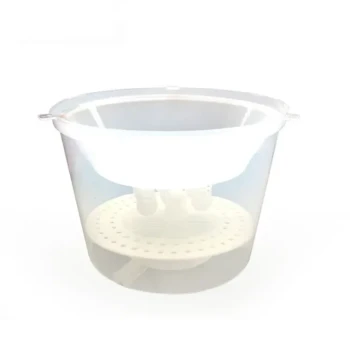
In honey bee pesticide exposure research, the professional-grade Pollen Trap functions as a strict dietary control mechanism. Installed directly at the hive entrance, its immediate purpose is to physically intercept and strip pollen pellets from returning forager bees. By blocking the colony’s access to natural, external pollen sources, the device forces the bees to consume artificially provided pollen patties that contain precise, researcher-controlled doses of pesticides.
The Pollen Trap acts as a variable isolation tool. By preventing the consumption of unknown wild pollen, it ensures that any observed physiological effects are the result of the specific pesticide dosage administered in the lab-controlled patties.
The Mechanics of Controlled Exposure
Intercepting Natural Forage
The Pollen Trap is installed at the flight entrance of the hive. As foragers return from the field, they must pass through the trap to enter the colony.
This process mechanically strips the pollen pellets from their legs. This effectively "starves" the colony of its external protein source, preventing the introduction of unknown environmental chemicals or varying nutritional qualities into the hive.
Enforcing Artificial Diets
Once the natural supply is cut off, the colony has no choice but to rely on alternative food sources provided by the researcher.
In this context, the alternative is Standardized Pollen Patties. These patties are spiked with specific concentrations of the pesticide being tested. Because the bees cannot eat anything else, the researcher can calculate exactly how much pesticide the colony is consuming.
Achieving Scientific Precision
Eliminating Contamination Variables
Without a Pollen Trap, researchers cannot be certain what the bees are bringing into the hive. Wild pollen might already contain agricultural chemicals from nearby fields.
By blocking external pollen, the trap ensures the experiment simulates exposure to a single, specific contamination source. This prevents "background noise" from interfering with the data.
Ensuring Dosage Consistency
Toxicology research requires exact measurements. If a colony eats 50% wild pollen and 50% treated patties, the pesticide intake is diluted.
The Pollen Trap guarantees that the intake remains controllable. It creates a closed system where the only input is the standardized, treated feed.
Understanding the Trade-offs
Total Nutritional Dependence
Using a Pollen Trap places the entire nutritional burden on the researcher. Because natural foraging is blocked, the artificial patties must be formulated perfectly to avoid nutritional deficiencies.
As noted in the supplementary data regarding Standardized Pollen Patties, these supplements must contain a consistent formula of pollen, sucrose, and professional feed. If the quality of the patty is poor, the colony may suffer from malnutrition, which could be mistaken for pesticide poisoning.
Stress on the Colony
Physically stripping pollen and altering the food source is an intervention that changes natural hive behavior.
While necessary for the experiment, researchers must ensure that the "control" group (bees receiving non-toxic patties) is subjected to the exact same trap conditions. This ensures that any decline in health is due to the chemical, not the physical stress of the trap itself.
Making the Right Choice for Your Goal
When designing a pesticide exposure study, the Pollen Trap is your primary tool for data integrity.
- If your primary focus is Dose-Response Accuracy: Use the Pollen Trap to guarantee that every milligram of protein consumed by the hive contains the exact concentration of the chemical you are testing.
- If your primary focus is Variable Elimination: Deploy the trap to rule out environmental factors, ensuring that no wild pesticides or unknown pathogens enter the hive via natural foraging.
By controlling the input, you transform the hive from a wild biological system into a precise, measurable instrument.
Summary Table:
| Feature | Function in Research | Scientific Benefit |
|---|---|---|
| Physical Interception | Strips pollen pellets from returning foragers | Eliminates unknown environmental variables |
| Dietary Isolation | Forces colony to rely on artificial patties | Ensures 100% adherence to controlled pesticide doses |
| Contamination Control | Blocks entry of wild, pre-contaminated pollen | Prevents 'background noise' in toxicological data |
| Input Standardization | Creates a closed nutritional system | Guarantees dose-response accuracy and consistency |
Elevate Your Research and Operations with HONESTBEE
Precision in beekeeping requires professional-grade equipment that delivers consistent results. At HONESTBEE, we specialize in supporting commercial apiaries and industry distributors with a comprehensive range of wholesale beekeeping solutions.
Whether you are conducting rigorous pesticide exposure studies or scaling commercial honey production, we provide the tools you need to succeed:
- Advanced Machinery: From precision hive-making to high-speed honey-filling machines.
- Full Spectrum Equipment: Professional-grade pollen traps, protective gear, and specialized hardware.
- Essential Consumables: A wide array of industry-standard supplies to maintain colony health.
Ready to optimize your apiary’s performance? Contact us today to learn how our tailored wholesale offerings and technical expertise can add value to your business.
References
- Kirsten S. Traynor, Zachary S. Lamas. Social disruption: Sublethal pesticides in pollen lead to Apis mellifera queen events and brood loss. DOI: 10.1016/j.ecoenv.2021.112105
This article is also based on technical information from HonestBee Knowledge Base .
Related Products
- Removable Plastic Pollen Trap With Ventilated Tray for Bees Pollen Collector
- Professional Bucket Style Wasp and Moth Pheromone Trap
- Professional Multi-Component Bucket Wasp Trap
- 30 cm Plastic Entrance Hole Bee Pollen Trap and Collector
- High-Efficiency Diamond Maze Bee Escape for Clearing Supers
People Also Ask
- What are the design principles and advantages of pollen traps in the collection of bee pollen? Boost Your Apiary Yield
- What is the function of professional pollen traps in evaluating honey plants? Quantifying Pollination and Crop Potential
- What functions do pollen traps serve for bee bread production? Optimize Your Raw Material Collection
- What maintenance and pest prevention measures should be taken for pollen traps? Protect Your Hive and Harvest Quality
- How does the use of pollen traps in honeybee hives enhance crop fertilization? Boost Your Yield Through Induced Activity