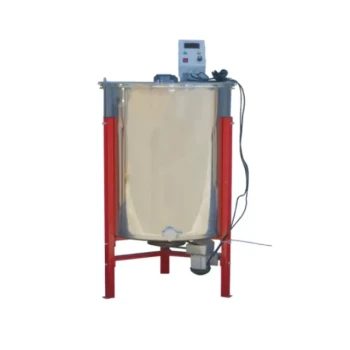
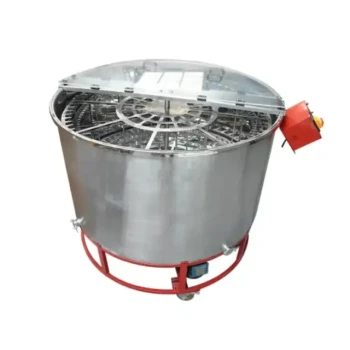
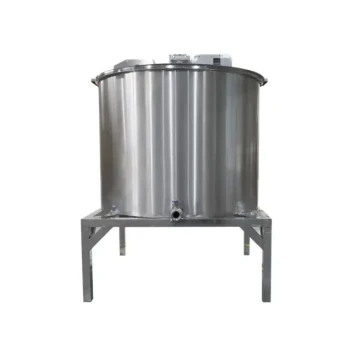
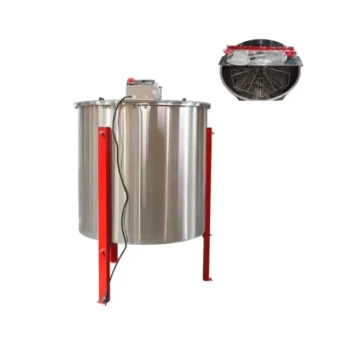
Industrial-grade centrifuges serve as the critical mechanical interface between raw hive output and commercial honey production. During the "slinging" stage, these machines spin uncapped frames at high velocities to generate centrifugal force, effectively extracting liquid honey while leaving the delicate wax honeycomb physical structure intact.
By replacing destructive pressing methods with centrifugal separation, this technology transforms extraction into a sustainable cycle; it preserves the wax comb for immediate reuse, sparing bees the energy-intensive task of rebuilding and significantly boosting overall apiary productivity.
The Mechanics of Sustainable Extraction
Preserving Structural Integrity
Traditional honey harvesting methods, such as pressing, often destroy the honeycomb.
Industrial centrifuges avoid this by using rotational force to pull honey out of the cells.
This leaves the beeswax frames physically undamaged and structurally sound.
The Cycle of Reuse
Because the frames remain intact, apiaries can immediately return them to the hives for subsequent seasons.
This capability is the foundation of commercial scalability.
It eliminates the downtime associated with bees constructing new storage cells from scratch.
Reducing Biological Energy Costs
Beeswax secretion is a highly energy-intensive process for a bee colony.
By reusing centrifuged frames, you significantly reduce the metabolic energy bees must spend on secreting wax.
This allows the colony to redirect their energy toward foraging and honey production, directly increasing the yield per hive.
Elevating Product Quality
Cold Processing Capabilities
Centrifuges operate effectively under non-heating conditions.
This mechanical separation maintains the honey's natural active components and flavor profile.
It prevents the degradation of heat-sensitive enzymes that are critical for organic certification.
Achieving High Purity
The centrifugal process separates liquid from solid more cleanly than pressing methods.
This minimizes the introduction of environmental impurities and wax particles into the final product.
The result is a high-purity sample suitable for strict commercial standards and accurate pollutant residue analysis.
Understanding Operational Trade-offs
Energy Consumption
While they save biological energy for the bees, these machines represent a significant operational cost.
Centrifuges are often the primary energy-consuming equipment in the extraction facility due to the power required for high-frequency rotation.
The Pre-Requisite of Uncapping
Centrifugation is not a standalone solution; it relies on precise preparation.
It only functions effectively on frames that have already had their wax cappings removed.
This adds a necessary step to the workflow, requiring specialized uncapping equipment before the centrifuge can be utilized.
Making the Right Choice for Your Goal
To determine the best extraction approach for your facility, consider your specific production targets:
- If your primary focus is commercial efficiency: Prioritize high-capacity centrifuges to maximize frame reuse, allowing your colonies to focus entirely on honey production rather than wax building.
- If your primary focus is product purity: Utilize the centrifuge's ability to extract without heat to produce premium, enzyme-rich honey that meets the highest standards for organic analysis.
Ultimately, the industrial centrifuge is less about simple extraction and more about resource management—balancing mechanical energy usage against biological conservation to maximize yield.
Summary Table:
| Feature | Benefit | Impact on Production |
|---|---|---|
| Centrifugal Force | Extracts honey without damaging wax frames | Enables immediate frame reuse & reduces downtime |
| Cold Processing | No heat required during mechanical separation | Preserves enzymes, flavor, and organic certification |
| Structural Integrity | Eliminates the need for bees to rebuild wax | Directs colony energy toward higher honey forage yield |
| High-Purity Output | Minimal wax particles and solid impurities | Meets strict commercial standards for premium honey |
Scale Your Honey Production with HONESTBEE
Maximize your apiary's output and product quality with professional-grade solutions. HONESTBEE specializes in supporting commercial apiaries and distributors with a robust selection of beekeeping machinery—from high-efficiency honey-filling machines to industrial-grade extraction hardware.
Whether you are looking to upgrade your facility's energy efficiency or need a reliable wholesale partner for essential industry consumables, our comprehensive portfolio is designed to enhance your commercial scalability.
Ready to elevate your honey processing? Contact us today to discover how our specialized tools and machinery can streamline your operations and deliver premium results.
References
- Scott Bremer, Etienne Dunn‐Sigouin. Adapting seasonal beekeeping patterns in western Norway. DOI: 10.1177/0961463x241275003
This article is also based on technical information from HonestBee Knowledge Base .
Related Products
- electric honey extractor honey centrifuge 3 frame honey extractor stainless steel honey frame extractor
- Manual Hand Crank 4 Frame Honey Extractor Centrifuge for Beekeeping
- Professional 4 Frame Self Reversing Electric Honey Extractor for Beekeeping
- HONESTBEE 72 Frame Industrial Electric Honey Extractor for Beekeeping
- Honey Concentrating and Filtering Dehumidifier Machine 2T Capacity for Honey
People Also Ask
- What are the characteristics of electric honey extractors? Boost Your Apiary Efficiency with Automated Technology
- What are the disadvantages of using an electric honey extractor? Weighing Cost, Power, and Comb Safety
- What are the advantages of an electric honey extractor? Boost Efficiency and Scale Your Honey Production
- What are the technical advantages of electric honey extractors? Maximize Yield and Protect Your Bee Colony
- How does an electric honey extractor affect the quality of honey? Preserve Flavor & Purity with Precision Extraction