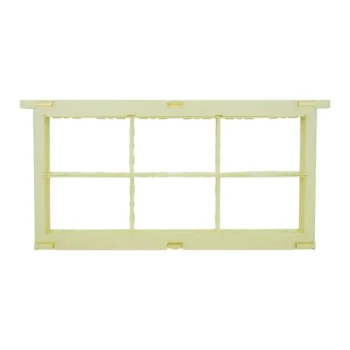
Standard beehives with foundation frames act as the structural calibration tool for establishing reliable experimental models. They function primarily to regulate the living environment of the honeybee, forcing the construction of uniform honeycomb cells to ensure that biological measurements regarding Varroa mite infestation are accurate and reproducible.
Core Takeaway By imposing a standardized architecture on the hive, foundation frames eliminate the natural variability of comb construction. This consistency is the absolute prerequisite for scientifically valid comparisons of reproductive data and parasite loads across different colonies.
The Necessity of Structural Standardization
Guiding Neat Construction
Left to their own instincts, bees often build irregular or "burr" comb.
Foundation frames provide a strict benchmark that guides worker bees to build straight, uniform combs.
This forces the colony to adhere to a specific architectural specification, rather than a variable natural design.
Enabling Precise Quantification
To assess an experimental model, researchers must measure specific biological markers.
Uniform foundation allows for the precise measurement of the capped brood area.
This metric serves as a reliable proxy for the colony's reproductive potential, which is difficult to estimate on irregular natural comb.
Accurate Parasite Counting
The primary focus of these models is often the Varroa mite.
Standardized cells facilitate the accurate counting of mites within the brood cells.
When cell depth and width are consistent, researchers can systematically inspecting the brood for infestation levels without dealing with structural anomalies.
Ensuring Experimental Validity
Establishing a Physical Basis
Scientific experiments require strict control of variables.
The foundation provides a consistent "physical basis" for the colony's development.
This ensures that any observed differences in mite levels are due to the experimental treatment, not differences in comb structure or available space.
Comparability Across Colonies
Data derived from a single hive is anecdotal; data comparing multiple hives is scientific.
Foundation frames ensure that Colony A is structurally identical to Colony B.
This allows researchers to aggregate data and make valid statistical comparisons between different test groups.
Understanding the Trade-offs
The "Natural" Alternative
It is important to acknowledge that standard foundation frames are artificial.
Foundationless frames allow bees to build comb based on instinct, often resulting in smaller cell diameters.
Supplementary data suggests that these natural, smaller cells can shorten the larval development period, which naturally suppresses mite reproduction.
The Experimental Compromise
While foundationless systems may offer natural mite suppression, they introduce variability.
Using standard foundation frames prioritizes measurement accuracy over natural defensive behaviors.
Researchers accept the trade-off of "forced" cell sizes to gain the benefit of standardized, readable data.
Making the Right Choice for Your Goal
Whether you choose standard foundation or a natural approach depends entirely on the outcome you seek.
- If your primary focus is rigorous data collection: Use standard foundation frames to guarantee uniform brood patterns and accurate, comparable mite counts across all test subjects.
- If your primary focus is natural mite suppression: Consider foundationless frames to allow for smaller cell sizes and shorter larval development times that inhibit mite reproduction.
Ultimately, standard foundation frames are not just hive equipment; in a research setting, they are precision measurement tools that turn a chaotic biological environment into a quantifiable dataset.
Summary Table:
| Feature | Standard Foundation Frames | Foundationless (Natural) Frames |
|---|---|---|
| Primary Function | Structural calibration and data accuracy | Natural mite suppression |
| Cell Consistency | Uniform cell size and depth | Variable, often smaller cell size |
| Data Comparison | High (enables statistical aggregation) | Low (significant natural variability) |
| Varroa Measurement | Precise counting in capped brood | Challenging due to irregular comb |
| Larval Development | Standardized timeframes | Potentially shorter (inhibits mites) |
Elevate Your Apiary’s Scientific Performance with HONESTBEE
At HONESTBEE, we understand that precision is the foundation of successful commercial beekeeping and mite management. As a leading global supplier for commercial apiaries and distributors, we provide a comprehensive wholesale range of professional-grade beekeeping tools and machinery designed for durability and accuracy.
Whether you are scaling up production with our honey-filling machines or establishing research-grade colonies using our standardized hive-making hardware, HONESTBEE delivers the high-quality consumables and equipment you need to succeed. From essential hive components to honey-themed cultural merchandise, we offer the full spectrum of industry solutions.
Ready to optimize your operation? Contact us today to learn how our wholesale offerings can enhance your productivity and research outcomes.
References
- Rajmund Sokół, Maria Michalczyk. A Preliminary Study on “Personalised Treatment” against Varroa destructor Infestations in Honey Bee (Apis mellifera) Colonies. DOI: 10.3390/ani13060987
This article is also based on technical information from HonestBee Knowledge Base .
Related Products
- Assembled Wooden Bee Frames with Plastic Foundation for Durability and Convenience by HONESTBEE
- HONESTBEE Wired and Assembled Wooden Bee Frames Foundation for a Thriving Hive
- Plastic Bee Frame Beekeeping Hive Frames for Wholesale
- Assembled Wooden Bee Frames with Beeswax Foundation Ready to Use by HONESTBEE
- Wooden Bee Hive Frames for Beekeeping and Wholesale
People Also Ask
- When should frames with new foundation be given to colonies? Master Timing for a Thriving Hive
- What are bee frames and how are they sized? A Professional Guide to Standardization & Material Choice
- How do you re-wax bee frames? A Simple Guide to Faster Comb Building
- What types of bee frames can be cleaned and returned to service? A Guide to Safe Apiary Refurbishment
- Can beekeepers switch between wooden and plastic frames? Optimize Your Hive's Performance