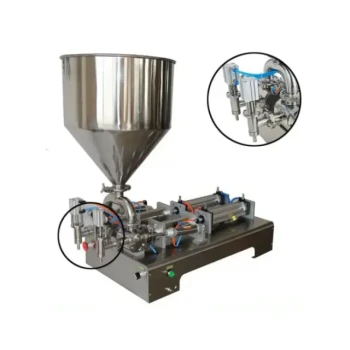
The general working principle of a honey filling machine is a sequential process designed to transport, fill, and seal containers with high-viscosity liquid efficiently. The operation begins when containers are placed on a conveyor, transported to a filling nozzle for a precise dosage of honey, and subsequently moved to stations for capping, sealing, and labeling.
Honey filling machines are specialized systems engineered to handle the unique resistance and stickiness of honey, utilizing volumetric or piston controls to ensure consistent product weight and professional packaging quality while minimizing manual labor.
The Standard Operational Workflow
The core process of filling honey remains consistent across most machine configurations, though the level of automation may vary.
Container Loading and Transport
The process initiates when containers, such as jars or bottles, are placed onto a conveyor belt.
In fully automated systems, this is done mechanically; in semi-automated setups, an operator may place them manually.
Pre-Treatment and Positioning
Before filling, the machine may pass the containers through auxiliary equipment to wash or pre-clean them.
Once at the filling station, a gate and hold device secures the container in place to prevent movement, ensuring the alignment between the bottle opening and the nozzle is perfect.
Precision Dispensing
The machine draws honey from a hopper (a holding tank) and forces it through a barrel (a hollow tube) toward the nozzles.
A control system dispenses a strictly measured volume of honey into the container. This step is critical for maintaining inventory control and ensuring every customer receives the exact amount of product promised.
Sealing and Finishing
Once filled, the conveyor moves the containers to the final stages of the line.
Here, the containers are capped and sealed to ensure freshness, followed by the application of labels. The final step involves packing the units for shipping or distribution.
Mechanisms for Handling Viscosity
Honey is a viscous fluid, meaning it resists flow. Filling machines utilize specific mechanisms to overcome this resistance while maintaining accuracy or speed.
Piston Filling Systems
Piston fillers use a cylinder to mechanically force a precise amount of honey into the container.
This method is highly effective for thick honey, prioritizing volumetric accuracy over raw speed.
Gravity and Vacuum Fillers
Gravity fillers utilize the weight of the honey from an overhead source to flow into the container.
Alternatively, vacuum fillers create suction to draw the honey into the bottle. The choice between these systems often depends on whether the priority is fill speed or extreme precision.
Critical System Components
To understand the working principle, it is helpful to identify the specific parts that drive the process.
The Hopper and Barrel
The hopper acts as the reservoir that holds the honey before it enters the system.
The barrel serves as the conduit, conveying the honey from the tanks to the dispensing point.
Logic Controllers (PLC)
Modern machines are equipped with Programmable Logic Controllers (PLCs).
These digital brains regulate the filling speed, volume, and timing, allowing operators to integrate the machine into a larger facility workflow for standardized automation.
Level Controllers
These sensors monitor the amount of honey in the holding tanks and the jars.
They ensure the system does not run dry and that containers are not overfilled, preventing waste and sticky spills.
Understanding the Trade-offs
While automation offers consistency, there are distinct differences between machine types that impact operations.
Sachet vs. Rigid Container
If you are filling sachets (packets) rather than bottles, the working principle changes to a "form-fill-seal" method.
This involves unwinding packing material, forming the sachet, filling it, heat sealing it, and cutting it. This is a continuous process that differs mechanically from the conveyor-based bottle filling described above.
Semi-Automated vs. Fully Automated
Semi-automated machines do not handle every step independently.
They require manual intervention, often for loading containers or activating the fill cycle, making them slower but more affordable. Fully automated systems reduce labor costs significantly but require a higher initial capital investment.
Making the Right Choice for Your Goal
Selecting the right machine depends on balancing your production volume against the physical properties of your specific honey product.
- If your primary focus is Accuracy: Prioritize piston filling mechanisms, as they provide the most precise dosage for thick, viscous fluids like honey.
- If your primary focus is Scalability: Invest in machines equipped with PLCs, as these allow for precise digital regulation and easier integration into larger, fully automated production lines.
- If your primary focus is Professional Presentation: Ensure the machine includes automated capping and labeling stations to guarantee consistency across every unit sold.
The best honey filling machine is one that removes the variability of manual pouring, transforming a sticky, labor-intensive task into a clean, predictable mechanical process.
Summary Table:
| Component/System | Function | Key Benefit |
|---|---|---|
| Piston Mechanism | Forces viscous honey into containers | High volumetric accuracy for thick fluids |
| PLC Controller | Regulates speed, volume, and timing | Standardized automation and easy integration |
| Hopper & Barrel | Reservoir and conduit for raw honey | Consistent material flow to nozzles |
| Level Sensors | Monitors tank and container fill levels | Prevents waste, overfilling, and sticky spills |
| Capping/Labeling | Final sealing and brand application | Professional presentation and freshness |
Scale Your Honey Production with HONESTBEE
Are you looking to transition from manual pouring to a high-efficiency production line? HONESTBEE specializes in supporting commercial apiaries and distributors with premium beekeeping machinery and wholesale supplies. From precision honey-filling machines and hive-making hardware to essential industry consumables and honey-themed merchandise, we provide the tools you need to grow.
Our Value to You:
- Comprehensive Wholesale Portfolio: One-stop shop for all beekeeping tools and machinery.
- Precision Engineered Solutions: Machines designed specifically to handle the high viscosity of honey.
- Industry Expertise: Tailored support for distributors and large-scale commercial operations.
Ready to enhance your facility's efficiency and product consistency? Contact HONESTBEE today to discuss your equipment needs!
Related Products
- Precision Durable Efficient HONESTBEE Rotary Honey Filling Machine
- Semi Automatic Small Honey Bottle Filling Machine Honey Filler
- Economy Small Honey Filling Machine Honey Bottle Filler Packaging Machine
- Fully Automatic Honey Filling Packaging Machine for Processing Line
- Commercial Rotary Honey Filling Machine for Production
People Also Ask
- How do high-precision honey filling machines ensure quality? Optimize Your Commercial Production with HONESTBEE
- How do honey filling and processing machines aid native bee product conservation? Boost Value with HONESTBEE Technology
- What are the common types of bottling machines used for honey? Choosing the Right Solution for Your Apiary
- What quality control role does professional honey filling equipment perform? Ensure Consistency and Product Stability
- How do honey filling machines work? Achieve Precision & Speed for Your Apiary