Grafting is the precise technical process of manually transferring young larvae from their original worker cells into artificial queen cell cups. While it requires dexterity, it is the primary method used by commercial beekeepers to standardize and scale their queen production.
The core value of grafting lies in scalability and genetic control. It allows beekeepers to mass-produce queens while rigorously selecting for specific, superior traits like disease resistance and honey production, rather than leaving the colony's future to chance.
The Mechanics of the Process
The Manual Transfer
The procedure requires a specialized grafting tool. The beekeeper must ensure the tool is clean and often moistened to prevent the delicate larvae from sticking.
Precision Technique
Using the tool, the beekeeper gently slides a flexible tip under a selected larva. They carefully scoop it out and deposit it into a prepared queen cell cup using a delicate rolling motion.
Critical Timing
Success depends on the age of the larva. The larva must be less than 24 hours old. At this stage, the larva is sexually undifferentiated, allowing the bees to feed it royal jelly to develop it into a queen rather than a worker.
Why Commercial Operations Favor Grafting
Efficiency at Scale
Grafting is widely considered the most effective way to raise a large number of queens simultaneously. For commercial operations managing hundreds or thousands of hives, natural methods are too slow and unpredictable.
Targeted Genetic Selection
This method provides the best opportunity to propagate desirable traits. Beekeepers can specifically choose larvae from a "mother colony" that exhibits gentleness, disease resistance, or high honey production.
Standardization
By using artificial cups, beekeepers can organize the developing queens into frames. This makes the management, incubation, and eventual harvesting of queen cells highly predictable and systematic.
Understanding the Trade-offs
High Barrier to Entry
Grafting is not effortless. As noted in alternative methods, successful grafting requires a steady hand and excellent vision. The physical manipulation of microscopic larvae can be difficult for beginners.
Equipment Dependencies
Unlike natural methods, grafting requires specific tools and artificial cell cups. If the transfer damages the larva, the bees will reject the cell, leading to failure.
Alternative Options
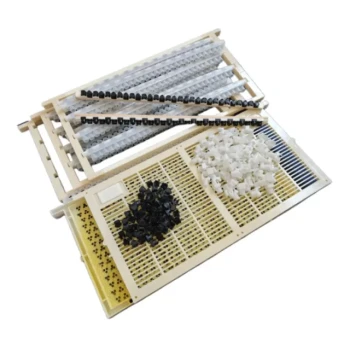
For those who find manual grafting impractical due to vision or dexterity issues, graft-free systems like Jenter or Nicot exist. These allow for queen production without direct larval handling, though they may offer less throughput than manual grafting.
Making the Right Choice for Your Goal
To decide if grafting is the right method for your apiary, consider your primary objective:
- If your primary focus is genetic improvement: Grafting is essential, as it allows you to hand-pick larvae from your absolute best-performing colonies.
- If your primary focus is volume sales: Grafting is the only viable choice for producing the quantity of queens required for commercial distribution.
- If your primary focus is small-scale simplicity: You may prefer graft-free systems (like Jenter or Nicot) to avoid the physical difficulty of manual transfer.
Mastering grafting transforms a beekeeper from a simple manager of hives into a breeder of superior genetics.
Summary Table:
| Feature | Grafting Method Details | Commercial Advantage |
|---|---|---|
| Core Process | Manual transfer of larvae < 24 hours old | High precision and timing control |
| Scalability | Mass-production via artificial cell cups | Enables high-volume queen rearing |
| Genetic Selection | Choosing larvae from superior "mother" colonies | Improved disease resistance & honey yield |
| Standardization | Systematic organization of queen frames | Predictable harvesting and management |
| Tooling | Requires specialized grafting tools & cups | Professional-grade output and consistency |
Scale Your Queen Rearing with Professional HONESTBEE Equipment
Maximize your apiary's potential with high-quality tools designed for commercial success. HONESTBEE specializes in catering to commercial apiaries and distributors with a comprehensive wholesale offering. Whether you need precision grafting tools, specialized hive-making machinery, or essential industry consumables, we provide the full spectrum of beekeeping hardware to streamline your operations.
From high-volume honey-filling machines to honey-themed cultural merchandise, our portfolio is built to support your growth and efficiency.
Ready to elevate your production? Contact us today to explore our wholesale solutions and see how HONESTBEE can power your business.
Related Products
- Plastic Chinese Queen Grafting Tool for Bee Queen Rearing
- Stainless Steel Beekeeping Queen Grafting Tool for Honey Bee Rearing
- Plastic Beekeeping Honey Bee Larvae Grafting Tools for Queen Rearing and Chinese Grafting
- Stainless Steel Queen Grafting Tool for Beekeeping and Bee Queen Grafting
- Retractable Chinese Queen Rearing Grafting Tools Equipment
People Also Ask
- Why is it necessary for migratory beekeeping enterprises to utilize professional queen bee rearing tools? Boost Resilience
- What specialized tools and frame configurations are needed for larval grafting during queen rearing, and how are queen cells properly spaced? Master the essentials for efficient queen production
- What are the benefits of using a queen grafting tool for queen rearing? Master Precision for Superior Bee Genetics
- What is grafting in queen rearing? Take Control of Your Apiary's Genetics
- What are the steps involved in using a queen grafting tool? A Guide to Successful Queen Rearing