The single most vulnerable moment when introducing a queen with a standard cage is the instant she is released into the colony.
While the bees may appear to have accepted her pheromones through the screen, her actual release triggers a critical biological evaluation by the workers. Because a queen in a standard cage has not yet begun to lay eggs, the colony views her with inherent suspicion, and the stress of the hive inspection can turn this suspicion into lethal aggression.
Core Takeaway Acceptance is not a binary switch; it is a process that culminates when the queen begins laying. The release moment is the most dangerous flashpoint because the queen is physically accessible to the workers but has not yet proven her value by producing brood, making her a target if the colony is disturbed or agitated.
The Biological Mechanics of Rejection
The "Non-Laying" Suspicion
A queen confined in a shipping or standard cage is biologically "inactive" regarding reproduction. She is present, but she is not performing her primary function.
Most colonies are naturally suspicious of a non-laying queen. In a natural setting, a queen that isn't laying is often a failing queen. When you release her from a standard cage, she is physically vulnerable before she has had a chance to deposit eggs, which is the ultimate chemical signal of a functioning sovereign.
The Disturbance Factor
The physical act of releasing the queen requires you to open the hive. This creates vibration, light exposure, and general disruption.
This disturbance elevates the colony's stress levels. When agitated, worker bees look for a target. A newly released, foreign, non-laying queen is the most obvious target for this redirected aggression.
Understanding the Trade-offs
Standard Cage Limitations
The standard cage is efficient for transport and initial scent introduction, but it fails to address the "performance" criteria of acceptance.
By design, a standard cage prevents egg-laying. This forces you to release the queen based on time or behavior on the screen, rather than the definitive proof of acceptance (brood production). This leaves a gap in security during the transition from captivity to freedom.
The Risk of Speed
A common mistake cited in apiary protocols is introducing the queen too quickly.
If the release happens before the colony's aggression has fully subsided, or if the "candy plug" is eaten through before the bees have habituated to her scent, the release moment becomes a death sentence. The colony needs time to accept her scent despite her lack of egg production.
Mitigating the "Release" Risk
Comparison: The Press-In Cage Advantage
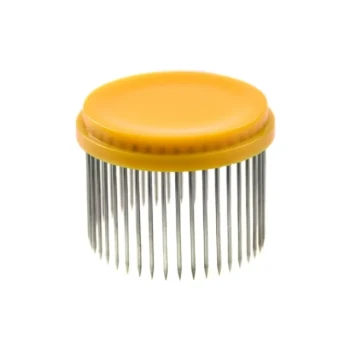
To understand the flaw of the standard cage, it is helpful to look at the press-in cage method.
A press-in cage covers emerging brood and honey, allowing the queen to roam on a small patch of comb. Crucially, she begins laying eggs while still protected under the screen.
When she is eventually released from a press-in cage, she is already a "laying queen" surrounded by her own brood. This eliminates the vulnerability of the "non-laying" phase that plagues standard cage releases.
Managing Standard Cage Release
Since a standard cage does not allow for prior egg-laying, you must control the environment to compensate for this vulnerability.
You must minimize disturbance during the release check. If the workers are biting the cage or banking tightly against the screen, do not release her. The colony is signaling that the transition moment will likely result in baling (killing) the queen.
Making the Right Choice for Your Goal
To ensure the survival of your queen, you must match your method to your risk tolerance.
- If your primary focus is efficiency: Use the standard cage but monitor the colony's behavior closely; do not release the queen if the workers show any sign of aggression or "clumping" on the cage.
- If your primary focus is maximum success rates: Consider using a press-in cage over emerging brood to allow the queen to begin laying eggs before she is fully exposed to the adult population.
The safest queen is a laying queen; until she produces eggs, she remains on probation.
Summary Table:
| Factor | Standard Cage Impact | Risk Level | Mitigation Strategy |
|---|---|---|---|
| Biological Status | Queen is non-laying; viewed with suspicion | High | Delay release until workers show calm behavior |
| Hive Environment | Opening hive creates stress/vibrations | Medium | Minimize disturbance; avoid release during agitation |
| Acceptance Sign | Based on pheromones only (no brood) | High | Check for "clumping" or biting on the cage screen |
| Alternative | No protection for laying activity | Very High | Use press-in cages to allow egg-laying before release |
Maximize Your Apiary Productivity with HONESTBEE
Successful queen introduction is just the beginning of a thriving commercial operation. At HONESTBEE, we empower commercial apiaries and distributors with the professional-grade tools needed to scale efficiently. From high-precision hive-making and honey-filling machines to a full spectrum of beekeeping hardware and essential industry consumables, our comprehensive wholesale offering is designed for your success.
Whether you are stocking your distribution network or upgrading your facility, we provide the reliable equipment and honey-themed cultural merchandise you need to stand out in the market. Contact us today to explore our wholesale solutions and see how our expertise can grow your business!
Related Products
- Durable Galvanized Steel Spring Queen Bee Cage
- Professional Queen Bee Introduction and Transport Cage
- Professional Queen Cage with Sliding Gate and Feeder Plug
- Professional Round Push-In Queen Cage with Metal Tines
- Premium Wood and Steel Push In Queen Cage
People Also Ask
- Why are specialized queen bee cages used for the banking of mated queen bees? Maximize Commercial Apiary Storage Efficiency
- What is the mechanism of action for using temporary queen bee cages? Master Successful Queen Introduction
- What is the step-by-step process for installing a queen bee's cage onto a frame? Ensure Hive Acceptance Safely
- What is the optimal placement for a queen bee cage? Essential Strategies for Successful Re-queening
- What are the advantages and disadvantages of introducing a queen bee by embedding the cage? Boost Your Queen Acceptance