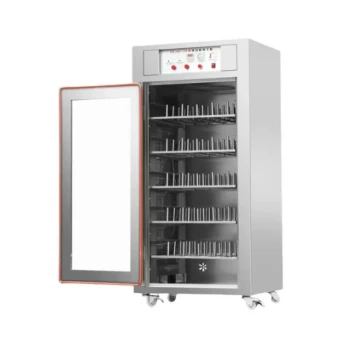
The necessity of vacuum freeze-drying lies in its unique ability to decouple dehydration from thermal damage. By utilizing sublimation in a low-temperature vacuum environment, this method removes moisture from royal and worker jelly without subjecting the samples to heat. This is the only reliable way to prepare these substances for analysis while retaining their complex, heat-sensitive bio-chemical structures.
Vacuum freeze-drying is essential for accurate analysis because it preserves volatile fatty acids like 10-HDA and heat-sensitive proteins. This process creates a stable, pre-treated sample that allows for precise determination of moisture content and dry matter ratios without the degradation caused by traditional thermal drying.
Preserving Chemical Integrity
Preventing Thermal Degradation
Royal jelly and worker jelly are biologically complex substances rich in heat-sensitive proteins and vitamins. Traditional drying methods rely on evaporation via heat, which can denature proteins and alter the sample's chemical profile. Vacuum freeze-drying bypasses this by keeping the sample frozen during dehydration.
Retaining Volatile Acids
A critical quality marker in royal jelly is 10-hydroxy-2-decenoic acid (10-HDA), a volatile fatty acid. Standard thermal drying runs the risk of evaporating or degrading these volatile components. Freeze-drying ensures these specific fatty acids remain intact for accurate quantification.
Enhancing Analytical Precision
Accurate Moisture Baselines
To determine the true ratio of dry matter components, you must remove water completely without altering the remaining solids. Freeze-drying achieves this through sublimation, where ice turns directly into vapor. This provides a reliable, unaltered dry baseline for subsequent calculations.
Sample Stabilization and Concentration
The process converts fresh jelly into a stable powder state. This stabilizes the product for long-term storage and concentrates the active ingredients. This concentration enhances the accuracy of both physical and chemical analyses by increasing the signal strength of bio-active components.
Understanding the Trade-offs
Process Complexity
Unlike simple thermal drying, this method requires maintaining a strict vacuum environment and extremely low temperatures (often around -60°C). This adds a significant layer of operational complexity to the sample preparation workflow.
Resource Intensity
Achieving sublimation requires specialized, industrial-grade equipment capable of precise environmental control. This makes the process more resource-intensive and technically demanding than using standard drying ovens.
Making the Right Choice for Your Analysis
Determining whether to use this method depends on the specific data you require from the jelly samples.
- If your primary focus is Chemical Profiling: You must use freeze-drying to protect sensitive biological markers like 10-HDA and proteins from heat-induced degradation.
- If your primary focus is Sample Stability: You should use this method to convert fresh samples into a powder form that allows for accurate analysis even after storage.
By choosing vacuum freeze-drying, you ensure that your analytical data is an accurate representation of the jelly's true biological composition.
Summary Table:
| Feature | Vacuum Freeze-Drying | Traditional Thermal Drying |
|---|---|---|
| Mechanism | Sublimation (Ice to Vapor) | Evaporation (Heat-based) |
| Temperature | Low Temperature (approx. -60°C) | High Temperature |
| Bio-active Preservation | High (Protects 10-HDA & Proteins) | Low (Risk of denaturation) |
| Sample State | Stable, concentrated powder | Often degraded or altered |
| Analysis Accuracy | High precision for chemical profiling | Lower due to thermal damage |
Elevate Your Bee Product Quality with HONESTBEE
Precise processing is the difference between premium royal jelly and a degraded product. At HONESTBEE, we empower commercial apiaries and global distributors with the professional-grade machinery needed to maintain biological integrity. From advanced vacuum freeze-dryers and honey-filling machines to a full spectrum of beekeeping tools and consumables, our comprehensive wholesale solutions are designed to scale your operations.
Ready to enhance your production efficiency and product value? Contact HONESTBEE today to discover how our specialized hardware and industry expertise can support your business growth.
References
- Ying Wang, Baohua Xu. Comparison of the nutrient composition of royal jelly and worker jelly of honey bees (Apis mellifera). DOI: 10.1007/s13592-015-0374-x
This article is also based on technical information from HonestBee Knowledge Base .
Related Products
- 0.5T Capacity Honey Dehumidifier Dryer with Vacuum Heating and Thickening Filtering Machine
- HONESTBEE Professional Cabinet Bottle Dryer
- High Quality Honey Dehumidifier Dryer Thickening Machine for Beekeeping
- Economy Small Scale Honey Dryer Dehumidifier Thickening Machine
People Also Ask
- What is the primary function of professional dehumidification equipment in honey processing? Stability & Quality
- How to dry up honey? The Safe Guide to Stabilizing Honey and Preventing Fermentation
- What is the process for using a dehumidifier to lower honey's moisture content? Expert Drying Techniques
- How to decrease moisture in honey? Prevent Fermentation and Ensure Long-Term Quality
- How to remove humidity from honey? Protect Your Harvest from Fermentation