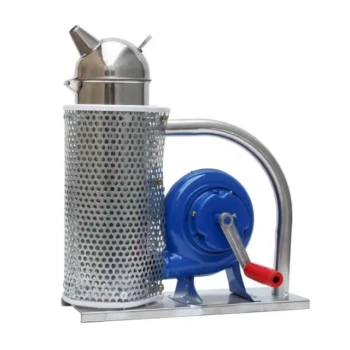
A professional Beekeeping Smoker operates by burning fuel to generate cool smoke that fundamentally disrupts the defensive mechanisms of a honeybee colony. This tool functions by masking chemical communication signals—specifically alarm pheromones—while simultaneously triggering a survival instinct that causes bees to prioritize resource preservation over aggression.
Core Takeaway: The smoker acts as a biological "jamming signal" rather than a simple repellent. By interrupting the colony's alarm network and inducing a feeding response, it creates a temporary truce that allows for safe hive maintenance and reduces bee mortality.
The Biological Mechanisms of Action
To understand the smoker's effectiveness, one must look beyond the smoke itself to how it interacts with bee biology and social structure.
Disrupting Chemical Communication
Honeybees rely heavily on olfactory signals to coordinate defense. When a hive is threatened, guard bees release alarm pheromones to alert the rest of the colony to attack.
The smoke physically and chemically masks these pheromones. By filling the air with combustion particulates, the smoker effectively cuts the communication line between the guard bees and the rest of the hive, preventing a localized defensive response from turning into a colony-wide attack.
Triggering the Survival Response
The presence of smoke mimics a natural forest fire, a catastrophic threat to a bee colony in the wild.
This triggers an ancient evolutionary "fire-escape" response. Instead of defending the hive, the bees instinctively begin to consume (gorge on) stored honey. They do this to save as many resources as possible in case they are forced to abandon the hive and migrate to a new location.
Mechanical Constraint on Aggression
The act of gorging on honey has a secondary, physical effect on the bees' ability to sting.
When a bee fills its stomach with honey, its abdomen becomes distended and less flexible. This physical rigidity makes it mechanically difficult for the bee to curl its abdomen into the necessary position to deploy its stinger, significantly reducing the likelihood of stings during harvesting or inspection.
Critical Operational Factors: Temperature and Fuel
While the mechanism is simple, the execution requires precision. The definition of "smoke" in this context is specific.
The Requirement for "Cool" Smoke
Professional smokers are designed to generate cool smoke, not hot exhaust.
Hot smoke can singe the bees' delicate wings and antennae, causing permanent injury and inciting panic rather than calm. Cool smoke achieves the necessary pheromone masking without physically harming the insects or raising the internal temperature of the hive.
Fuel Selection and Combustion
The device relies on burning specific plant materials or fuels that smolder rather than flame openly.
This slow combustion produces the dense, white smoke required to effectively permeate the hive. The goal is to maintain a steady stream of smoke that remains cool to the touch as it exits the nozzle.
Understanding the Trade-offs
While the smoker is an essential safety tool, improper use can lead to negative outcomes.
The Risk of Over-Smoking
There is a distinct difference between calming a hive and choking it. Excessive smoke can cause high stress, leading to a disorganized colony that is difficult to manage.
Over-smoking can also taint the flavor of the honey and wax, lowering the quality of the harvest. The objective is to use the minimum amount of smoke necessary to interrupt pheromone transmission, not to fumigate the hive.
Making the Right Choice for Your Goal
The smoker is a tool of modulation, not force. How you use it depends on your immediate objective.
- If your primary focus is Operator Safety: Prioritize applying smoke at the entrance and under the lid before opening to immediately mask the initial release of alarm pheromones.
- If your primary focus is Bee Health: Ensure the smoke is cool and white; blue or black smoke indicates high heat that will injure the colony.
- If your primary focus is Product Quality: Use smoke sparingly during honey harvesting to prevent combustion residues from affecting the flavor profile of the honey or wax.
Mastering the smoker is about balancing the disruption of defense with the preservation of the colony's wellbeing.
Summary Table:
| Mechanism | Action Type | Primary Effect on Bees |
|---|---|---|
| Pheromone Masking | Chemical | Disrupts alarm signals; prevents colony-wide aggression. |
| Survival Response | Biological | Triggers honey gorging; shifts focus from defense to preservation. |
| Physical Constraint | Mechanical | Distends the abdomen; makes it difficult for bees to deploy stingers. |
| Cool Smoke Delivery | Safety | Prevents singeing of wings and antennae; maintains hive temperature. |
Elevate Your Apiary Performance with HONESTBEE
At HONESTBEE, we specialize in providing professional-grade beekeeping solutions designed for commercial apiaries and global distributors. Whether you need precision-engineered beekeeping smokers, advanced hive-making machinery, or automated honey-filling systems, our comprehensive wholesale offering is built to scale your operations.
From essential industry consumables to specialized hardware and honey-themed cultural merchandise, we deliver the tools you need to ensure colony health and maximize harvest quality.
Ready to upgrade your equipment?
Contact our expert team today to discuss how our full-spectrum supply chain can support your business growth!
References
- Oswald Gilbert Dingtoumda, Zakaria Ilboudo. Peasant perception of beekeeping constraints and practices in large honey production areas in Burkina Faso. DOI: 10.1186/s13002-024-00690-z
This article is also based on technical information from HonestBee Knowledge Base .
Related Products
- Stainless Steel Honey Bee Smoker Hive and Honeycomb Smoker for Beekeeping
- Miniature Stainless Steel Bee Smoker for Beekeeping
- Professional Bee Smoker with Elongated Spout and Durable Bellows for Beekeeping
- Electric Bee Smoker European Style Bee Hive Smoker for Beekeeping
- Galvanized Beekeeping Smoker for Honey Bee and Apiculture
People Also Ask
- What are bee smokers made out of? Choose the Right Material for Your Apiary
- What type of bee smoker is recommended for a beginner? Top Picks for Easy Hive Management
- Why is a stainless steel bee smoker considered indispensable? Master Hive Management with Cool Smoke Technology
- Why is a specialized bee smoker considered a critical tool for apiary safety? Master Hive Control & Productivity
- How do bee smokers and colored light sources work together to assist in night-time honey harvesting? Expert Strategies