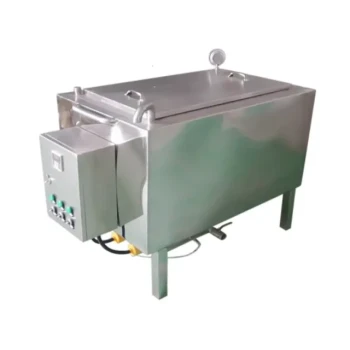
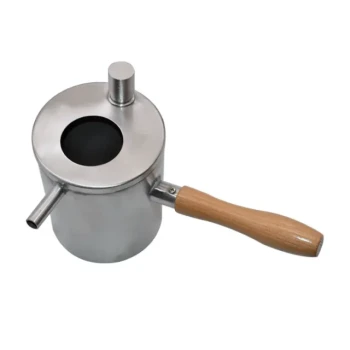
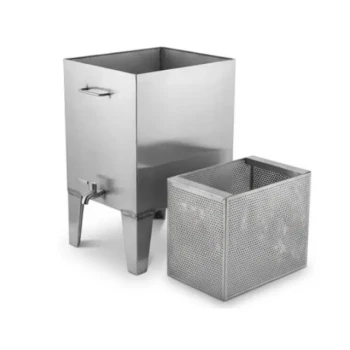
The primary function of an industrial-grade beeswax press is to apply deep, uniform pressure to heated honeycomb or cappings to mechanically separate liquid wax from solid impurities. This process forces the molten wax out of absorbent waste materials, such as cocoons and residue, ensuring the recovery of wax that gravity filtration alone cannot retrieve.
Core Takeaway Heating honeycomb melts the wax, but significant amounts often remain trapped within solid waste (slumgum). An industrial press bridges this gap by applying powerful mechanical force to maximize yield, reducing resource waste and producing high-purity raw material suitable for industrial applications.
The Mechanics of Pressure Extraction
Applying Deep Pressure
The defining feature of this equipment is its ability to apply deep pressure to the raw material.
Unlike simple gravity straining, the press exerts force on heated old honeycombs or cappings. This physical compression squeezes the liquid wax out of the porous structures of the hive waste.
Separating Physical Impurities
The press is specifically engineered to handle the solid-liquid separation phase.
It effectively segregates the valuable liquid wax from physical contaminants like cocoons and residue. By compacting the solids, the press releases the wax while keeping the impurities contained within the press cake.
Why Industrial-Grade Extraction Matters
Maximizing Resource Recovery
The primary advantage of using an industrial-grade press is the significant reduction in resource waste.
Without sufficient pressure, a high percentage of wax remains absorbed in the waste material. The press maximizes the recovery rate, ensuring that the operation captures the highest possible volume of natural beeswax from the raw comb.
Producing High-Quality Raw Materials
The output of a beeswax press is high-purity natural beeswax.
By efficiently removing the bulk of physical impurities, the press provides the necessary quality of raw material required for producing beeswax foundations. It also prepares the wax for use in other high-grade industrial consumables.
Understanding the Limitations and Distinctions
Physical vs. Chemical Separation
It is critical to understand that a wax press is designed for physical separation, not chemical purification.
While it excels at removing solids like cocoons, it does not remove chemical contaminants absorbed into the wax itself. Removing specific chemical residues, such as acaricides (e.g., amitraz), typically requires ultrasonic treatment or solvent processes, as noted in advanced extraction methodologies.
Pressure vs. Centrifugal Force
The press operates on the principle of compression, which is distinct from centrifugal separation.
A centrifuge utilizes high-speed rotation to separate phases based on density, often used for separating molten wax from liquid solvents or very fine contaminants. The press is better suited for the initial, heavy-duty separation of wax from bulky solid waste.
Making the Right Choice for Your Goal
To select the right equipment for your beeswax processing line, consider your specific purity and yield requirements.
- If your primary focus is Maximum Volume Recovery: Prioritize a high-quality beeswax press to squeeze every drop of liquid wax from the absorbent cocoons and slumgum.
- If your primary focus is Chemical Decontamination: Acknowledge that a press is only the first step; you will likely need supplementary technologies like ultrasonic cleaners or centrifugal separators to remove microscopic or chemical residues.
Effective beeswax processing relies on mechanical pressure to turn waste-heavy raw comb into a valuable industrial commodity.
Summary Table:
| Feature | Description |
|---|---|
| Primary Function | Mechanical separation of molten wax from solid impurities (slumgum). |
| Mechanism | Applies deep, uniform pressure to heated raw material to force out liquid wax. |
| Key Benefit | Minimizes resource waste by recovering wax that gravity filtration cannot. |
| Output Quality | Produces high-purity raw wax suitable for foundations and industrial use. |
Optimize Your Wax Extraction with HONESTBEE
Are you looking to scale your beeswax production and eliminate resource waste? HONESTBEE provides commercial apiaries and distributors with the high-performance machinery needed to succeed in a competitive market. Our comprehensive wholesale offering includes:
- Precision Machinery: Industrial beeswax presses, honey-filling machines, and specialized hive-making hardware.
- Beekeeping Equipment: A full spectrum of professional-grade tools for large-scale operations.
- Essential Consumables: A wide array of industry-standard supplies and honey-themed cultural merchandise.
Maximize your operational efficiency and ensure the highest purity for your beeswax today. Contact HONESTBEE for professional wholesale pricing and consultation.
References
- Getachew Worku Alebachew, Tewabe Mihret Eshetie. Assessment of Beekeeping Practices of Youth Groups in Eastern Amhara, Ethiopia. DOI: 10.1080/0005772x.2019.1637191
This article is also based on technical information from HonestBee Knowledge Base .
Related Products
- Electric Commercial Beeswax Melter for Factory Use
- Beeswax Machine Press Embosser Wax Foundation Mold Printer Bee Hive Equipment Making Sheet
- Manual Beeswax Flat Sheet Machine for Beeswax Processing
- 10L Stainless Steel Honey Wax Press Extractor for Wax Cappings
- Stainless Steel Manual Honey Press with Guard for Pressing Honey and Wax
People Also Ask
- Why might a commercial beekeeper prefer an electric beeswax melter? Maximize Profit with Speed & Scale
- What safety precautions should be taken when melting beeswax? A Guide to Flammable Wax Handling
- What types of beeswax melters are available for different scales of beekeeping? Solar vs. Electric Melters Compared
- What are the three popular methods for melting beeswax? Safely Process Your Wax with Ease
- How do you melt beeswax without making a mess? Master Safe & Clean Techniques