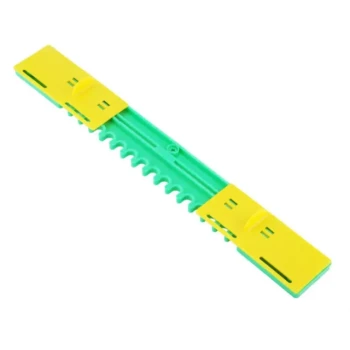
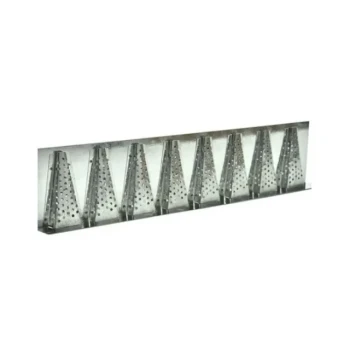
The primary function of the multi-channel tunnel design is to act as a physical flow regulator, forcing bees to pass through the sensing area individually in a single-file line. By preventing bees from entering in clusters, this structural constraint allows the electronic gate to accurately distinguish between incoming and outgoing traffic and eliminates the confusion caused by simultaneous movement.
The core challenge in bee monitoring is converting chaotic biological movement into linear data. The multi-channel tunnel solves this by creating a controlled physical environment where optical sensors can isolate and count one insect at a time, drastically reducing false alarms.
The Mechanics of Precision Monitoring
Enforcing Single-File Passage
In a busy hive, bees often move in unpredictable clusters. The multi-channel tunnel physically guides bees, forcing them to separate and pass through the gate one by one. This mechanical separation is the fundamental requirement for converting a swarm of movement into individual data points.
Enabling Directional Counting
To assess colony health, you must differentiate between a forager leaving and a forager returning. Because the tunnel constrains lateral movement, the system can reliably track the sequence of motion. This ensures accurate directional counting of both incoming and outgoing traffic.
Enhancing Sensor Reliability
Creating a Stable Environment
Optical sensors require a controlled field of view to function correctly. The tunnel design provides a stable detection environment by isolating the bee within a specific physical channel. This defined space ensures that the sensor is measuring the insect, not background noise or adjacent activity.
Reducing False Alarms
Without channels, two bees passing a sensor at once could be counted as a single, large object or cause a reading error. By physically preventing overlap, the design significantly reduces false alarms. This ensures that the data collected reflects actual bee counts rather than sensor confusion caused by multiple insects.
Understanding the Trade-offs
Flow Restriction vs. Accuracy
The tunnel design prioritizes counting precision over unrestricted movement. By forcing a single-file protocol, the gate inherently creates a bottleneck compared to an open entrance. While this is necessary for sensor accuracy, it fundamentally changes how bees interact with the hive entrance.
Physical Complexity
Implementing a multi-channel system adds structural complexity to the hive entrance. Unlike a simple open slot, these gates require precise fabrication to ensure the channels are sized correctly to admit bees without causing injury or blockage.
Making the Right Choice for Your Goal
When evaluating bee colony monitoring systems, the physical design of the gate is just as important as the electronic sensors.
- If your primary focus is absolute counting accuracy: Prioritize designs with rigid multi-channel tunnels that strictly enforce single-file passage to minimize optical occlusion.
- If your primary focus is minimizing false positives: Ensure the tunnel structure is deep enough to provide a fully stable environment that shields optical sensors from external interference.
The multi-channel tunnel is the essential hardware component that transforms the chaotic traffic of a bee colony into an organized stream of reliable data.
Summary Table:
| Feature | Primary Function | Impact on Data Accuracy |
|---|---|---|
| Single-File Passage | Prevents clustering at sensors | Eliminates counting errors from overlapping bees |
| Directional Tracking | Constrains lateral movement | Ensures precise distinction between incoming and outgoing traffic |
| Stable Environment | Isolates bees in fixed channels | Minimizes background noise and sensor interference |
| Flow Regulation | Acts as a physical bottleneck | Converts chaotic swarm movement into linear, measurable data |
Maximize Your Colony Productivity with HONESTBEE Solutions
Precise monitoring is the backbone of modern apiculture. At HONESTBEE, we understand the technical needs of commercial apiaries and distributors. Whether you require high-precision beekeeping machinery, honey-filling automation, or a full spectrum of durable hive hardware, we provide the industrial-grade tools necessary for scaling your operations.
Our Value to You:
- Wholesale Excellence: Comprehensive supply of tools and consumables tailored for large-scale distributors.
- Advanced Machinery: From hive-making to honey processing, we equip you with the latest industry technology.
- Market Growth: Boost your brand with our unique honey-themed cultural merchandise and specialized equipment.
Ready to upgrade your beekeeping infrastructure? Contact HONESTBEE today to explore our wholesale offerings and technical equipment solutions!
References
- Ilyas Potamitis, Spyros Kouzoupis. A novel electronic gate that identifies and counts bees based on their RGB backscattered light. DOI: 10.1051/matecconf/201929201005
This article is also based on technical information from HonestBee Knowledge Base .
Related Products
- Multi-Functional Sliding Hive Entrance for Beekeeping
- Steel Round Disc Entrance Reducer for Flexzion Bee Hive Nuc Box Gate
- Multi-Functional Rotary Hive Entrance Disc for Beekeeping
- Beehive Entrance Reducer Guardian Metal Hive Entrance for Bees
- Honey Gate Valve with Ergonomic Ball Handle Plastic Bee Honey Tap for Beekeeping Bottling and Honey Extractor Equipment
People Also Ask
- What roles does the hive entrance (piquera) play in beehive management and colony health? Essential Guide for Pro Apiaries
- Where is the hive entrance typically located? Optimize Your Hive's Health and Honey Production
- What role does the size of the entrance play in hive ventilation? Master Beehive Climate Control
- What is the best entrance for a bee hive? Maximize Colony Health & Honey Production
- What happens if you block the entrance to a bee hive? Avoid This Dangerous Mistake