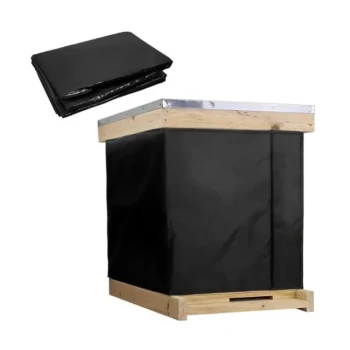
The use of a cardboard layer is a critical environmental control method. In experimental honeybee research, this barrier serves to strictly block external light, effectively mimicking the dark, enclosed conditions of a natural hive. By removing visual stimuli, researchers prevent the bees from becoming overexcited, ensuring they remain in a stable physiological state necessary for accurate data collection.
Honeybees are highly sensitive to photic stimulation; exposure to artificial or excessive light in a lab setting can significantly alter their behavior. Covering cages with cardboard creates a "pseudo-hive" environment, eliminating light-induced stress to ensure experimental results reflect natural biological responses rather than agitation.
The Biology Behind the Protocol
Mimicking the Natural Habitat
In the wild, honeybees spend the vast majority of their lives inside dark cavities or hive boxes. They are biologically adapted to function and rest in low-light or no-light environments.
Cardboard covers serve to replicate this darkness within the laboratory. This aligns the artificial experimental setup with the insect's evolutionary expectations, reducing the shock of confinement.
Managing Sensory Input
Bees are extremely responsive to light cues, which they use for foraging and orientation. In a laboratory cage, unmanaged light acts as a powerful, unnatural stimulant.
The cardboard acts as a sensory shield. It prevents the bees from reacting to laboratory lighting or movement outside the cage, keeping their focus within the immediate environment.
Ensuring Experimental Integrity
Reducing Behavioral Artifacts
When bees are exposed to constant light while confined, they often become agitated or "overexcited." This agitation introduces variables that have nothing to do with the experiment at hand.
By blocking light, the cardboard layer minimizes these non-natural reactions. This ensures that any behavioral changes observed are due to the experimental treatment, not environmental stress.
Maintaining Physiological Stability
Stress impacts biology at a cellular and metabolic level. If a bee is constantly stimulated by light, its physiological state fluctuates away from the baseline.
The dark environment maintains a stable physiology. This stability is essential for researchers who need to measure subtle biological changes without the "noise" of light-induced metabolic spikes.
Operational Considerations and Trade-offs
The Challenge of Observation
The primary utility of cardboard—opacity—is also its main drawback for the researcher. It completely blocks the view of the subjects.
To check on the bees, the cover must be lifted. This action reintroduces light and can momentarily disrupt the stable state the cardboard was meant to preserve, potentially skewing immediate observations.
Thermal Implications
While the primary reference focuses on light, it is important to note that cardboard is an insulator.
In creating a dark environment, the cover may also trap heat produced by the bees. Researchers must ensure that "mimicking the hive" darkness does not accidentally create a high-heat environment that stresses the bees in a different way.
Optimizing Your Experimental Design
To ensure your data is valid, you must prioritize the mental and physical state of your subjects.
- If your primary focus is behavioral baselining: Ensure the cardboard provides total coverage to eliminate all external light triggers that cause hyperactivity.
- If your primary focus is physiological measurement: Use the cover to keep metabolic rates stable, but be mindful of airflow to prevent the cage from overheating.
By rigorously controlling light exposure, you transform a simple cage into a reliable scientific instrument capable of yielding accurate biological data.
Summary Table:
| Feature | Function in Research | Impact on Honeybee Behavior |
|---|---|---|
| Light Blocking | Mimics natural dark hive cavities | Prevents overexcitation and photic stress |
| Sensory Shield | Eliminates visual stimuli from lab movement | Ensures focus remains on experimental variables |
| Insulation | Provides a thermal barrier | Maintains temperature but requires airflow monitoring |
| Environmental Control | Creates a stable "pseudo-hive" | Reduces metabolic noise for accurate biological data |
Elevate Your Apiary Operations with HONESTBEE
At HONESTBEE, we understand that precision in beekeeping—whether in the lab or the field—is the key to success. As a dedicated partner to commercial apiaries and global distributors, we provide more than just supplies; we provide solutions.
From high-performance honey-filling and hive-making machinery to a full spectrum of beekeeping tools and essential consumables, our wholesale portfolio is designed to enhance efficiency and yield. Whether you are scaling a commercial operation or looking to supply the industry with top-tier hardware and honey-themed cultural merchandise, HONESTBEE delivers the quality you need to thrive.
Ready to optimize your beekeeping business? Contact us today to explore our comprehensive wholesale offerings!
References
- Fiona Lupi-Peate. Effects of Hydroxymethylfurfural in High Fructose Corn Syrup on Honeybee Health. DOI: 10.4079/2578-9201.1(2022).04
This article is also based on technical information from HonestBee Knowledge Base .
Related Products
- Inner Beehive Cover for Beekeeping Bee Hive Inner Cover
- Acrylic Lid Beekeeping Honey Extractor for Beekeepers
- Professional Insulated Winter Hive Wrap for Beekeeping
- Assembled Wooden Bee Frames with Plastic Foundation for Durability and Convenience by HONESTBEE
People Also Ask
- What is the purpose of the inner cover in a beehive? A Key to Hive Health & Easy Management
- What is the function and placement of an inner cover in a beehive? Essential Hive Management Guide
- What is the purpose of the inner and outer covers in a beehive? Essential for Hive Health & Management
- What is a beehive's inner cover and how is it used? Essential Guide for Hive Insulation and Ventilation
- What are the functions of the inner and outer covers on a beehive? Essential Guide for Hive Protection and Management