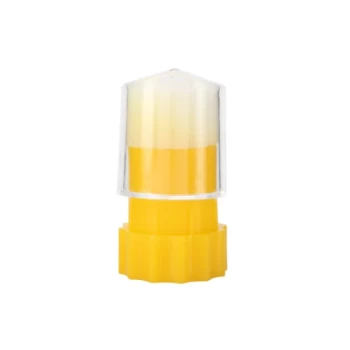
The practice of marking queen bees involves placing a standardized colored ink dot on the queen's thorax. This simple visual aid serves two fundamental purposes in commercial apiaries: it drastically reduces the time required to locate the queen during hive inspections and serves as a permanent record of the queen's age based on an international color code.
Core Takeaway Marking queens transforms colony management from a guessing game into a streamlined process. It allows beekeepers to instantly assess the age and location of their most critical asset—the queen—ensuring timely replacement and consistent colony productivity.
The Mechanics of Efficiency
Rapid Visual Identification
In a commercial hive containing thousands of worker bees, finding a single queen can be labor-intensive.
Marking creates an immediate visual contrast. The colored dot allows the beekeeper to spot the queen quickly against the backdrop of workers and comb.
This efficiency is critical for large-scale operations where minimizing the duration of hive inspections directly impacts labor costs and operational speed.
Age Tracking and Replacement Schedules
The color of the mark is not random; it follows a standardized international code representing the year the queen was born.
This coding system provides an undeniable record of the queen's age.
By identifying the specific year a queen was introduced, beekeepers can objectively determine when she is approaching the end of her prime productive lifespan.
Strategic Colony Management
Preventing Production Decline
As the central production unit of the colony, the queen's egg-laying rate directly dictates honey yield and colony strength.
Supplementary data indicates that timely replacement of aging queens is essential to prevent colony decline.
The marking system empowers beekeepers to identify and cull older queens before their fertility drops, replacing them with high-quality reared queens to maintain consistent production levels.
Facilitating Genetic Management
Professional queen rearing involves selecting for superior genetic traits and reproductive vigor.
Marking ensures that these high-value queens are easily trackable once introduced into a colony.
It distinguishes the specific, selected queen from any potential "supersedure" queens (new queens raised naturally by the colony) that may not possess the same desirable genetic characteristics.
Understanding the Limitations
Age vs. Performance
While marking reliably indicates age, it does not guarantee performance.
A queen may be young (indicated by a current-year color) yet still be "weak" or genetically inferior.
Beekeepers must not rely solely on the mark; they must cross-reference the queen's age with the actual brood pattern and colony strength to ensure she possesses the necessary reproductive vigor.
The Necessity of Standardization
The system relies entirely on adherence to the international color code.
If a beekeeper fails to follow the standard rotation of colors, the mark becomes a simple locator tool rather than a management data point.
Effective management requires that the marking process be integrated into a broader strategy of standardized record-keeping.
Making the Right Choice for Your Goal
To leverage marked queens effectively in your operation, consider your primary management objectives:
- If your primary focus is Operational Efficiency: Prioritize marking to minimize the time spent searching for queens during routine health checks and hive manipulations.
- If your primary focus is Maximizing Yield: Use the color-coded age data to implement a strict replacement schedule, rotating out queens before their egg-laying rates decline.
By treating the queen's mark as a data point rather than just a visual aid, you ensure the long-term stability and profitability of the apiary.
Summary Table:
| Feature | Purpose | Commercial Benefit |
|---|---|---|
| Color-Coded Ink | Identifies queen's birth year | Simplifies replacement schedules and age tracking |
| Visual Contrast | Locates queen quickly among workers | Reduces labor time and inspection costs |
| Genetic Tracking | Distinguishes reared vs. natural queens | Ensures maintenance of superior genetic traits |
| Performance Link | Pairs age data with brood patterns | Prevents colony decline by identifying weak queens |
Maximize Your Apiary's Productivity with HONESTBEE
Efficient hive management starts with the right tools. At HONESTBEE, we understand the demands of commercial apiaries and distributors. We provide a comprehensive wholesale range of professional beekeeping equipment—from specialized queen-marking tools and hive-making machinery to high-capacity honey-filling systems and essential consumables.
Whether you are scaling your honey production or supplying the industry with hardware and honey-themed cultural merchandise, our portfolio is designed to enhance your operational efficiency and genetic management.
Ready to elevate your beekeeping business? Contact us today to explore our wholesale solutions and see how HONESTBEE can deliver the quality and reliability your operation deserves.
Related Products
- Plastic Long Marker Device for Catching and Marking Bees Queen Bee Marking Tube and Cage
- Queen Bee Marking Pen UNI Medium Point for Queen and Bee Marking
- Queen Bee Marking Pen POSCA Queen Marking Pens for Beekeeping Bee Markers
- Queen Bee Marking Tube Cage Bottle Catcher Holder with Clear Plastic Plunger Marker
- One Hand Yellow Queen Marking Catcher Tube Cage Beekeeper Tool Accessory for Queen Bee
People Also Ask
- Where on the queen bee's body should the mark be applied? Master the Art of Safe Queen Identification
- What are the primary objectives for marking a queen bee? Master Hive Management and Data Tracking
- Why is the physical marking of a queen bee important? Ensure Precise Colony Replacement Cycle Tracking
- How do you capture and immobilize a bee for marking? Master Safe Queen Handling for Your Apiary
- What are the different methods for applying a mark to a queen bee? Master Safe and Effective Queen Marking Techniques