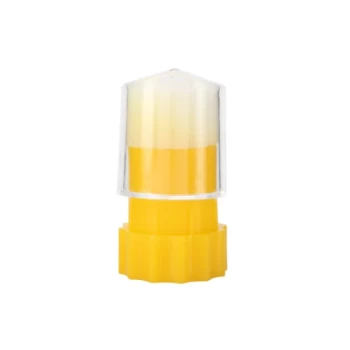
A professional pollen catcher functions as a precise mechanical sieve installed at the hive entrance to harvest botanical resources without manual intervention. By forcing foraging bees to navigate a calibrated grid, the device physically dislodges pollen pellets from their hind legs, capturing 40% to 70% of the incoming load. This material is immediately channeled into a protected collection drawer, ensuring the harvest remains clean for commercial processing.
The device functions as a precision harvester, utilizing specific grid geometry to strip pollen without harming the bee. Its primary role is to secure high-purity, commercial-grade pollen by isolating it immediately in a clean environment to prevent contamination.
The Mechanics of Interception
The Calibrated Grid System
The core component of the catcher is a physical barrier featuring specifically sized internal grids. These openings are engineered to be just large enough for a worker bee to pass through, but too narrow to accommodate the full width of the pollen baskets on their hind legs.
Physical Dislodgement
As the bee squeezes through the restriction, the grid mechanically scrapes or knocks the pollen pellets loose. This leverages the natural entry behavior of the bee to achieve non-contact harvesting.
Gravitational Collection
Once dislodged, the pollen pellets fall directly into a collection tray situated below the bee's path. This separates the product from the bees immediately, preventing them from re-collecting or damaging the harvest.
Ensuring Commercial Quality
Preventing Secondary Contamination
A specific function of professional-grade catchers is the isolation of the harvest. The collection drawer is designed to ensure detached pollen enters a clean container immediately, shielding it from hive debris and external dust.
Preserving Biological Activity
Rapid isolation is critical for maintaining food-grade purity. By securing the pollen in a pollution-proof box, the device minimizes exposure to moisture and prevents mold growth, which preserves the biological integrity of the product.
Understanding the Trade-offs
Impact on Colony Nutrition
The device mechanically removes a significant portion of the hive's resources—typically between 40% and 70%. Beekeepers must balance harvest goals with the colony's need for protein to rear brood and maintain population health.
Variable Efficiency
The "calibrated" grid is not universally effective for all plant types. The capture rate varies depending on the size of the pollen pellets relative to the grid openings; smaller pellets may bypass the trap entirely.
Making the Right Choice for Your Goal
To maximize the utility of a pollen catcher, align its usage with your specific operational objectives.
- If your primary focus is commercial production: Prioritize units with isolated, moisture-proof collection drawers to ensure the harvest meets food-grade purity standards.
- If your primary focus is colony health: Monitor the hive strictly to ensure the 40-70% removal rate does not starve the colony of the protein required for brood rearing.
- If your primary focus is scientific sampling: Utilize the trap for non-destructive, large-scale collection to analyze botanical sources without harming the bee population.
Professional pollen collection is a balance of mechanical precision and biological stewardship.
Summary Table:
| Feature | Specific Function | Commercial Benefit |
|---|---|---|
| Calibrated Grid | Mechanically dislodges pollen pellets from bee legs | Automated, non-contact harvesting |
| Isolation Drawer | Separates pollen from hive debris and dust | Ensures food-grade purity and cleanliness |
| Gravity Flow | Channels pellets into a protected lower tray | Prevents re-collection or damage by bees |
| Moisture Shield | Minimizes exposure to external humidity | Preserves biological activity and prevents mold |
Scale Your Pollen Production with HONESTBEE
Are you looking to optimize your commercial apiary's output? HONESTBEE specializes in supplying high-performance beekeeping machinery and tools designed for professional efficiency. From precision pollen catchers and hive-making equipment to advanced honey-filling machines, we provide the full spectrum of hardware and consumables needed by distributors and large-scale operations.
Why partner with HONESTBEE?
- Wholesale Excellence: Comprehensive inventory for global distributors.
- Industrial Strength: Durable machinery built for high-volume processing.
- End-to-End Support: Everything from specialized hardware to honey-themed merchandise.
Ready to enhance your apiary's productivity and product purity? Contact our expert team today to discuss your wholesale needs and discover how our solutions can grow your business.
References
- Violeta Santrač. Biological and economic significance of beekeeping. DOI: 10.7251/eoru2204445s
This article is also based on technical information from HonestBee Knowledge Base .
Related Products
- Gourd Shaped Hanging Wasp Trap Professional Wasp Catcher
- HONESTBEE Professional Telescopic Pole Bee Swarm Catcher
- Plastic Bee Pollen Trap Strips Comb Catcher Collector
- Stainless Steel Pollen Shovel with Wooden Handle
- Professional Multi-Component Bucket Wasp Trap
People Also Ask
- How do professional wasp traps function? Master Physical Control of Oriental Hornets to Protect Your Apiary
- What are the practical advantages of using professional wasp traps and protective equipment in apiary management? Scale Up
- Why replace sugar syrup bait in wasp traps every three days? Ensure Maximum Attraction and Catch Rates
- What role do specialized wasp traps play in wasp control? Enhance Apiary Security and Pest Monitoring
- How can commercial apiary operators mitigate wasp predation around hives using specialized trapping equipment? Effective strategies for wasp control