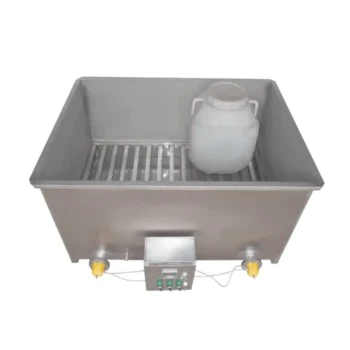
In modern food processing, the only widely approved materials for honey equipment are stainless steel and food-grade plastic. Regulatory standards in many countries strictly prohibit the use of older materials—specifically tinplate, galvanized metal, and aluminum—due to the risk of chemical contamination.
The Core Requirement Because honey is naturally acidic, it actively corrodes reactive metals. Modern equipment must utilize inert materials like 304 or 316 stainless steel to prevent heavy metals from leaching into the final product and to meet international hygiene standards.
The Industry Standard: Stainless Steel
304 Stainless Steel
The most common material for sanitary fittings and extractors is 304 stainless steel.
It provides excellent durability and sufficient corrosion resistance for standard processing environments.
For the majority of commercial and hobbyist operations, this is the benchmark material ensuring the product remains uncontaminated.
316 Stainless Steel
For custom-built processing equipment or operations requiring the highest specification, 316 stainless steel is often utilized.
This grade offers superior resistance to corrosion compared to 304.
It is particularly valuable in high-throughput industrial settings where equipment is subjected to rigorous cleaning cycles and constant exposure to acidic substances.
Surface Hygiene
Beyond material composition, stainless steel provides a crucial mechanical advantage: a smooth, non-porous surface.
This facilitates effective cleaning and sterilization, which is essential for maintaining strict hygiene standards.
It also preserves the sensory quality and biochemical stability of the honey by preventing bacterial harborages.
The Chemistry of Compatibility
Understanding Honey’s Acidity
Natural honey is inherently acidic, with a pH value typically ranging from 3.2 to 4.5.
This acidity is the primary driver behind material selection standards.
While safe for consumption, this pH level is aggressive enough to erode ordinary metal containers over time.
Preventing Metal Migration
The primary function of using approved materials is to stop the migration of metal ions.
Food-grade stainless steel effectively resists acid corrosion, creating a stable barrier between the equipment and the product.
This ensures that the honey remains pure and compliant with export safety standards.
Risks and Materials to Avoid
The Danger of Legacy Equipment
You must strictly avoid older extractors made from tinplate, galvanized metal, or aluminum.
While these were common in the past, modern standards deem them unsafe for direct contact with honey.
If you are retrofitting a facility, replacing these legacy components is mandatory.
Heavy Metal Leaching
When acidic honey contacts non-compliant materials, it triggers chemical leaching.
This reaction can release heavy metal residues into the food supply, including lead, zinc, copper, iron, and cadmium.
This contamination alters the physicochemical properties of the honey and poses significant health risks to the consumer.
Making the Right Choice for Your Goal
If your primary focus is standard commercial compliance:
- Ensure all extractors, tanks, and fittings are explicitly rated as 304 food-grade stainless steel.
If your primary focus is high-end industrial export:
- Consider custom equipment made from 316 stainless steel for maximum corrosion resistance and longevity.
If your primary focus is budget-conscious or small-scale extraction:
- Utilize equipment made from high-quality food-grade plastic, which offers chemical inertness at a lower price point than steel.
If your primary focus is safety and quality:
- Immediately discard any equipment made of aluminum, galvanized steel, or tin, regardless of its condition.
Select inert materials to ensure your product remains as pure as the moment it left the hive.
Summary Table:
| Material Type | Approval Status | Key Benefits | Best For |
|---|---|---|---|
| 304 Stainless Steel | Approved | Corrosion resistance, durable, non-porous | Standard commercial & hobbyist extractors |
| 316 Stainless Steel | Approved | Superior acid resistance, high durability | High-throughput industrial & export processing |
| Food-Grade Plastic | Approved | Inert, lightweight, cost-effective | Small-scale extraction & budget operations |
| Galvanized / Aluminum | Prohibited | None (Risk of heavy metal leaching) | Do Not Use |
Elevate Your Honey Production with HONESTBEE
Ensure your apiary meets global safety standards with professional-grade equipment. As a leading supplier for commercial apiaries and distributors, HONESTBEE provides high-quality 304 and 316 stainless steel machinery designed to resist corrosion and preserve honey purity.
From advanced honey-filling machines and industrial extractors to essential consumables and honey-themed merchandise, we offer a complete wholesale solution tailored to your business needs.
Ready to upgrade your processing facility? Contact us today to discuss our full spectrum of beekeeping tools and hardware!
Related Products
- Electric Double Wall Honey Filtering Machine Purifier Equipment for Honey Processing Plant
- 0.5T Capacity Honey Dehumidifier Dryer with Vacuum Heating and Thickening Filtering Machine
- Heavy Duty Stainless Steel Honey Processing Machine Decrystallizing Tank
- Double Wall Honey Heating Stirring Homogenizer Mixing Machine with Various Capacity
- Economy Honey Homogenizer Mixer and Melting Machine for Beekeeping
People Also Ask
- What types of equipment are used in honey filtering? Build an Efficient System for Pure, Marketable Honey
- What is the process of filtering honey? A Guide to Clean, Pure, and Market-Ready Honey
- What is the overall importance of using the right equipment in honey filtering? Boost Quality & Marketability
- What are the benefits of drying honey filtering equipment after use? Protect Your Honey Quality & Equipment Investment
- Why is filtering important in honey processing, and what equipment is used? A Guide to Quality & Efficiency