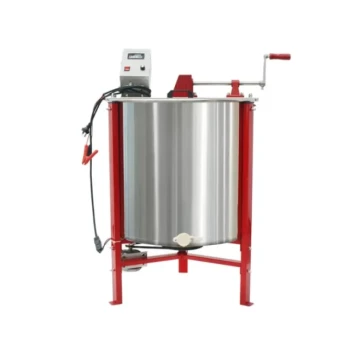
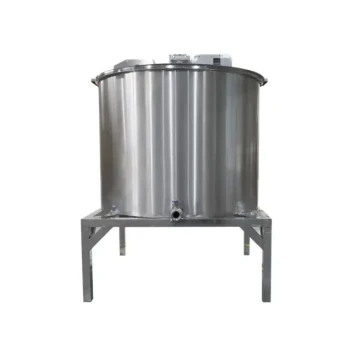
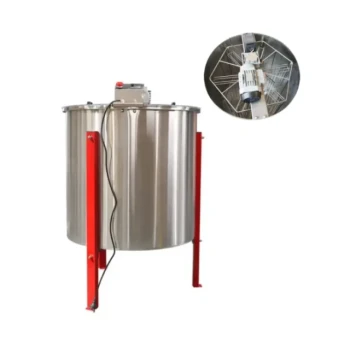
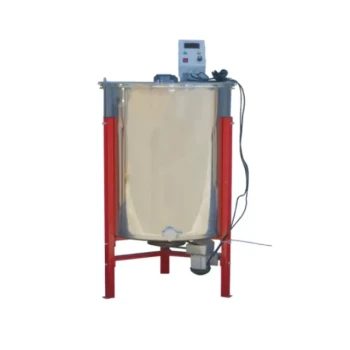
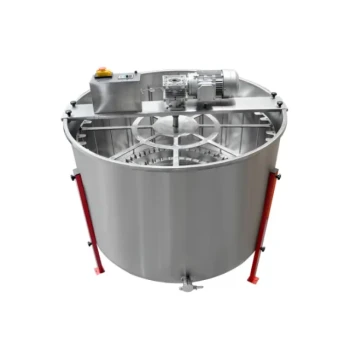
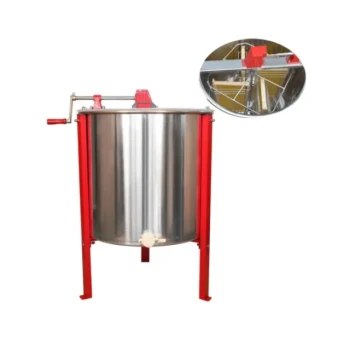
Honey flow rate and frame handling efficiency are governed primarily by temperature, viscosity, extractor design, machine capacity, and operator technique. Warmer honey is less viscous, so it leaves the comb and flows through outlets faster. Standard extractors also require operators to flip frames to empty both sides, while balanced loading and properly matched equipment reduce interruptions, mechanical strain, and comb damage.
The most efficient extraction workflow combines temperature control, consistent honey supply, balanced frame loading, and high-capacity equipment. These factors determine how quickly honey leaves the comb and how much labor is required to handle frames between extraction cycles.
What Determines Honey Flow Rate?
Honey Temperature Controls Viscosity
Temperature is one of the strongest operational influences on extraction speed. Warmer honey flows more readily, allowing it to drain from the comb and pass through spouts with less resistance.
When honey is too cool, its higher viscosity slows drainage and can extend the time required before frames are fully emptied. Maintaining an appropriate processing temperature therefore supports faster throughput and more consistent recovery.
Raw Honey Consistency Affects Throughput
Professional extraction and filling systems perform more efficiently when the incoming honey supply is consistent. Variations in viscosity can change drainage speed, machine loading, and the timing of downstream filling operations.
For distributors, wholesalers, and commercial apiaries, reliable sourcing and responsive technical support are important because equipment performance depends on the condition of the raw material as well as the machine itself.
Outlet and Collection Capacity Matter
Honey must move efficiently from the frames into the collection area and onward to storage or filling equipment. High-capacity extraction machinery can process larger volumes and reduce delays caused by frequent unloading, transfer, or waiting for collection vessels.
A properly matched extraction line helps maintain a steady workflow from comb loading through honey collection and commercial packaging.
How Frame Handling Affects Efficiency
Standard Extractors Require Frame Flipping
Many standard centrifugal extractors empty one side of a frame before the operator flips it to expose the other side. This manual step adds labor and creates a handling interval between extraction cycles.
Operators must also monitor the frames to confirm that both sides have been adequately emptied. Efficient frame handling therefore depends on organized loading, unloading, and flipping procedures.
Balanced Loading Prevents Interruptions
Frames with unequal weights create rotational imbalance inside the extractor. During high-speed operation, this imbalance can cause bouncing, vibration, mechanical strain, or equipment movement.
Pairing frames of similar weight opposite each other supports smooth rotation and helps protect the drive mechanism, extractor structure, and wax combs. It also reduces the risk of stopping the machine to correct an unstable load.
Comb Integrity Supports Reuse
Centrifugal extraction separates honey while preserving the wax comb when the equipment is correctly operated. Reusable combs can be returned to the hive, reducing the energy bees must spend producing wax and rebuilding nest structure.
For commercial operations, this preservation can shorten the production cycle and support higher total output over time.
Equipment Capacity Reduces Labor Pressure
Higher-capacity machinery can process more frames per cycle and reduce the number of loading and unloading events. This is especially valuable when labor availability, order volume, or delivery commitments place pressure on the extraction schedule.
Capacity should be evaluated alongside frame compatibility, operating temperature requirements, collection volume, and the workflow used by the apiary or processing facility.
How Extraction Technology Changes Handling Requirements
Centrifugal Machines Support Repeated Production
Mechanized centrifugal extractors are designed for repeatable separation of honey from combs. Their main operational advantage is the combination of volume processing and comb preservation.
This makes them suitable for professional apiaries and commercial suppliers that need to maintain output while preparing combs for reuse.
Flow Frames Reduce Conventional Handling
Flow frames allow honey to drain through an internal mechanism when the operator turns a handle. This can reduce the need to remove, transport, and centrifugally spin individual frames.
However, the system changes rather than eliminates operational requirements. Operators still need to verify that the honey is capped and ready for harvest before opening the hive and starting the drainage process.
Flow Frame Drainage Is Temperature-Dependent
Flow frames operate most effectively in warm conditions, with the supplementary reference identifying performance above approximately 24 degrees Celsius. Cooler conditions increase honey viscosity and can slow drainage.
The reported drainage time of 20 to 25 minutes per frame may also make flow frames less suitable where rapid, high-volume extraction is the primary objective.
Understanding the Trade-offs
Faster Flow Requires Controlled Conditions
Heating or maintaining honey at a suitable processing temperature improves flow, but temperature management must be controlled. The operational goal is consistent viscosity and efficient drainage, not uncontrolled heating.
A processing setup should therefore include a repeatable temperature practice that matches the honey, equipment, and desired throughput.
Manual Flipping Adds Labor but Preserves Flexibility
Standard extractors require more operator involvement because frames must be flipped. This increases handling time, but the equipment can remain practical for operations that need a versatile and established extraction method.
The labor impact becomes more significant as frame volume increases or as the business moves toward standardized commercial fulfillment.
Flow Frames Simplify Extraction but Limit Speed
Flow frames can make harvesting more direct, but they have important limitations. Uncapped honey may contain excess water and can ferment, while exposed honey may attract wasps and other insects.
Their temperature dependence and slower per-frame drainage also reduce their suitability for operations that prioritize rapid batch processing and high daily throughput.
Poor Balance Can Damage Equipment and Combs
Improperly balanced frames do more than create noise or vibration. Repeated imbalance can place unnecessary stress on the extractor and increase the likelihood of comb damage or operational stoppages.
Frame pairing should be treated as a standard operating requirement, not an optional adjustment made only when the machine becomes unstable.
Making the Right Choice for Your Goal
Select the operating method and equipment configuration according to the volume, labor model, temperature control, and delivery commitments of the business.
- If your primary focus is maximum extraction speed: Maintain suitable processing temperatures and select high-capacity centrifugal equipment that can support continuous frame loading and honey collection.
- If your primary focus is labor efficiency: Reduce unnecessary handling through organized frame staging, efficient flipping procedures, and equipment sized for the expected batch volume.
- If your primary focus is equipment reliability: Pair frames of similar weight, balance the extractor reel correctly, and operate the machine within its intended capacity.
- If your primary focus is maximum honey recovery: Confirm that honey has sufficient flow characteristics and allow both sides of conventional frames to drain fully before removing them.
- If your primary focus is commercial order fulfillment: Use an integrated workflow that maintains consistent raw honey supply, extraction capacity, collection, and downstream filling performance.
- If your primary focus is comb reuse: Use correctly operated centrifugal equipment that separates honey while preserving wax combs for return to the hive.
Efficient extraction comes from controlling honey condition, matching machinery to production volume, and treating frame handling as a central part of the processing workflow.
Summary Table:
| Factor | Impact on Efficiency | Key Consideration |
|---|---|---|
| Honey Temperature | Warmer honey flows faster, reducing drainage time | Maintain consistent processing temperature |
| Viscosity | Higher viscosity slows flow | Control raw honey consistency |
| Extractor Design | Standard centrifugal vs. flow frames affect handling | Choose based on speed vs. labor |
| Capacity | Larger capacity processes more frames per cycle | Match capacity to production volume |
| Frame Handling | Manual flipping adds labor, balanced loading reduces downtime | Implement organized procedures |
| Comb Integrity | Preserving combs supports reuse and reduces bee workload | Operate extractor correctly |
Maximize your honey extraction efficiency with HONESTBEE's high-capacity extractors and full-spectrum beekeeping equipment. For commercial apiaries and distributors, our one-stop sourcing, rapid delivery, and dedicated support ensure your production stays on track. Leverage our OEM/ODM expertise and premium trading services to boost your profit margins. Contact us today to discuss your needs — our team is ready to provide fast quotes and reliable supply. Get in touch now!
Related Products
- Stainless Steel Manual 8 Frame Radial Honey Extractor Machine for Beehives
- HONESTBEE 72 Frame Industrial Electric Honey Extractor for Beekeeping
- HONESTBEE 6 Frame Three Use Electric Honey Extractor for Beekeeping
- 32 Frame Commercial Electric Honey Extractor for Beekeeping and Honey Production
- HONESTBEE 3-Frame Manual Acrylic Honey Extractor
People Also Ask
- What types of beehive frames are compatible with honey extractor machines? Find the Perfect Match for Your Apiary
- Which type of honey extractor is generally more durable? Focus on Material & Build Quality for Longevity
- What are the key features and benefits of a stainless steel honey extractor? Upgrade to Professional Purity
- Why are manual extractors popular among beginner beekeepers? A Guide to Starting Simple & Saving Money
- What is a manual honey extractor? The Essential Guide to Cost-Effective Beekeeping for Beginners