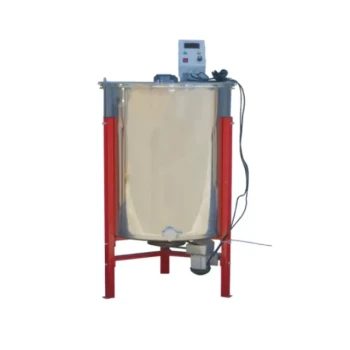
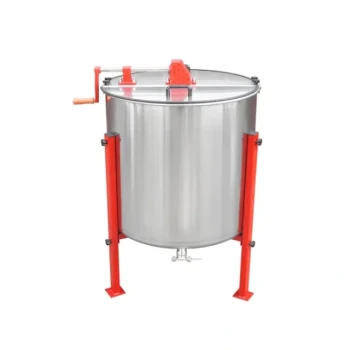
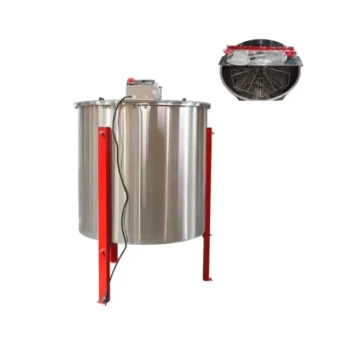
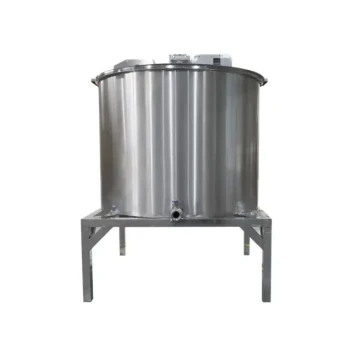
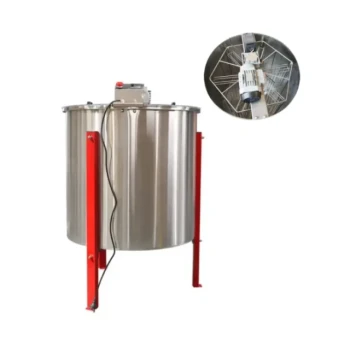
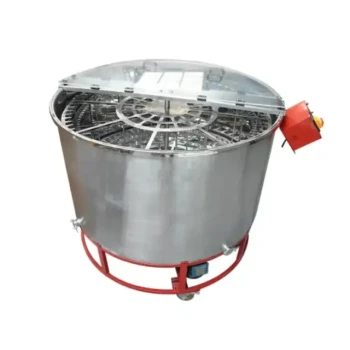
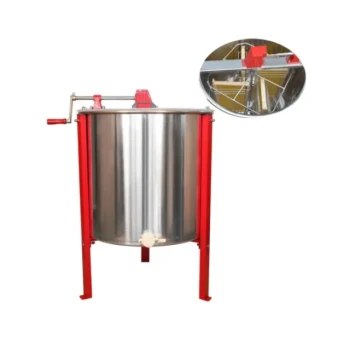
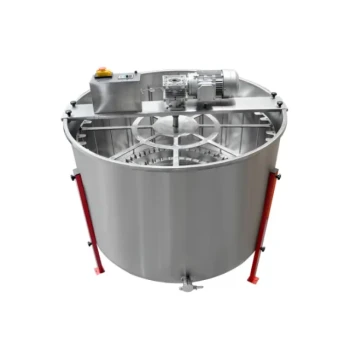
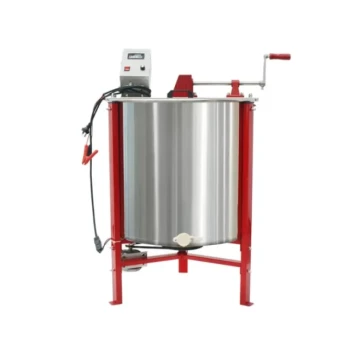
The governing physical principle is centrifugal force. A centrifugal honey extractor operates by spinning honeycomb frames at high speeds, creating an outward inertial force. This force overcomes the surface tension holding the honey in the wax cells, throwing the liquid against the extractor's walls while leaving the solid structure intact.
By harnessing centrifugal force, the extractor separates honey without crushing the delicate wax comb. This non-destructive process is the cornerstone of modern beekeeping efficiency, as it allows frames to be immediately reused rather than rebuilt.
The Mechanics of Extraction
Generating the Force
The extractor secures the hive frames in a central basket or reel. An electric motor or hand crank rotates this basket rapidly around a central axis.
Separation Dynamics
As rotation speed increases, the centrifugal force exerted on the honey becomes greater than the adhesion holding it inside the hexagonal cells. The honey is ejected outwards, hits the inner wall of the drum, and flows down to a collection valve.
Structural Preservation
Crucially, the force is calibrated to remove the viscous liquid without exceeding the structural limit of the beeswax. This separates the harvestable product from the storage medium without physical damage to the frame.
The Biological and Economic Impact
Eliminating Reconstruction Costs
The primary advantage of this physical process is that it yields empty, intact honeycombs. In traditional methods that crush the comb, bees must rebuild the entire wax structure from scratch.
The Energy Exchange Ratio
Wax production is biologically expensive for a colony. Bees consume approximately 8 to 10 kilograms of honey to produce just one kilogram of beeswax.
By returning intact combs to the hive, you prevent this massive resource drain. The colony can immediately focus on nectar collection rather than wax secretion.
Shortening the Production Cycle
Because the bees skip the rebuilding phase, the time between harvests is significantly reduced. This allows for increased frequency of harvests during a single flowering season, directly boosting total apiary output.
Operational Considerations
The Balance Requirement
Because the machine relies on high-speed rotation, the load must be perfectly balanced. Uneven distribution of heavy honey frames can cause severe vibration, potentially damaging the machine or the frames.
Speed vs. Integrity
There is a functional limit to the force applied. Spinning too slowly leaves honey behind; spinning too fast can cause the wax foundation to collapse ("blow out") under the pressure.
Maximizing Harvest Efficiency
If your primary focus is Volume:
- Prioritize returning wet, extracted frames to the hive immediately, as this stimulates the colony to refill them without expending energy on wax production.
If your primary focus is Equipment Longevity:
- Ensure careful load balancing within the extractor rotor to prevent mechanical wear and preserve the structural integrity of older, more brittle combs.
If your primary focus is Resource Management:
- Remember that every kilogram of wax saved by the extractor equals roughly 8 to 10 kilograms of honey that remains in your harvest rather than being consumed by the bees.
Mastering the use of centrifugal force transforms honey harvesting from a destructive reset into a continuous, high-efficiency cycle.
Summary Table:
| Feature | Physical/Economic Impact |
|---|---|
| Core Principle | Centrifugal Force (Inertial separation) |
| Action | Ejects honey from cells without destroying the wax structure |
| Energy Efficiency | Saves 8-10kg of honey for every 1kg of wax preserved |
| Production Benefit | Shorter harvest cycles and immediate frame reuse |
| Key Constraint | Requires precise load balancing and speed control |
Maximize Your Apiary Yield with HONESTBEE Professional Equipment
Efficiency in beekeeping starts with the right mechanics. HONESTBEE specializes in supporting commercial apiaries and distributors with high-performance honey-filling machines, advanced extraction hardware, and a complete range of beekeeping tools. By preserving your beeswax frames through our precision-engineered machinery, we help your colonies focus on honey production rather than wax secretion, directly increasing your bottom line.
Ready to upgrade your harvesting capacity? Contact us today to explore our wholesale equipment solutions!
References
- Sahin Aydin, Serhat Solmaz. An Ontology for Apiculture Practices (Onto4API): Towards Semantic Interoperability and Knowledge Sharing in the Apiculture Community. DOI: 10.18615/anadolu.1749470
This article is also based on technical information from HonestBee Knowledge Base .
Related Products
- electric honey extractor honey centrifuge 3 frame honey extractor stainless steel honey frame extractor
- Manual Hand Crank 4 Frame Honey Extractor Centrifuge for Beekeeping
- Professional 4 Frame Self Reversing Electric Honey Extractor for Beekeeping
- 24 Frame Honey Extractor Commercial Radial Honey Frame Extraction Machine
- Electric 4 Frame Tangential Honey Extractor
People Also Ask
- What are the characteristics of electric honey extractors? Boost Your Apiary Efficiency with Automated Technology
- What are the disadvantages of using an electric honey extractor? Weighing Cost, Power, and Comb Safety
- What are the advantages of an electric honey extractor? Boost Efficiency and Scale Your Honey Production
- What are the technical advantages of electric honey extractors? Maximize Yield and Protect Your Bee Colony
- How does an electric honey extractor affect the quality of honey? Preserve Flavor & Purity with Precision Extraction