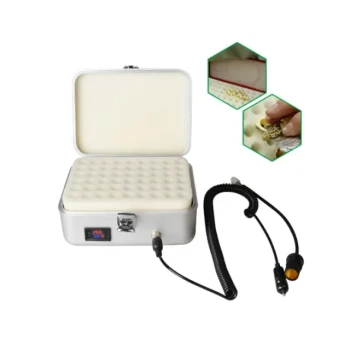
Maintain capped queen cells at 32–34°C (89–92°F) and 50% relative humidity. For commercial handling, use a stable chamber set near 33°C with RH held at 50%, particularly when cells are removed from colonies within 48 hours of expected emergence. Keep the cells in sterile individual emergence vials to reduce desiccation and environmental stress.
The controlling specification is 32–34°C and 50% RH, held continuously rather than allowed to fluctuate. Although other incubation settings are sometimes reported, the primary operating parameters for this application are the narrower temperature range and 50% relative humidity.
Why Precise Control Matters
Protecting the Developing Pupa
Capped queen cells remain biologically active during the final pupation and emergence stages. Temperature or moisture deviations can place stress on the developing queen and reduce emergence reliability.
Preventing Cell Desiccation
Maintaining 50% relative humidity helps prevent excessive moisture loss from the cell and its developing contents. Excessively dry conditions may contribute to desiccation, while uncontrolled humidity can create an inconsistent incubation environment.
Improving Emergence Reliability
A constant 32–34°C environment supports predictable development after cells are removed from the colony. For operational consistency, a chamber target of approximately 33°C provides a practical midpoint within the specified range.
Recommended Chamber Parameters
Temperature
Set the chamber to approximately 33°C, while ensuring the actual operating range remains between 32°C and 34°C (89–92°F).
The key requirement is not merely the setpoint; it is the chamber’s ability to maintain that range consistently throughout the holding period.
Relative Humidity
Maintain relative humidity at 50%.
Use a calibrated humidity sensor and monitor the chamber rather than relying only on the equipment’s nominal display. Humidity should remain stable enough to prevent drying or uncontrolled moisture exposure.
Cell Containment
Place each capped queen cell in a sterile individual emergence vial before chamber incubation. This supports clean handling and helps protect the cell from external contamination and mechanical damage.
Operational Controls for Commercial Use
Calibrate Before Loading
Verify temperature and humidity with calibrated instruments before placing cells in the chamber. A chamber display may show the programmed value without accurately representing conditions at the cell location.
Minimize Door Opening
Frequent door opening can create short-term temperature and humidity swings. Organize loading, inspection, and order fulfillment procedures to limit unnecessary access.
Monitor Uniformity
For larger chambers, confirm that conditions are reasonably uniform across shelves and positions. Cells should not be concentrated in locations with known hot, cold, dry, or humid spots.
Use an Alarm or Data Logger
A temperature and humidity data logger provides evidence that the chamber remained within specification. Alarms are particularly valuable for commercial operations where a deviation could affect an entire batch.
Understanding the Trade-offs
Do Not Substitute Generic Hive-Condition Settings
Some references describe settings such as 34–35°C and 60–75% RH, while others cite approximately 33°C and 40% RH. These values are not interchangeable with the primary specification for holding capped queen cells in this application.
The appropriate operating standard here is 32–34°C and 50% RH. Alternative settings should only be used when supported by a specific validated protocol, equipment qualification, or biological study.
Stability Is More Important Than a Short-Term Ideal Reading
A chamber that briefly reaches a target value but repeatedly fluctuates may be less suitable than one that holds a slightly variable reading within the approved range. Continuous stability should therefore be treated as a core performance requirement.
Avoid Overloading the Chamber
Excessive loading can restrict airflow and create local gradients. Maintain adequate spacing around vials and follow the chamber manufacturer’s loading limits.
Making the Right Choice for Your Goal
Use the following operating guidance when specifying equipment or preparing a commercial incubation process:
- If your primary focus is reliable queen emergence: Maintain 32–34°C and 50% RH continuously, with a practical temperature target near 33°C.
- If your primary focus is batch quality control: Use calibrated sensors, data logging, and alarms to document that conditions stayed within specification.
- If your primary focus is safe handling and fulfillment: Hold each cell in a sterile individual emergence vial and minimize chamber access during storage and dispatch preparation.
- If your primary focus is equipment sourcing: Select a chamber designed for stable temperature and humidity control, uniform airflow, monitoring, and rapid service support.
Consistent control of 32–34°C and 50% relative humidity is the clearest basis for protecting capped queen cells and achieving predictable emergence.
Summary Table:
| Parameter | Recommended Range | Critical Notes |
|---|---|---|
| Temperature | 32–34°C (89–92°F) | Set chamber near 33°C; ensure continuous stability, not just at setpoint. |
| Relative Humidity | 50% | Use calibrated sensors; avoid fluctuations that cause desiccation or excess moisture. |
| Containment | Sterile individual vials | Protects cells from contamination and mechanical stress. |
| Monitoring | Data logger & alarms | Verify conditions with calibrated instruments before loading; track throughout. |
| Chamber Loading | Avoid overloading | Maintain airflow and uniform conditions; follow manufacturer's limits. |
Ensure optimal conditions for your queen cells with our professional-grade incubation chambers. At HONESTBEE, we supply high-precision environmental chambers and a comprehensive range of beekeeping equipment. Perfect for commercial apiaries and distributors, our chambers offer reliable temperature and humidity control, uniform airflow, and data logging capabilities. With ultra-fast delivery and dedicated support, we help you achieve consistent emergence rates. Contact us today to discuss your needs and get a tailored quote! Get in touch now
Related Products
- Portable Queen Bee Incubator with 12V Car Adapter for Safe Transport
- Wholesales Dadant Size Wooden Bee Hives for Beekeeping
- Heavy-Duty Ergonomic Grip Galvanized Pollen Shovel
- Yellow Plastic Bucket Pail Perch for Beekeeping
- HONESTBEE AC Powered Wire Embedder with Alligator Clips
People Also Ask
- What happens if a colony loses its queen during the nectar flow? A Guide to Salvaging Your Honey Harvest
- How can you tell if the worker bees have accepted the queen? Decode Bee Behavior for a Thriving Hive
- How can the queenless state of a newly created nuc be resolved? Expert Solutions for Colony Growth
- What are the primary reasons for replacing a queen bee? Boost Your Commercial Honeybee Colony's Success
- What queen bee behaviors should be observed after introduction? Ensure Hive Success with Our Expert Monitoring Guide