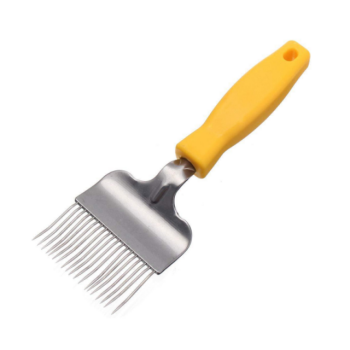
Fine probes or needles serve as the primary catalyst for assessing hygienic behavior in honeybee colonies. In this testing process, technicians use these instruments to manually pierce sealed brood cells, intentionally killing the developing larvae or pupae inside to simulate a disease event or natural death.
The use of fine needles transforms a biological observation into a quantifiable dataset. By creating a controlled "infection" scenario, breeders can measure exactly how fast worker bees detect and remove dead brood, directly correlating this speed with the colony's genetic resistance to diseases like American Foulbrood.
The Mechanics of the "Pin-Kill" Test
Simulating Disease via Physical Trauma
The fundamental role of the needle is to act as a standardized physical stimulus.
By piercing the cell capping and terminating the larva beneath, the needle mimics the presence of diseased or dead brood. This artificial trigger forces the colony to demonstrate its natural instinct to clean the hive.
Creating a Controlled Sample Set
In a typical assessment, needles are not used randomly across the hive. They are applied to a specific grid, often measuring 5x5 or 10x10 cells.
This creates a defined sample size, allowing technicians to calculate precise percentages rather than relying on anecdotal observation.
Triggering the Removal Sequence
Once the needle has done its work, the biological test begins. The damage triggers a three-step response from hygienic worker bees: detection, uncapping, and removal.
The needle's role is to start this clock, allowing breeders to evaluate how efficiently the colony performs this cycle.
Measuring Disease Resistance
The 24-Hour Benchmark
The effectiveness of the colony is almost always measured against a specific timeframe, typically 24 hours.
After the needles are used, the frame is returned to the hive. When checked a day later, the number of empty cells indicates the colony's speed; a high clearing rate suggests a robust immune response.
Predicting Colony Health
The data generated by this process is a core technical parameter for breeding programs.
Colonies that quickly clear the brood killed by the needles have been proven to possess stronger resistance to pathogens such as American Foulbrood, Chalkbrood, and even parasites like Varroa mites.
Selecting Superior Genetics
The ultimate goal of using these probes is to identify breeding stock.
By quantifying the removal behavior, breeders can select queens that pass on high-hygienic traits, ensuring future generations are naturally more resilient to infection.
Understanding the Trade-offs
Invasiveness and Loss
It is important to acknowledge that this method is destructive by design.
To gain data on colony health, a specific number of viable larvae must be sacrificed. While the loss is negligible for a strong colony, it is an invasive procedure that stresses the immediate area of the comb.
Precision is Critical
The reliability of the test depends entirely on the technician's manual precision.
If the needle damages the honeycomb structure or cell walls—rather than just the larva—it may trigger a repair response rather than a hygienic removal response, skewing the data.
Making the Right Choice for Your Goal
The "pin-kill" method is a diagnostic tool, not a treatment. Use the data derived from this test to inform your management decisions.
- If your primary focus is breeding disease-resistant stock: Prioritize colonies that clear over 95% of the pin-killed brood within 24 hours, as this indicates high hygienic genetics.
- If your primary focus is general colony health assessment: Use this test periodically to screen for susceptibility to brood diseases like American Foulbrood before an outbreak occurs.
The fine needle is the industry standard for converting the complex biological trait of "hygiene" into a simple, measurable number.
Summary Table:
| Feature | Role in Pin-Kill Testing |
|---|---|
| Primary Tool | Fine probes or specialized needles |
| Mechanism | Standardized physical stimulus (simulated larva death) |
| Sample Size | Typically 50 to 100 cells (e.g., 10x10 grid) |
| Key Metric | Percentage of cells cleared within 24 hours |
| Target Outcome | Detection of resistance to American Foulbrood and Varroa |
| Selection Goal | High-hygienic genetics (>95% removal rate) |
Elevate Your Beekeeping Operation with HONESTBEE
Are you looking to enhance your breeding program or scale your commercial apiary? At HONESTBEE, we specialize in supporting commercial apiaries and distributors with high-performance tools and machinery.
From specialized hive-making and honey-filling machines to the fine instruments needed for professional hygienic testing, we provide the full spectrum of beekeeping equipment and essential industry consumables. Partner with us to access superior wholesale solutions tailored to your success.
Contact HONESTBEE Today to Discuss Your Wholesale Needs
References
- Dennis van Engelsdorp, Gard W. Otis. Application of a Modified Selection Index for Honey Bees (Hymenoptera: Apidae). DOI: 10.1603/0022-0493-93.6.1606
This article is also based on technical information from HonestBee Knowledge Base .
Related Products
- Heavy-Duty Ergonomic Grip Galvanized Pollen Shovel
- Professional Dual Action Queen Excluder Scraper for Beekeeping
- 5 Gallon Pail Opener Bucket Opener Tool for Honey Bucket
- HONESTBEE AC Powered Wire Embedder with Alligator Clips
- Solar Beeswax Melter Easy Solar Wax Melter for Beeswax
People Also Ask
- For what reasons do beekeepers collect bee pollen? Boost Hive Health and Unlock New Revenue Streams
- Why should commercial apiaries focus on the collection of diversified bee products? Maximize Your Hive’s Profit Potential
- How do bee pollen collection tools affect the quality of bee pollen used in functional dairy ice cream production?
- How does a specialized pollen collector facilitate the harvesting of diverse bee products? Automate High-Value Yields
- What is the impact of pollen collectors and associated equipment on the cost structure of pollen production? Maximize ROI