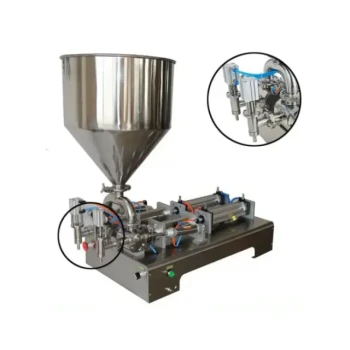
Honey filling machines act as the critical control point for quality assurance in the transition from bulk harvest to retail product. By utilizing high-precision quantitative technology within a closed system, these machines guarantee the accuracy of net weights while eliminating the human contact that leads to contamination. This automation preserves the strict hygiene standards required to maintain the "organic" status and brand reputation of high-value honey.
The core value of automated filling lies in standardizing a natural, variable product without compromising its purity. By enforcing a closed-loop environment, these machines protect organic honey from oxidation and contamination, ensuring the final product meets the rigorous sanitary and traceability standards demanded by premium international markets.
Protecting Organic Integrity via Closed Systems
Eliminating Cross-Contamination
The primary risk to organic honey during processing is secondary contamination. Automated filling machines operate as closed systems, physically isolating the honey from the external environment.
By removing manual handling from the equation, you eliminate the introduction of pathogens or foreign debris often associated with human contact. This isolation is the only reliable way to ensure the honey remains additive-free and chemically pure from tank to bottle.
Preserving Sensory Quality
Organic honey derives its market value from unique floral aromas and specific moisture content. Exposure to air can cause volatile aromatic compounds to evaporate and allow the honey—which is naturally hygroscopic—to absorb moisture.
Automated fillers minimize this exposure time significantly compared to manual methods. This speed and containment prevent fermentation risks and lock in the natural flavor profile that defines premium forest or floral honeys.
Standardization and Market Compliance
Precise Weight Control
Manual filling inevitably results in weight variance, which is unacceptable in retail markets. High-precision quantitative filling technology ensures that every unit complies exactly with the labeled net weight.
This consistency reduces product giveaway (loss of revenue) and prevents legal penalties associated with under-filling. It transforms bulk organic honey into a standardized commercial product ready for mass retail.
Enabling Traceability
To sell in high-end commercial or export markets, producers must prove the origin and processing history of their honey. Automated lines facilitate traceability and batch tracking, which are prerequisites for maintaining organic certifications.
This capability allows brands to label their products confidently, meeting the entry requirements for global trade where safety standards are non-negotiable.
Operational Trade-offs to Consider
Maintenance and Cleaning Rigor
While automation reduces biological contamination risks, it introduces mechanical risks. Improperly cleaned machinery becomes a central point of failure, potentially contaminating an entire batch rather than just a few jars.
Because honey is viscous and can crystallize, filling nozzles and lines require rigorous, scheduled sanitation protocols to prevent clogging and bacterial buildup.
Capital vs. Flexibility
Automated lines are optimized for specific bottle sizes and viscosity ranges. High-speed efficiency often comes at the cost of flexibility.
If your product line requires frequent changes in bottle shapes or honey types (e.g., switching between raw crystallized honey and liquid acacia), the changeover time and calibration adjustments can impact overall throughput.
Scaling Your Organic Production
To maximize the value of your organic honey, align your equipment choice with your specific market goals:
- If your primary focus is Market Access: Prioritize machines with advanced hygiene certifications and closed-loop systems to meet strict international export standards.
- If your primary focus is Brand Protection: Focus on high-precision dosing technology to guarantee consistent fill levels and preserve the aesthetic quality of the final package.
- If your primary focus is Profit Margins: Leverage high-throughput automation to drastically reduce labor costs and minimize product loss due to overfilling.
Ultimately, the filling machine is not just a packaging tool; it is the guardian of your product's purity, ensuring that the value created by nature is successfully transferred to the consumer.
Summary Table:
| Feature | Impact on Organic Honey Value | Business Benefit |
|---|---|---|
| Closed-System Filling | Prevents secondary contamination and oxidation | Maintains organic certification and flavor purity |
| High-Precision Dosing | Eliminates net weight variance and product loss | Ensures retail compliance and maximizes profit margins |
| Automated Traceability | Simplifies batch tracking and origin proof | Meets rigorous international export standards |
| High-Speed Efficiency | Reduces exposure time to air and pathogens | Lowers labor costs and prevents fermentation risks |
Elevate Your Beekeeping Operation with HONESTBEE
At HONESTBEE, we specialize in empowering commercial apiaries and distributors with professional-grade automation solutions. Whether you are scaling an organic honey brand or expanding a wholesale distribution network, our comprehensive portfolio of honey-filling machines, hive-making equipment, and essential beekeeping tools is designed to ensure your product's purity from hive to bottle.
Our value to you:
- Industry-Leading Precision: Guarantee exact fill levels for premium retail positioning.
- Total Solutions: From heavy machinery to honey-themed cultural merchandise, we supply your entire business cycle.
- Global Compliance: Equipment built to meet the hygiene and safety standards of international markets.
Ready to transform your production line and protect your honey's organic integrity? Contact us today to discuss your wholesale needs!
References
- Benyam Tadesse, Zelalem Adimasu. Factors influencing organic honey production level and marketing: evidence from southwest Ethiopia. DOI: 10.1016/j.heliyon.2021.e07975
This article is also based on technical information from HonestBee Knowledge Base .
Related Products
- Precision Durable Efficient HONESTBEE Rotary Honey Filling Machine
- Semi Automatic Small Honey Bottle Filling Machine Honey Filler
- Economy Small Honey Filling Machine Honey Bottle Filler Packaging Machine
- Fully Automatic Honey Filling Packaging Machine for Processing Line
- Commercial Rotary Honey Filling Machine for Production
People Also Ask
- What are the common types of bottling machines used for honey? Choosing the Right Solution for Your Apiary
- How do honey filling and processing machines aid native bee product conservation? Boost Value with HONESTBEE Technology
- What is a key feature of the new generation of the honey filling machine? The Advanced Electronic Control Unit
- How do honey filling machines work? Achieve Precision & Speed for Your Apiary
- How do high-precision honey filling machines ensure quality? Optimize Your Commercial Production with HONESTBEE